

Apple has announced new Mac Studios that are available with M5 Max or M5 Ultra chips. According to Apple, the Mac Studio delivers a huge leap in performance, leveraging massive power to run various creative suites as well as resource-demanding AI applications.
If you have purchased a Mac in the last few years, there is probably no need to update, as it’s probably more than capable of performing the tasks you already need it to.
Both the M5 Max and the M5 Ultra include a built-in Media Engine that leverages various codecs and other operational systems to enhance video editing capabilities, enabling power users to perform a multitude of tasks in a timely manner. There is hardware-accelerated H.264, HEVC, ProRes, and ProRes RAW profiles built into the Media Engine.
With the M5 Max chip, you get two video encode engines and a single video decode engine, along with two ProRes encode and decode engines as well as a single AV1 decode engine. The M5 Ultra receives double the performance, backed by two video decode engines, four video encode engines, and four ProRes encode and decode engines. A single AV1 decode engine remains.
M5 Max

The M5 Max was designed to push real-time 3D effects and motion graphics. It comprises an 18-core CPU that consists of 12 performance cores and six super cores. Hardware-accelerated ray tracing, a 16-core Neural Engine, and enhanced Neural Accelerators provide the M5 Max with up to 480 GB/s memory bandwidth. You can configure the M5 Max up to a 40-core GPU for an enhanced memory bandwidth of 614 GB/s.
M5 Ultra

The M5 Ultra has almost double the performance of the M5 Max. Apple states that users can color-grade uncompressed 8K footage in real time, while VFX artists can quickly render complex simulations. Data scientists can use local AI models on various datasets.
The M5 Ultra chip features a 30-core CPU made of 10 super cores and 20 performance cores to drive raw performance. Graphics are handled by a 64-core GPU outfitted with hardware-accelerated ray tracing capabilities. Naturally, Neural Accelerators and a 32-core Neural Engine work together to enhance throughput across the board. Altogether, this gives you 1.2 TB/s of memory bandwidth. The M5 Ultra can be upgraded to a 36-core CPU and an 80-core GPU.
The M5 Max starts with 36GB of unified memory that can be configured up to 48GB, 64Gb, or 128GB. The M5 Ultra starts with 96GB of unified memory with 256GB or 512GB options.
The M5 Max starts with 512GB while the M5 Ultra starts with 1TB. Expansion options include 1TB (for the M5 Max), 2TB, 4TB, and 8TB for extreme workloads. The M5 Ultra gets the additional option of a 16TB internal storage drive.
The M5 Max can support four displays up to a native resolution of 6K at 60 Hz or 4K at 165 Hz, plus a fifth display with up to 5K at 60 Hz over HDMI. When only using three displays, two offer support up to 8K at 60 Hz or 5K at 120 Hz or 4K at 240 Hz, plus a third display with up to 5K at 60 Hz over HDMI.
When connecting eight displays to the M5 Ultra, you get native resolution of 6K at 60 Hz or 4K resolution at up to 165 Hz. When using four displays, you get 8K at 60 Hz, 5K at 120 Hz, or 4K at 240 Hz. Variable Refresh Rate (VRR) HDR, and Multichannel audio are all supported.

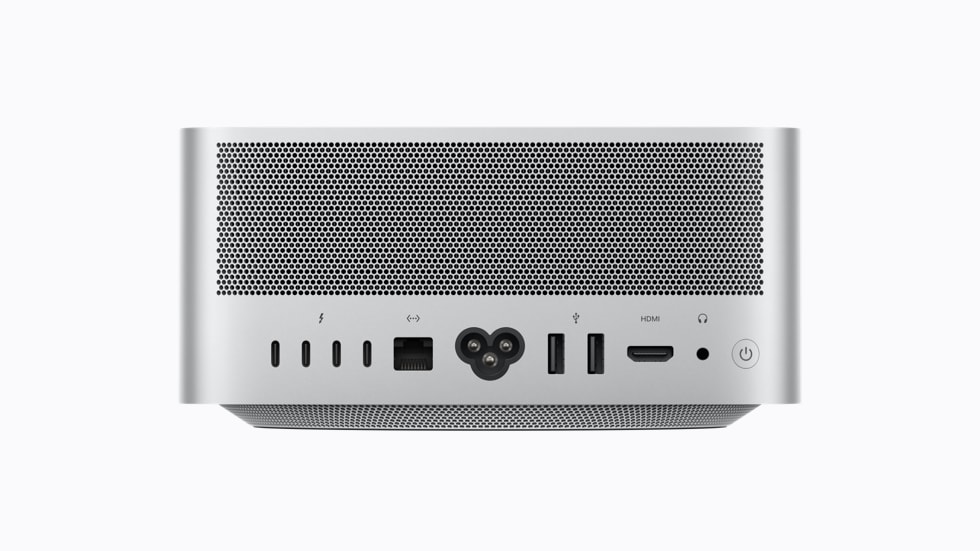
On the front of the Mac Studio, there are two USB-C ports that support USB 3.2 Gen 2 (10 Gb/s) speeds on the M5 Max and Thunderbolt 5 speeds on the M5 Ultra. Both include an SDXC card slot with UHS-II speeds.
The M5 Max and the M5 Ultra also have four Thunderbolt 5 ports, two USB-A ports, an HDMI port, and a 10Gb Ethernet port. The 3.5mm headphone jack found on the back panel supports high-impedance headphones.
The Mac Studio includes Apple’s N1 wireless networking chip that provides users access to Wi-Fi 7 speeds with Thread networking technology and Bluetooth 6 for enhanced peripheral support.
Pricing and Availability
Customers can pre-order the new Mac Studio with M5 Max and M5 Ultra starting today, August 25, on apple.com/store and in the Apple Store app in 30 countries and regions, including the U.S. It will begin arriving to customers and in Apple Store locations and Apple Authorized Resellers, starting September 22. Mac Studio with 512GB of unified memory is coming in late October.
- Mac Studio with M5 Max starts at $2,499 USD and $2,299 USD for education. Additional configure-to-order options are available at apple.com/mac-studio.
- Mac Studio with M5 Ultra starts at $5,499 USD and $5,099 USD for education. Additional configure-to-order options are available at apple.com/mac-studio.
Below you can see the full press release from Apple.
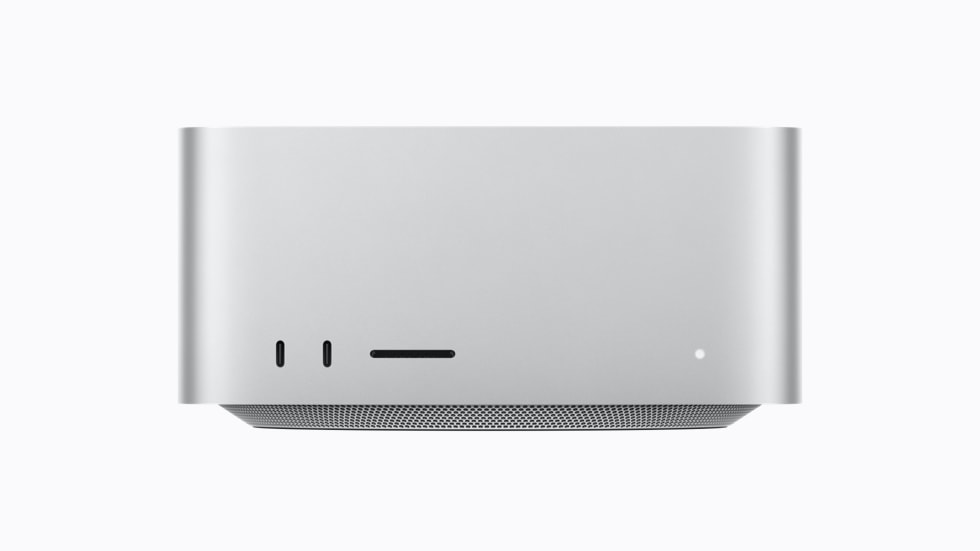
CUPERTINO, CALIFORNIA Apple today announced the new Mac Studio, featuring M5 Max and the all-new M5 Ultra, delivering a monumental leap in AI performance and even faster graphics for the most demanding pro workflows, all in its signature compact design that lives right on a user’s desk. Now featuring up to 4.3x faster AI performance, up to 2x faster storage, up to 1.8x faster graphics, and up to 1.3x faster CPU speed, along with higher memory bandwidth, Mac Studio empowers creatives, developers, AI researchers, data scientists, and more to push the boundaries of what they can do. Mac Studio with M5 Max features an 18-core CPU, an up-to-40-core GPU with Neural Accelerators built into each core, and up to 128GB of unified memory, accelerating complex pro and AI workloads. With the powerful M5 Ultra, Mac Studio scales up to a 36-core CPU, up to an 80-core GPU, and a staggering 512GB of unified memory, enabling users to run enormous LLMs entirely on device. Wi-Fi 7 and Bluetooth 6 come to Mac Studio for the first time, while Thunderbolt 5 rounds out its extensive connectivity, so users can take advantage of blazing-fast external storage, PCIe expansion chassis, and powerful hub solutions for the most intense workloads. Thunderbolt 5 also enables multiple Mac Studio systems to be clustered, bringing up to 3x faster performance for distributed AI inference when compared to a single system.1 Together with Studio Display and Studio Display XDR, along with the power of macOS 27 and the next generation of Apple Intelligence, including Siri AI, it is the ultimate pro desktop. The new Mac Studio is available for pre-order starting today, with availability beginning September 22.
“Mac Studio is the ultimate desktop for on-device AI and the world’s most demanding pro workflows, relied on by users for its tremendous performance and extensive pro connectivity, all in a quiet, compact design that sits right on your desk — and today, we’re pushing the boundaries even further,” said Johny Srouji, Apple’s chief hardware officer. “With the powerful M5 Max and the incredible capabilities of M5 Ultra, Mac Studio ushers in a new era of desktop computing, delivering huge performance gains for pro workloads and AI inference with frontier-class models. By integrating Neural Accelerators directly into the GPU and offering massive amounts of high-bandwidth unified memory, the new Mac Studio is our most powerful Mac ever.”
A Monumental Step for AI
Mac Studio is at the forefront of high-performance AI computing. Now, with M5 Max and M5 Ultra — Apple’s most powerful silicon ever — it’s turbocharged, putting frontier-class AI models right on a user’s desk. Neural Accelerators in each GPU core deliver dramatically faster matrix multiplication. M5 Max features phenomenal on-device AI compute with up to 3.9x faster AI performance than the prior generation, speeding up prompt processing. With M5 Ultra, Mac Studio achieves up to 4.3x the peak AI compute performance of M3 Ultra and a staggering 9.8x more than M1 Ultra. Combined with up to 512GB of unified memory and 1.2TB/s of memory bandwidth, 50 percent higher than before, Mac Studio lets users run massive models entirely on device with complete privacy — without counting tokens or worrying about rising cloud costs.AI inference scales to entirely new levels with multiple Mac Studio systems. Users and teams looking to share AI compute can cluster multiple Mac Studio systems together using the built-in support for Thunderbolt 5 and RDMA (remote direct memory access). This creates a vast shared memory pool across systems, allowing users to load the largest and most demanding frontier-class open-weight models available today. A cluster of four Mac Studio systems delivers up to a remarkable 3x faster AI inference than a single system. Mac Studio is also a powerful platform for the rich ecosystem of tools AI researchers and developers rely on every day, utilizing the advanced frameworks in macOS. Core AI is a brand-new framework for building, running, and deploying AI models on Apple silicon. It provides an architecture optimized for Apple silicon, including unified memory, CPU, GPU, and Neural Engine, allowing developers to deploy full-scale LLMs locally and bring their own custom models into their apps. MLX, Apple’s open-source machine learning framework optimized for Apple silicon, enables developers to run, train, and fine-tune models with exceptional efficiency on Mac. In addition to these powerful frameworks, combined with Xcode and a robust ecosystem of AI tools and solutions, Mac Studio provides a complete, end-to-end platform for AI development — from experimentation and training to deployment.
Serious Speed and Power for Pro Workloads
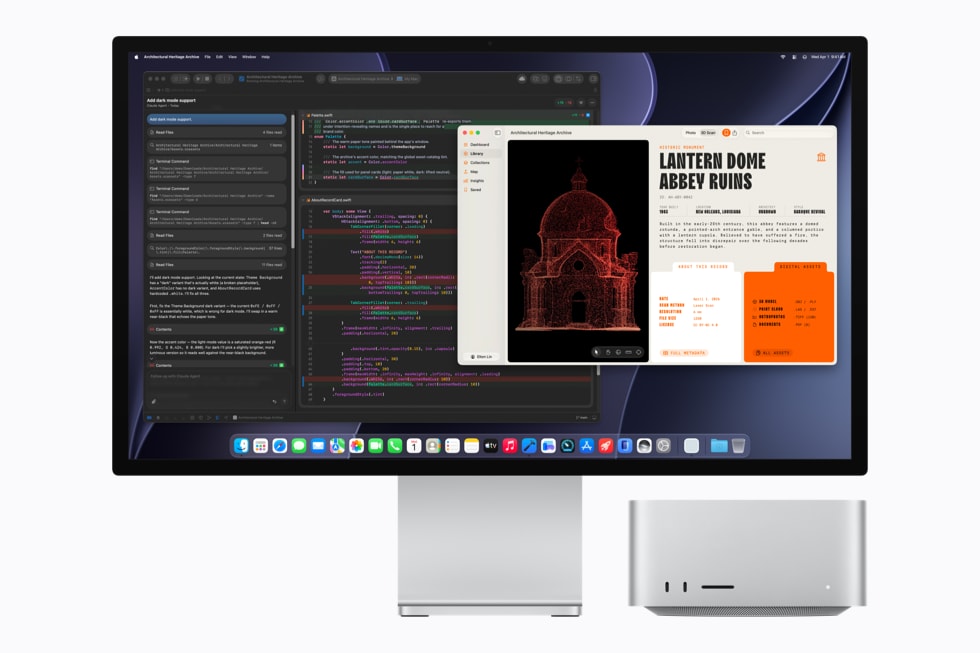
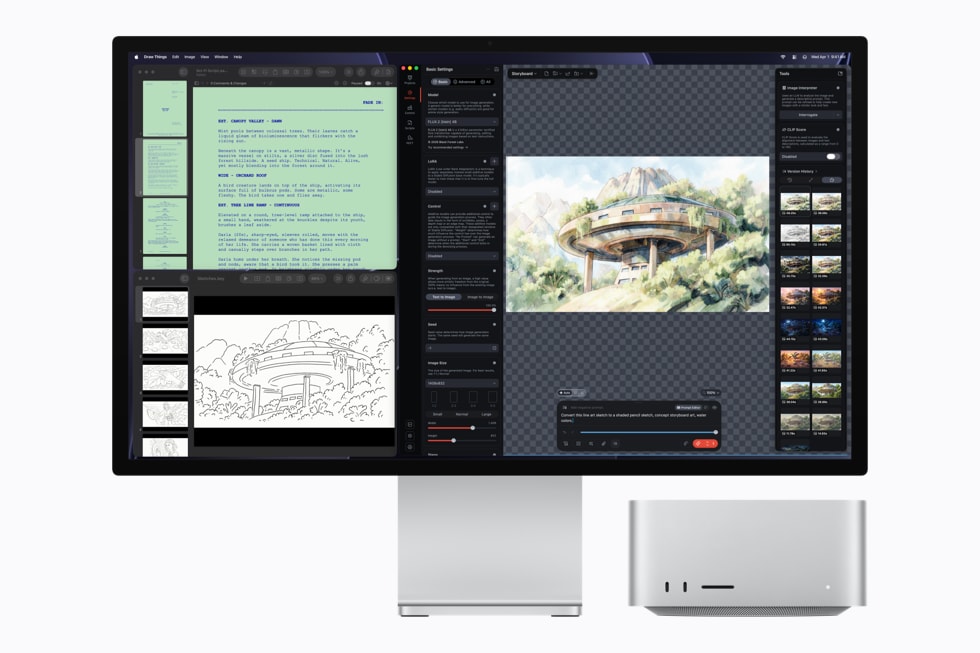
Built for users who demand powerful performance in a compact footprint, Mac Studio with M5 Max is ideal for musicians, photographers, software engineers, and designers pushing real-time 3D and motion graphics. Mac Studio with M5 Max delivers a huge boost in performance, featuring an 18-core CPU with 6 super cores and 12 performance cores, so developers can compile code even faster. The up-to-40-core GPU with Neural Accelerators is now up to 50 percent faster than the previous generation, boosting graphics-intensive tasks like game development with higher frame rates and more complex scene geometry. With up to 614GB/s of unified memory bandwidth, M5 Max delivers superfast on-device AI compute, enabling users to run LLMs, generate images and video, as well as accelerate complex workflows.
The new Mac Studio also includes third-generation hardware-accelerated ray tracing, delivering faster, more realistic lighting, reflections, and shadows across professional 3D, VFX, and design workflows. Enhanced shader cores boost parallel processing, enabling smoother real-time viewport navigation and faster offline renders in creative workloads. In addition, its powerful Media Engine supports hardware-accelerated H.264, HEVC, ProRes, and AV1 decode, allowing filmmakers to color-grade uncompressed 8K footage and process multiple concurrent video streams with ease.
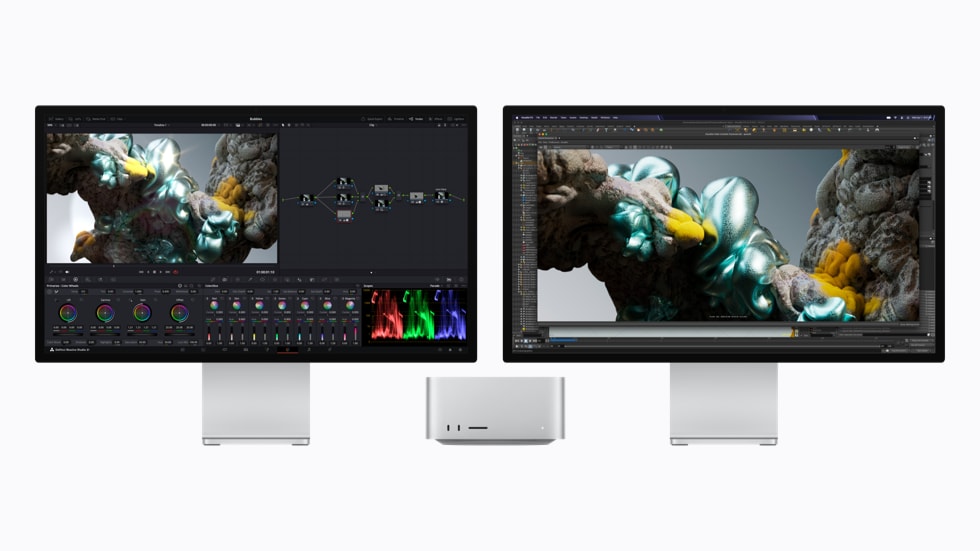
Mac Studio with M5 Max enables:
- Up to 10.7x faster LLM prompt processing in LM Studio when compared to Mac Studio with M1 Max, and 3.9x faster than M4 Max.
- Up to 7.4x faster text-to-image performance when compared to Mac Studio with M1 Max, and up to 3.5x faster than M4 Max.
- Up to 5.3x faster Magic Mask performance in Blackmagic Design DaVinci Resolve Studio when compared to Mac Studio with M1 Max, and up to 3x faster than M4 Max.
- Up to 3.5x faster basecalling for DNA sequencing in Oxford Nanopore MinKNOW when compared to Mac Studio with M1 Max, and up to 1.9x faster than M4 Max.
A Powerhouse for the Most Demanding Workloads
Engineered for professionals who tackle the most extreme workloads, Mac Studio is the ultimate pro desktop, taking performance to an entirely new level. There is no other chip like M5 Ultra, which delivers the highest levels of performance and massive amounts of unified memory, enabling pros to push the limits of what they can accomplish on a single machine.
Filmmakers can color-grade uncompressed 8K footage in real time, VFX artists can render complex simulations, and data scientists can train local AI models on expansive datasets. The new Mac Studio with M5 Ultra features an up-to-36-core CPU with 12 super cores and 24 performance cores, delivering up to 1.3x higher multithreaded performance than M3 Ultra. Its up-to-80-core GPU, the most powerful Apple silicon GPU ever, brings Neural Accelerators to the Ultra chip for the first time, enabling up to 4.3x the peak AI compute performance when compared to M3 Ultra. It also features up to 1.8x faster graphics than the prior generation, providing smoother real-time 3D rendering for VFX workflows. Combined with up to 512GB of unified memory and 1.2TB/s of memory bandwidth, the new Mac Studio is a game changer for AI workloads. AI coding agents process significantly faster, image generation tools can render creations in an instant, and enterprise teams can cluster multiple systems to scale performance to new heights. In addition, with twice the video encode and decode blocks as M5 Max, the Media Engine in M5 Ultra is more capable than ever, empowering pros to simultaneously play up to 33 streams of 8K ProRes 422 at 30 fps on M5 Ultra.
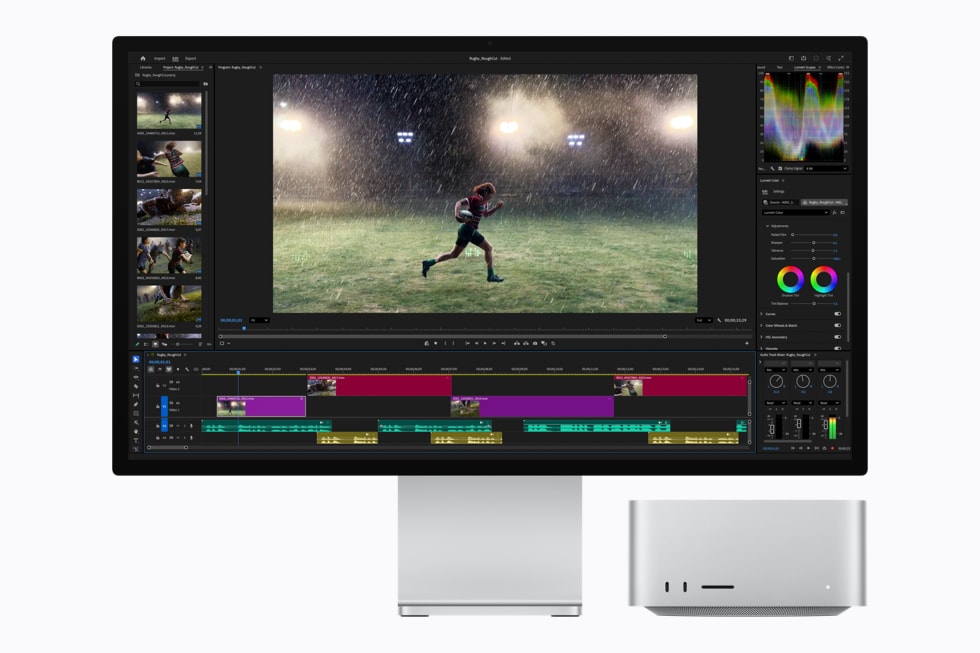
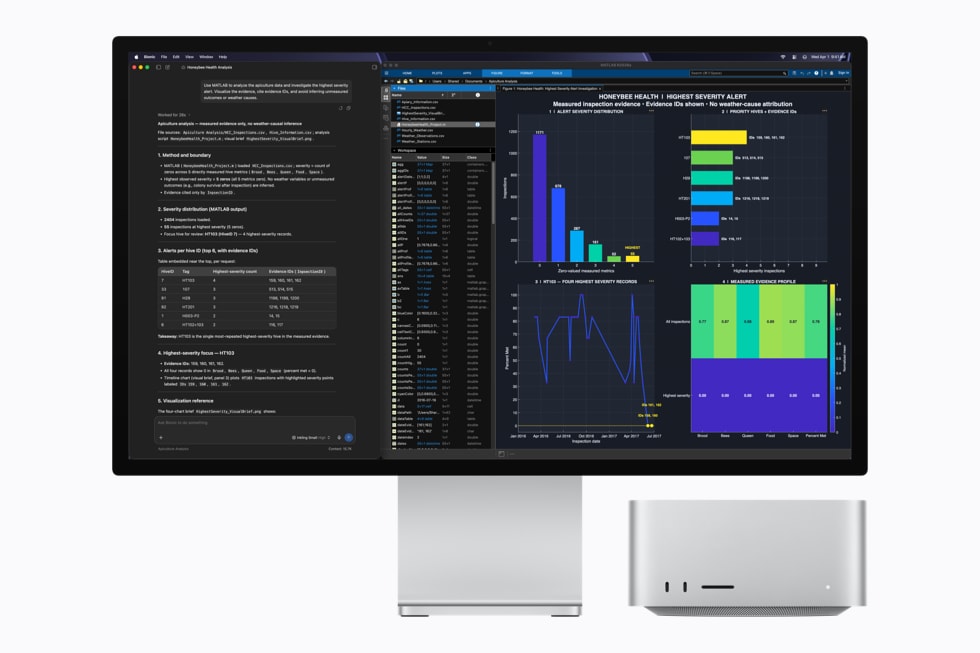
Mac Studio with M5 Ultra enables:
- Up to 15.4x faster CopyCat ML training performance in Foundry Nuke when compared to Mac Studio with M1 Ultra, and up to 3.3x faster than M3 Ultra.
- Up to 9.8x faster LLM prompt processing in LM Studio when compared to Mac Studio with M1 Ultra, and up to 4x faster than M3 Ultra.
- Up to 8.2x faster text-to-image performance when compared to Mac Studio with M1 Ultra, and up to 4.3x faster than M3 Ultra.
- Up to 4.7x faster scene rendering performance in Maxon Redshift when compared to Mac Studio with M1 Ultra, and up to 1.7x faster than M3 Ultra.
Blazing-Fast Storage and Pro Connectivity
The new Mac Studio also features faster storage and a comprehensive array of pro connectivity. Storage performance is up to twice as fast, with a next-generation SSD architecture built on PCIe Gen 6, delivering industry-leading read and write speeds for rapid project loading, file transfers, and loading huge LLMs. Thunderbolt 5 ports deliver transfer speeds up to 120Gb/s of bandwidth, so pros can connect high-performance peripherals, displays, PCIe expansion chassis, and external storage to utilize its remarkable speeds. The Apple-designed N1 chip brings Wi-Fi 7 and Bluetooth 6 to Mac Studio for the first time, delivering improved performance and reliability to wireless connections. Mac Studio now enables genlock over USB-C for precise synchronization between a display and professional camera capture like iPhone 17 Pro. It also supports up to eight displays, or up to four Studio Display XDR at full 5K resolution and 120Hz, providing an expansive screen for the most demanding projects.
macOS 27 Golden Gate: An Unrivaled Experience
The new Mac Studio comes to life with the upcoming macOS 27, which includes Siri AI, a profoundly more capable and personal assistant; helpful Apple Intelligence features across everyday apps; and an expansive set of improvements that make the Mac even more responsive and reliable. Siri AI can draw on personal context to help users find what they need in the moment across their messages, emails, and photos; answer questions about virtually any topic; and get things done across apps. Siri AI is integrated into Spotlight and systemwide context menus, and users can ask Siri about what’s on their display with Visual Intelligence using a dedicated keyboard shortcut. Pros can also write and edit with Siri almost anywhere they type.
Additionally, Apple Intelligence makes apps smarter and more useful with new ways to tailor and organize browsing in Safari, easily create an automation in Shortcuts by simply describing it, and tap into advanced photo editing in the Photos app. Features pros already rely on get even better with improvements to performance and search. Refinements to Liquid Glass improve readability and add uniform toolbars, edge-to-edge sidebars, and updated window shapes and menu bar icons, enabling users to further personalize its appearance.
Mac Studio and the Environment
The new Mac Studio was built with the environment in mind and drives progress toward Apple’s ambitious plan to be carbon neutral across its entire footprint by 2030. It is made with 35 percent recycled content overall, including 100 percent recycled aluminum in the enclosure and 100 percent recycled rare earth elements in all magnets. The new Mac Studio is manufactured with 40 percent renewable energy, like wind and solar, across the supply chain, and meets Apple’s high standards for energy efficiency and safe chemistry. Like all Apple products, its paper packaging is 100 percent fiber-based and can be easily recycled at home.