
Sennheiser used IBC 2026 to show off a year of Spectera in the field, its wideband, bidirectional wireless system that replaces separate racks of mic receivers and IFB transmitters with a single shared infrastructure, plus the system’s newest piece: a handheld transmitter that’s now actually shipping. We talked to Sennheiser’s Jonas about how the system works in practice.
What it is
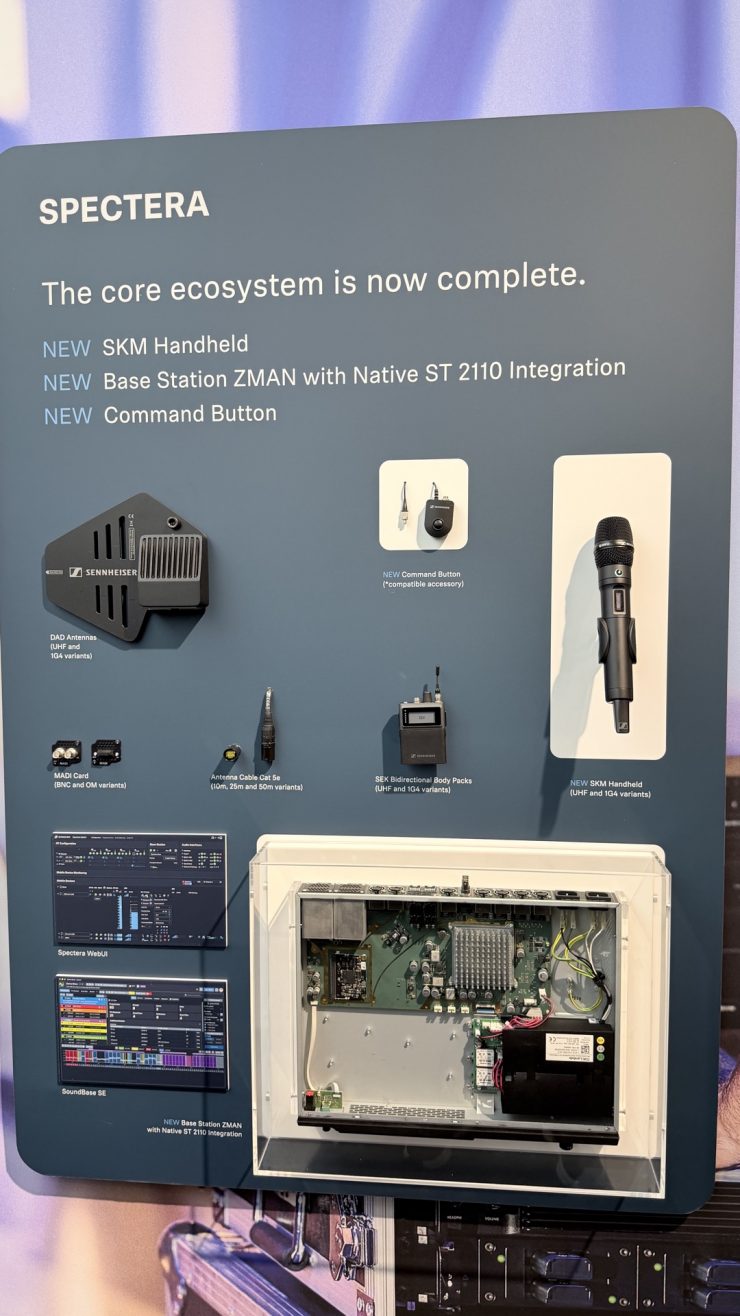
Spectera treats wireless transmission as shared infrastructure rather than dedicated point-to-point links. Instead of a rack of receivers and a separate rack of transmitters, a single Base Station provides up to 32 audio inputs and 32 audio outputs (up to 64 channels total), and any number of portable devices pair into it and get assigned resources, audio in a given direction, IEM feed, or both. Jonas compared the pairing process to connecting a Bluetooth headphone to a phone.
Featured Specifications
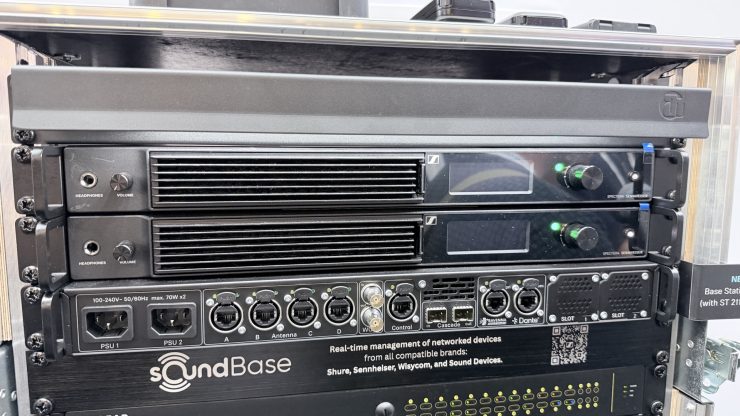
- Base Station: 1RU, up to 64 channels (32 in/32 out), up to two independent wideband RF carriers (UHF or 1G4, 6 or 8MHz)
- Core technology: Sennheiser WMAS (Wireless Multichannel Audio System), single wideband RF carrier for an entire production
- Dropout resistance: Equivalent to 40x diversity (8MHz carrier) or 30x diversity (6MHz carrier) versus narrowband systems
- Latency: As low as 0.7ms for IEM feeds
- Bodypack (SEK): Bidirectional transceiver, handles mic/line input and IEM output simultaneously
- New for IBC 2026: SKM handheld transmitter now shipping, after a preview at IBC 2025
Specifications
| Category | Spec |
|---|---|
| System type | Bidirectional wireless ecosystem (mic, IFB/IEM, and data share one infrastructure) |
| Base Station | 1RU, 32 in / 32 out (64 channels total), up to 2 wideband RF carriers |
| RF carrier options | UHF or 1G4, 6MHz or 8MHz wide |
| Core RF tech | WMAS (Wireless Multichannel Audio System) |
| Dropout resistance | 40x diversity equivalent (8MHz) / 30x diversity equivalent (6MHz) |
| IEM latency | Down to 0.7ms |
| Redundancy | Redundant power supply, redundant Dante, optional redundant MADI, up to 4 antennas |
| Bodypack (SEK) | Bidirectional, simultaneous mic/line input + IEM output |
| Antenna (DAD) | Transceiving, integrated RF components (no separate combiners/splitters/boosters needed) |
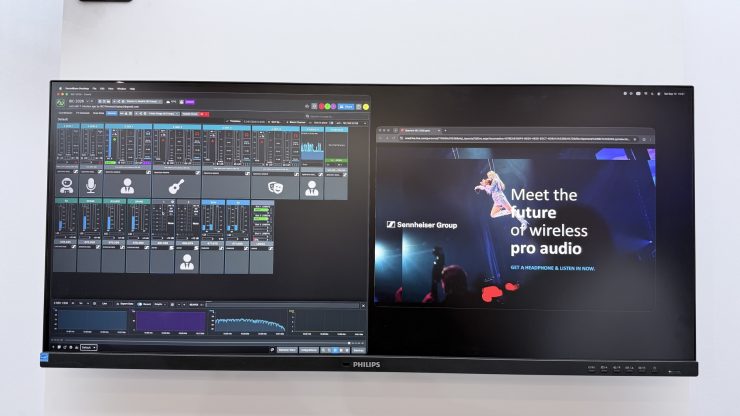
| Software | Spectera WebUI (single system), SoundBase (multi-system management) |
| Devices per RF channel | Up to 128 (per Jonas) |
| Awards | ISE 2025 Best of Show, IBC Best of Show, Infocomm 2025 Best of Show |
Remote monitoring and diagnostics
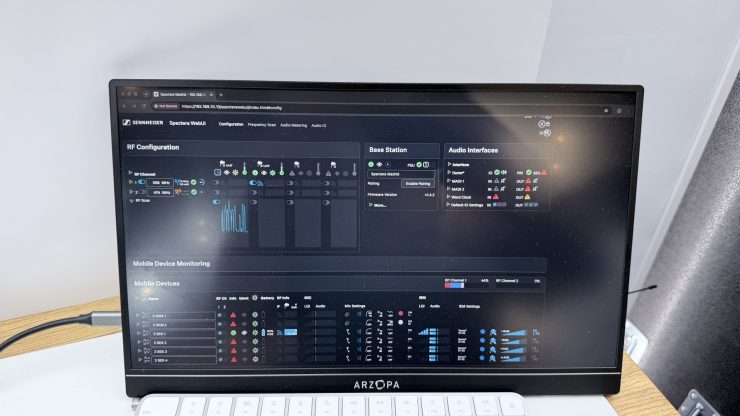
Because every device is bidirectional, the Base Station doesn’t just send audio, it reads back device state: whether a headphone or mic is physically connected, current volume and gain, RF signal health, and battery status, all visible and adjustable from the software rather than requiring a hands-on check with talent. Jonas said this extends to historical logging, so if a dropout happens, an operator can go back and look at signal parameters at that point in time to figure out whether it was an RF issue or a hardware problem, and even play back the affected audio.
Show file workflow
Rather than manually syncing each new device to the system, Spectera can load a pre-built show file, names, gain settings, volume levels, per device, so a large deployment can be configured in minutes and reused across venues.
The new SKM handheld
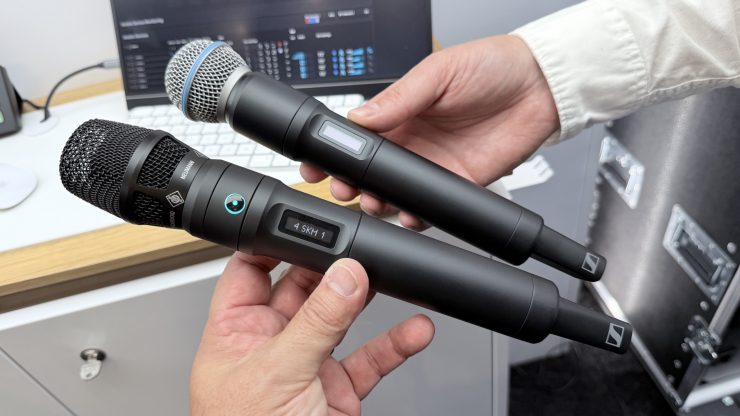
The SKM handheld transmitter previewed at last year’s IBC is now shipping, after roughly a year of field testing. It completes the Spectera lineup alongside the existing bodypack, and pairs into the same Base Station infrastructure. Jonas said a new capsule from Neumann is part of this release, alongside adapters that will accept competitors’ mic heads as well as Sennheiser’s and Neumann’s own. The handheld shares its battery with the bodypack, and Sennheiser has released an updated battery with about 30% more capacity, extending runtime on both devices.
Programmable command button
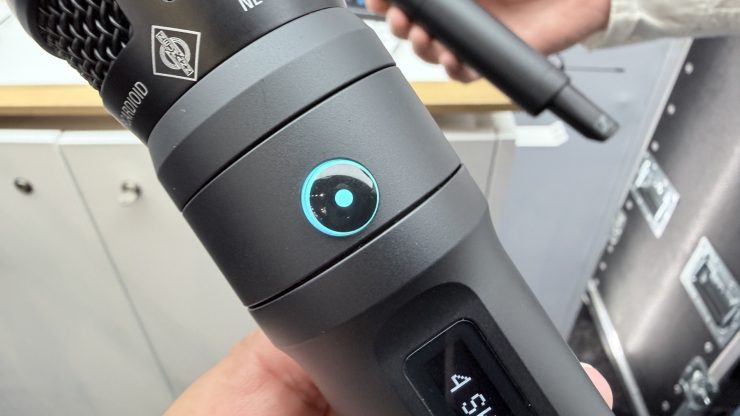
An optional ring that fits between the transmitter and the mic head adds a programmable button with an RGB indicator light. Beyond a basic mute, it can be configured for latching or momentary behavior, drive different states across the device’s multiple outputs, or fire a trigger over Spectera’s API to control something entirely external, advancing a slide deck, changing a lighting snapshot, or stepping through a playback queue.
Price & availability
Jonas states pricing varies by configuration and currency, small single-channel systems cost more per channel, but by the time a deployment reaches 10-12 channels, Spectera becomes close to break-even against competing top-tier systems, and IEM capability comes at no additional license cost. He cited an internal comparison putting a 20-channel Spectera system at roughly 20% cheaper than Sennheiser’s own D6000 series.