
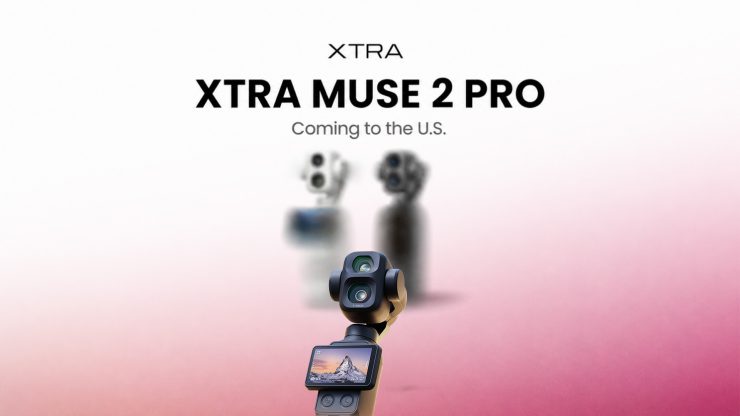
A new pocket gimbal camera is headed to American shooters this summer. It records 4K at up to 240fps. It carries a 1-inch CMOS sensor, 3-axis mechanical stabilization, ActiveTrack 7.0, 107GB of onboard storage, 10-bit D-Log color, a 3x optical zoom module, and a dual flip touchscreen. It’s sold by a Delaware-registered startup called Xtra Technology. The price has not yet been announced.
It is, by every measurable spec, the DJI Osmo Pocket 4P. Just without the name.
The Camera DJI Cannot Sell Here
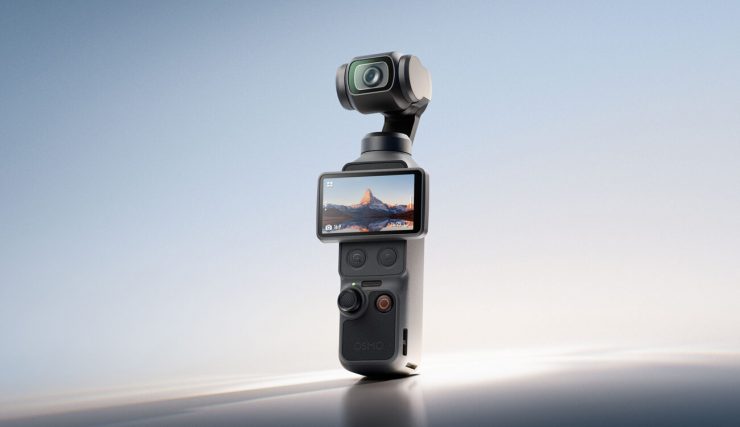
The Osmo Pocket 4P has officially been released, and it will launch globally. It will not launch in the United States — at least not under that name.
DJI has been on the FCC’s Covered List since late 2025, a regulatory designation that bars the company from obtaining approval for new hardware in the US market. The trigger was a provision in the 2025 National Defense Authorization Act requiring a formal national security audit of DJI by December 23, 2025. No US agency completed the review before the deadline. DJI’s new drones, cameras, and wireless accessories are now blocked from FCC certification, and without FCC authorization, new DJI hardware cannot be legally imported for sale in the US.
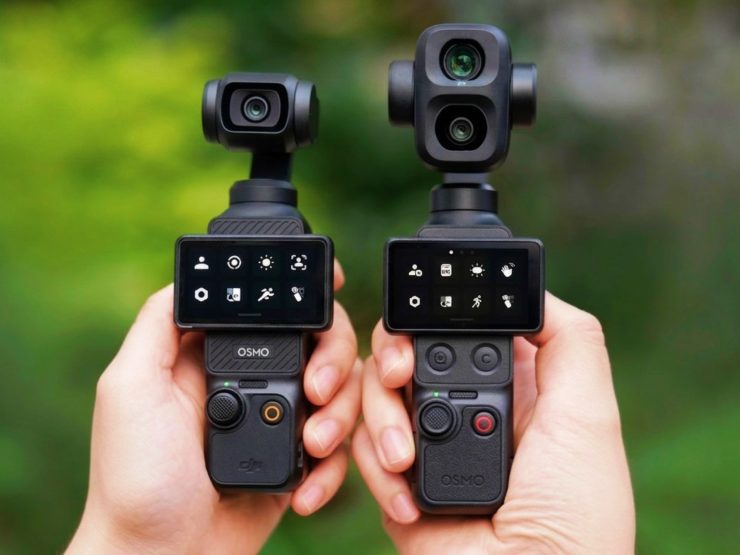
The Osmo Pocket 4P cannot come in through the front door. Xtra Technology might be a way.
Specs Side by Side
The XTRA MUSE 2 PRO and the DJI Osmo Pocket 4P share the following: a 1-inch main sensor, ActiveTrack 7.0 subject tracking, 107GB of internal storage, 10-bit D-Log color, 4K slow-motion up to 240fps, a vertical dual-camera system, a rotating touchscreen, and an identical 3-axis gimbal layout. Notebookcheck published a direct comparison in April 2026, calling the Muse 2 Pro “the spitting image of the Osmo Pocket 4P.”
The Muse 2 Pro makes a few ergonomic upgrades over DJI’s original design: a dual-sided flip touchscreen that opens from either side, a 1/4-inch mounting thread built directly into the body (no adapter required), and a side-mounted USB-C port instead of bottom-mounted — a meaningful change for run-and-gun shooters trying to monitor audio while recording.
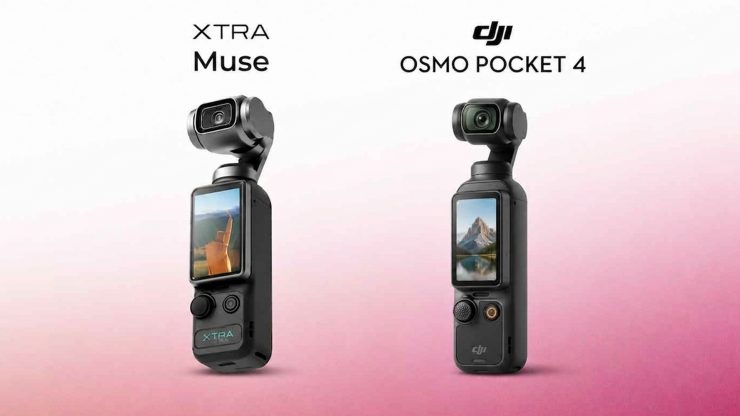
Pricing for the Muse 2 Pro hasn’t been officially announced, but the pattern from the first generation is telling. The original Xtra Muse is currently $379 on Amazon and available at B&H for $499. The DJI Osmo Pocket 3 — its hardware equivalent — has ballooned to $800 on Amazon after tariffs. The savings margin is the entire value proposition.
This Is Not the First Time
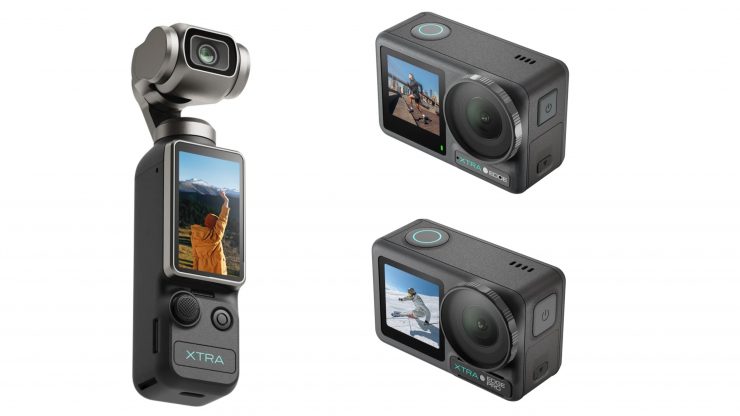
Xtra’s original product launch in October 2025 introduced three cameras simultaneously: the Muse (Osmo Pocket 3), the Edge (Osmo Action 4), and the Edge Pro (Osmo Action 5 Pro). The resemblances were not subtle. PetaPixel and The Verge both covered the story immediately.
The Verge’s investigation went well past visual comparison. Security consultant Jon Sawyer analyzed Xtra’s companion app and found what he called “countless places” where DJI’s original code had been replicated with just the “DJI” label swapped out. Left behind: 7,552 references to DJI’s LightCut video editing app, and one reference to DJI’s e-bike drive system — apparently no one caught that one. The Verge’s Sean Hollister then bought both cameras and tested them head-to-head. The Muse and the Osmo Pocket 3 behaved identically in operation, had the same menu structure, and — in a detail that is hard to dismiss — got warm in the same locations after the same duration of shooting.
FCC teardown filings provided hardware confirmation. The internal components, circuit boards, and chips inside the Xtra Muse are the same as those inside the DJI Osmo Pocket 3.
A Pattern of Front Companies
Researcher Konrad Iturbe has been tracking what he describes as a network of DJI front operations in the US market. His public GitHub repository, dji-front-companies, documents at least eight suspected shells being used to distribute DJI hardware under rebranded names. IBTimes reported in 2025 that DJI had approached a US partner as early as 2023 with an offer to “Americanize its drones” and “somehow cleanse the Chinese-ness from their technology.”
Xtra is not isolated. SkyRover, another brand in this network, sold what turned out to be DJI’s Mini 4 Pro drone on Amazon in mid-2025. Each of these companies holds its own FCC approval number and independent corporate registration, which is precisely the point. The FCC Covered List targets DJI by name. A Delaware-registered entity with its own approval numbers sidesteps that mechanism entirely.
Xtra’s own mailing address, as registered, is a shell company formation agent, a service that provides addresses for businesses without physical offices.
What This Means for Working Shooters
For documentary cinematographers, news shooters, and content creators considering a pocket gimbal, none of this necessarily changes much, as you can somewhat get the same product under a different name. If the Muse 2 Pro hardware is genuinely Osmo Pocket 4P hardware, and the evidence strongly suggests it is, the camera will deliver. A 1-inch sensor with 10-bit D-Log and 4K/240fps slow motion in a form factor that fits in a jacket pocket is a legitimately capable B-camera or supplemental tool for professional productions. The form factor is incredible, and I have used it in a few productions.
The real concerns are downstream. DJI’s firmware ecosystem, warranty infrastructure, and repair network won’t cover an Xtra camera. Xtra’s after-sales support is, by all accounts, thinner. Firmware updates, who pushes them, on what timeline, and with what commitment, remain undefined. For shooters who buy gear and keep it for years, that gap matters.
The pricing, once announced, will be the clearest confirmation of everything. If the Muse 2 Pro arrives anywhere near the Osmo Pocket 3’s pre-tariff launch price of $519 USD, the theory moves from well-supported to potentially proven.
The camera that dares not speak DJI’s name is almost certainly a DJI camera. No one involved is saying otherwise. No one is denying it either.
DJI Wireless Audio Receiver Built In
The DJI OSMO Pocket is compatible with DJI mic systems, and the XTRA is as well. Interesting, right? XTRA cameras (including the XTRA Muse, Atto, Edge, Edge Pro, and Sphera360) are compatible with the DJI Mic Mini, DJI Mic 2, and DJI Mic 3
Key Specs: XTRA MUSE 2 PRO
| Specification | Detail |
|---|---|
| Sensor | 1-inch CMOS |
| Video | 4K up to 240fps |
| Color | 10-bit D-Log (X-Log) |
| Stabilization | 3-axis mechanical gimbal |
| Storage | 128GB internal |
| Tracking | ActiveTrack 7.0 |
| Zoom | 3x optical zoom module |
| Display | 2-inch rotatable OLED touchscreen (dual flip) |
| Connectivity | USB-C (side-mounted) |
| Mounting | Built-in 1/4-inch thread |
| Availability | Summer 2026 (US) |
| Price | TBA |
Pre-release OSMO Pocket 4P Specifications
| Sensor | 1-inch CMOS; up to 14 stops of dynamic range |
| Video Resolution | 4K up to 120fps; slow-mo up to 4K/240fps |
| Lens | 20mm equiv., f/2.0; Pro adds dual-camera setup (main + 1/1.3″ telephoto, f/1.7–f/2.8) |
| Photo Resolution | Standard (pixel-binned) and Ultra-Clear up to 37MP |
| Display | 2.0–2.5-inch rotatable OLED touchscreen, 1000 nits |
| Stabilization | 3-axis mechanical gimbal with 360° rotation |
| Storage | 107GB built-in |
| Audio | 4–6 channel array with Spatial Audio |
| Smart Features | ActiveTrack 7.0 (up to 4x zoom), Gesture Control |
| Battery Life | 1,545 mAh; up to 240 minutes |
| Weight | ~116–117g |
I like DJI products and use them for professional work and daily life. They work well; I’m a bit confused with the FCC being so harsh on them, as it doesn’t add up. I hope this all can get resolved, but it looks like we are not going to be entirely abandoned.
Since I’m in the US, I can’t buy an OSMO Pocket 4 or 4P, but from the research for this article, I think I will settle for the “other ” brand for my upgrade path to the newest “Pro” model.
Buy the current XTRA Muse:
Sources: The Verge · PetaPixel · Notebookcheck · Imaging Resource · IBTimes · GlobeNewswire · GitHub/KonradIT