
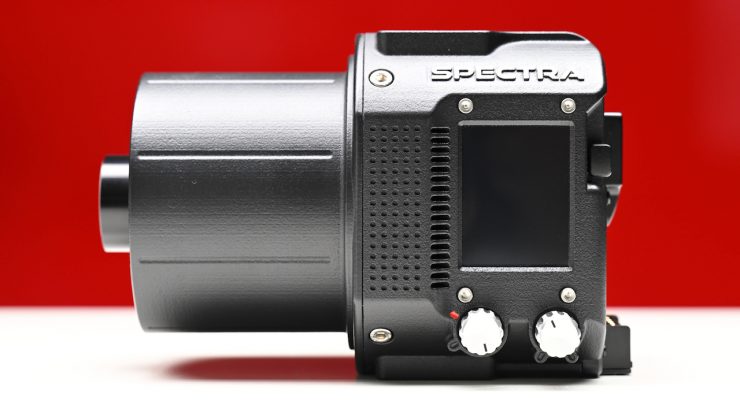
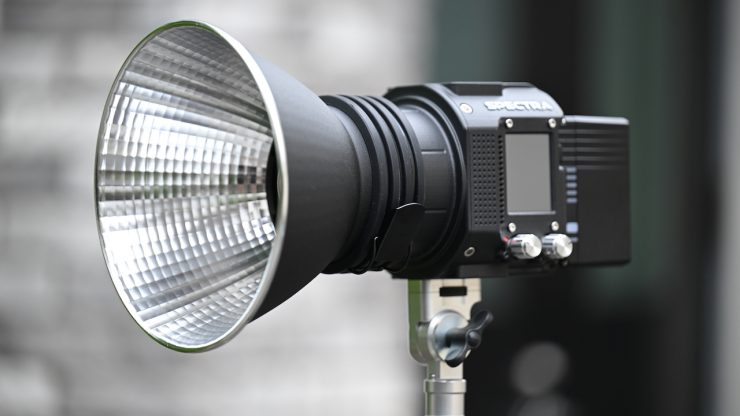
The Maxima Spectra is the latest fixture from the Italian lighting manufacturer. The Maxima Spectra is claimed to deliver studio-grade cinematic lighting in a lightweight, battery-first design.
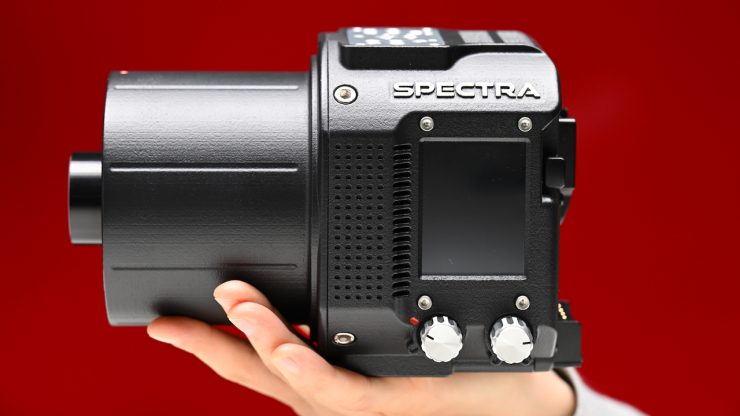
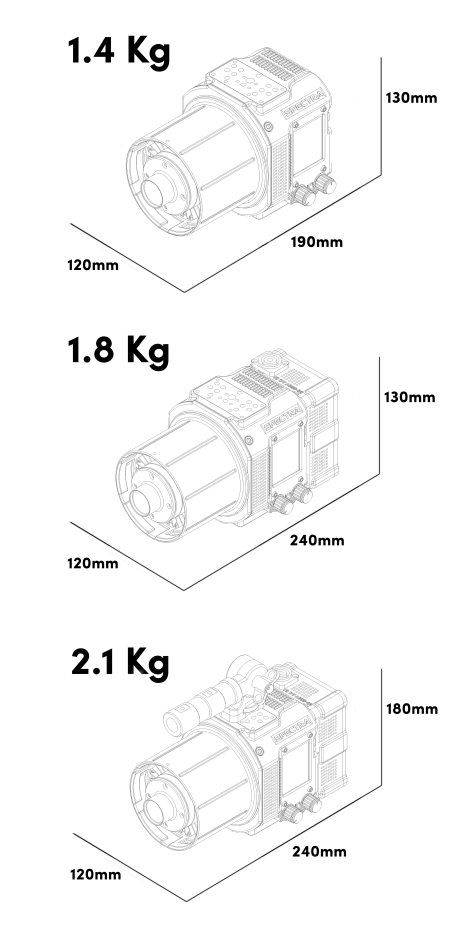
It weighs in at just 1.4 kg / 3.08 lbs, and it is 19cm / 7.48″ long, and its form factor almost makes it look like a small-sized digital cinema camera. Maxima Spectra was designed with an integrated, all-in-one body, so that you don’t need any cables (if you are running it via a battery).
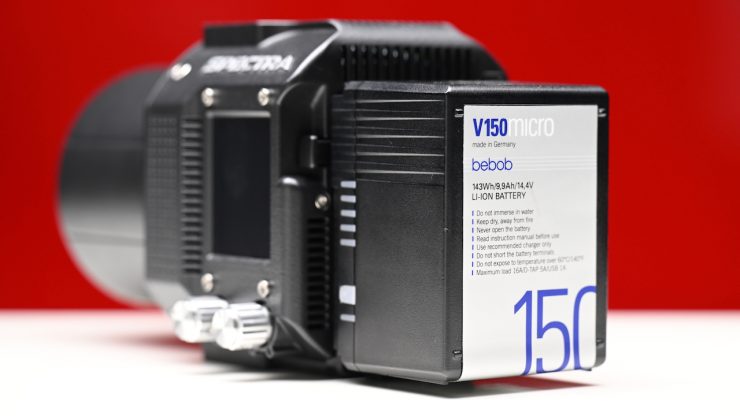
It features direct V‑Mount battery support, Profoto and Bowens mount compatibility, and a CCT range of 2600K to 7000K.
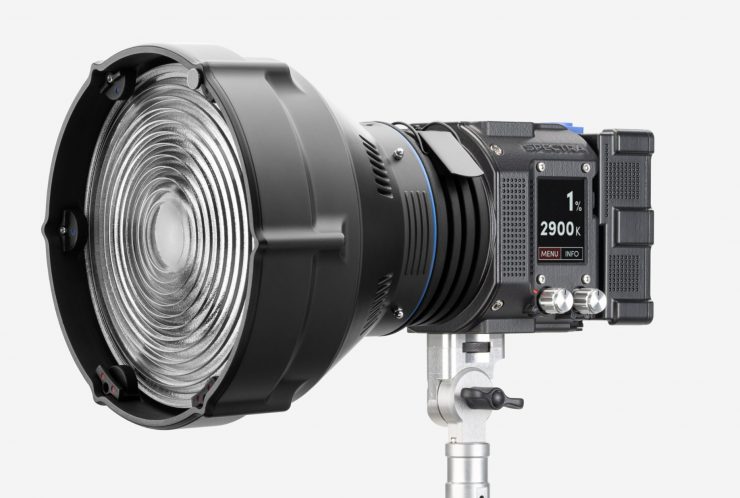
If you use it with the optional Maxima Fresnel in spot mode, the claimed output is ~170.000 lux at 1m / 3.3′.
In an age where full-color fixtures have become increasingly popular, some readers may well question the validity of owning a 5600K fixture or even a Bi-color one. That is certainly a legitimate concern; however, we used tungsten and daylight-only fixtures for decades, and that never held us back. Sure, a Bi-color fixture is not going to be as versatile as a full-color one, but it really depends on your use case requirements as to whether or not you need full color.
The Maxima fixtures have been some of the most color-accurate fixtures I have ever tested.
Power it via a Flight Safe V-mount battery
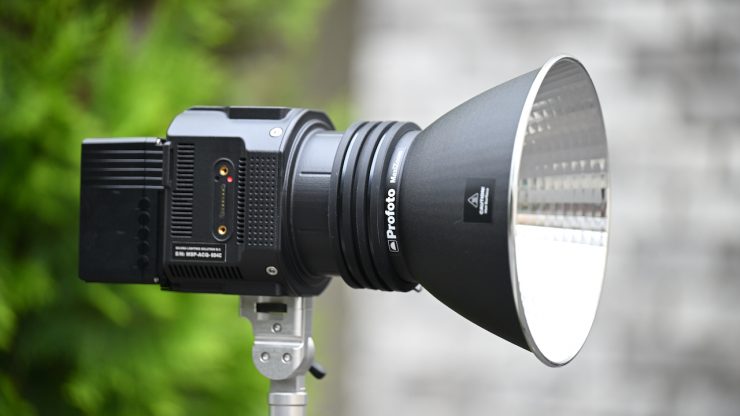
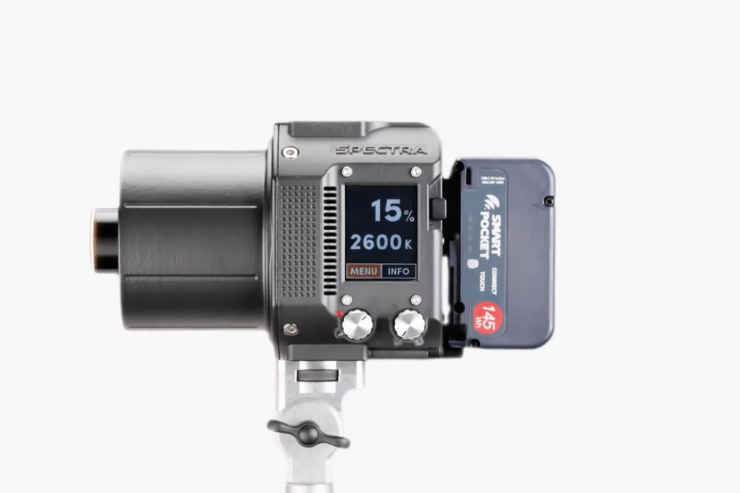
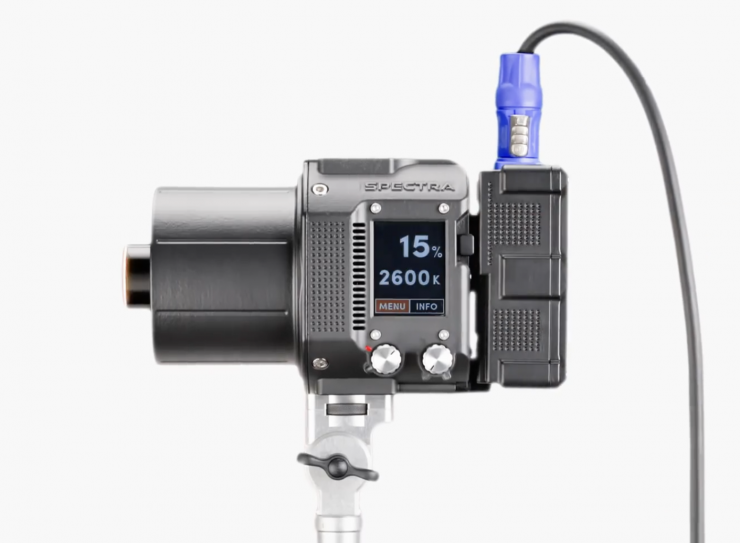
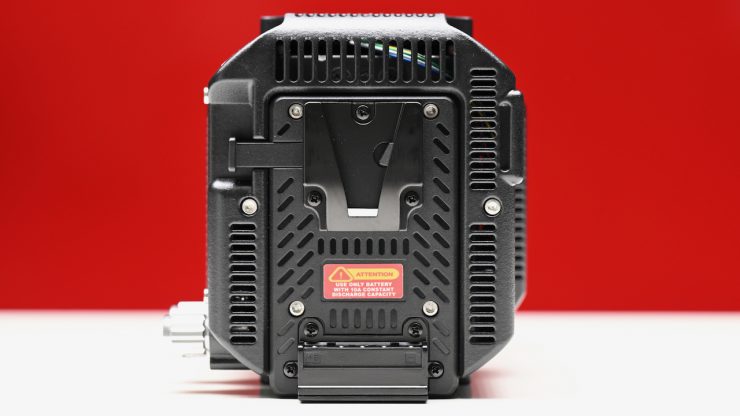
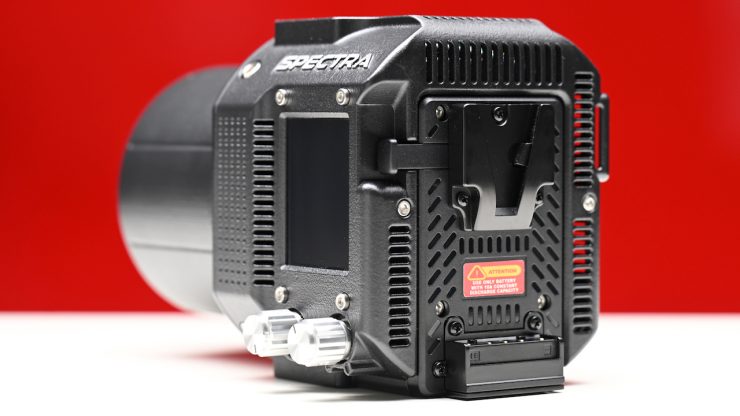
The design allows you to power the light directly from a Flight Safe V-mount battery or mains power. You simply attach the power supply to the V-mount receptacle to use mains power or take it off and directly attach a V-mount battery. This is a nice design, but when running it from mains power, the cable sticks straight up.
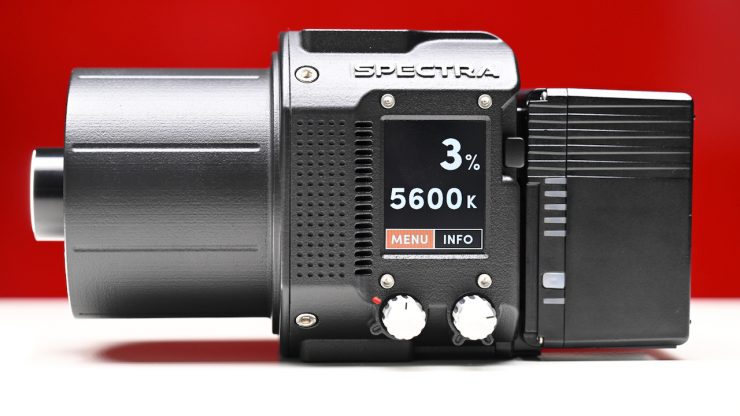
Whether powered by V‑Mount batteries or AC, Spectra is claimed to be able to deliver the same output (as long as you are using an appropriate battery). You can switch between mains power and a battery in under 5 seconds. With an efficacy of 125 lm/W, it operates for nearly an hour at full power on a single 145 Wh V-Mount battery.
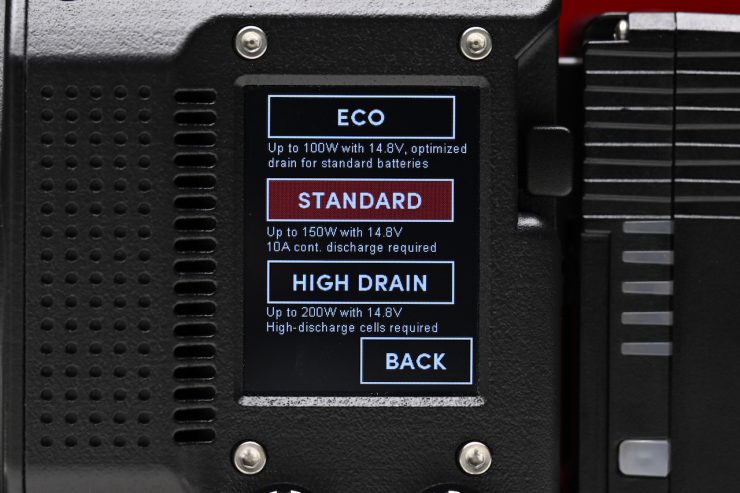
Thanks to the three battery operation modes, Spectra is compatible with the widest range of V-Mount batteries available on the market. Battery operation mode is selectable by the user via the LCD touchscreen and is designed to accommodate batteries that provide 100W power output (ECO mode) through the full 200W setting (HIGH DRAIN mode) for more powerful batteries.
Thanks to Maxima’s patented thermal-management system, Spectra delivers class-leading efficiency (~125 lm/W), supporting extended run-times on battery while reducing energy consumption and environmental impact. All the materials and components of Maxima are manufactured in a zero-waste industrial process, completely carried out in Italy, which also allows the re-circulation of components after end-of-life.
According to Maxima, the Spectra features advanced fan management for quiet operation, from 19 dBA to 32 dBA.
Integrated Microlens with 90° beam angle
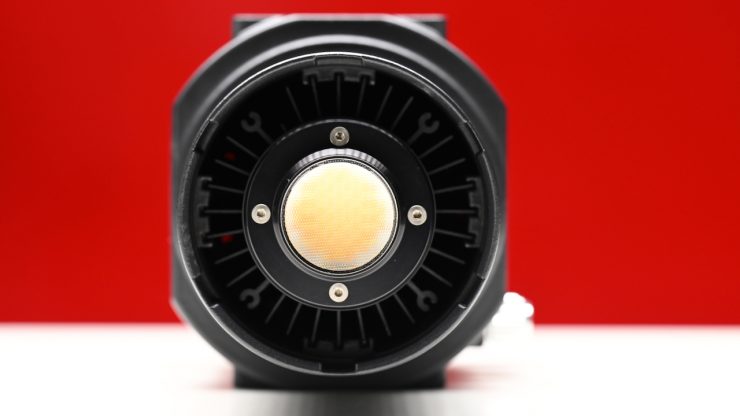
The Spectra features an integrated Microlens with a 90° beam angle for
wide coverage with no visible mosaic effect. Maxima claims that the integrated MicroFocus lens combines Fresnel-like sharpness with a diffused quality, producing hard, crisp shadows alongside a natural, soft light. According to the company, this is ideal for achieving both dramatic and flattering lighting effects.
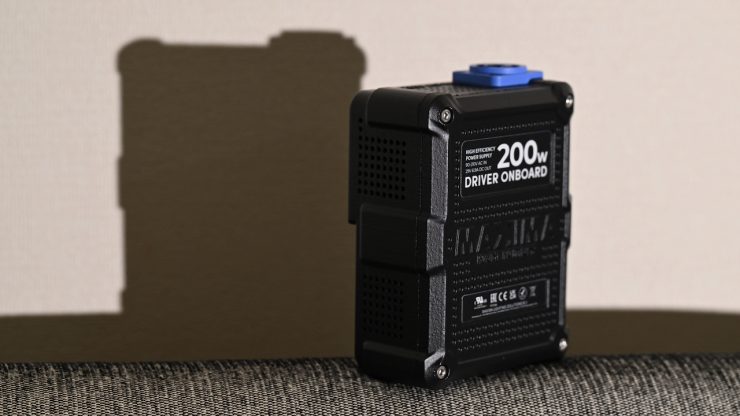
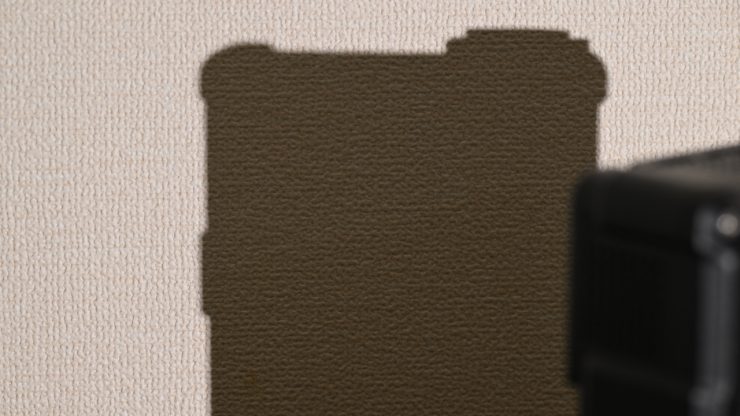
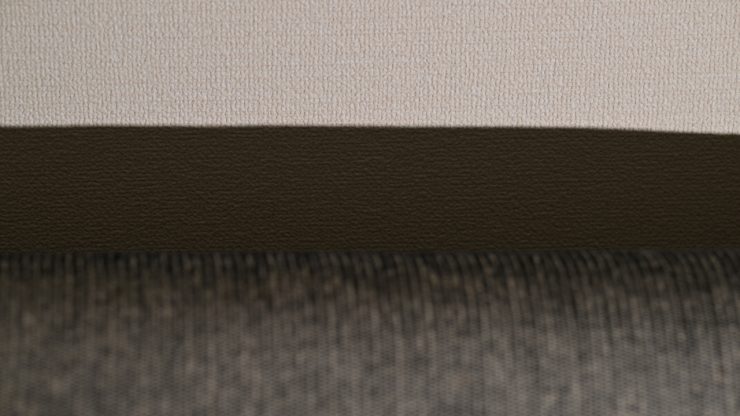

The Microlens works really well, and it creates very sharp and well-defined shadows.
Having a nice, wide beam angle certainly makes the Spectra a versatile option. Too often, with small-sized fixtures, they tend to have tight beam angles and prioritize brightness over versatility.
Maxima GaNPOWER
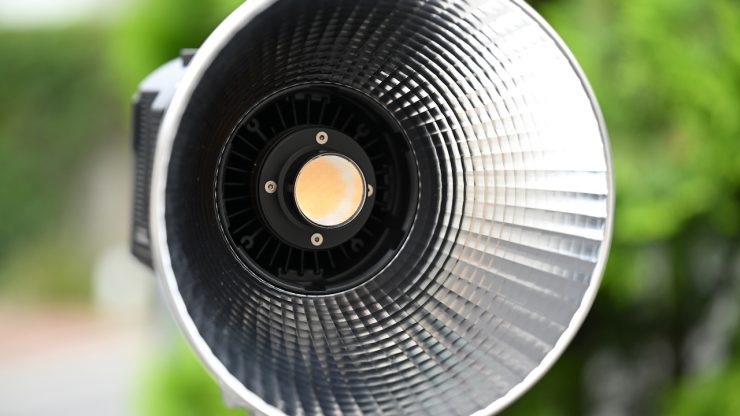
The Maxima utilizes the company’s GaNPOWER lighting engine and a 32-bit Arm Cortex-M7 processor.
What is GaN?
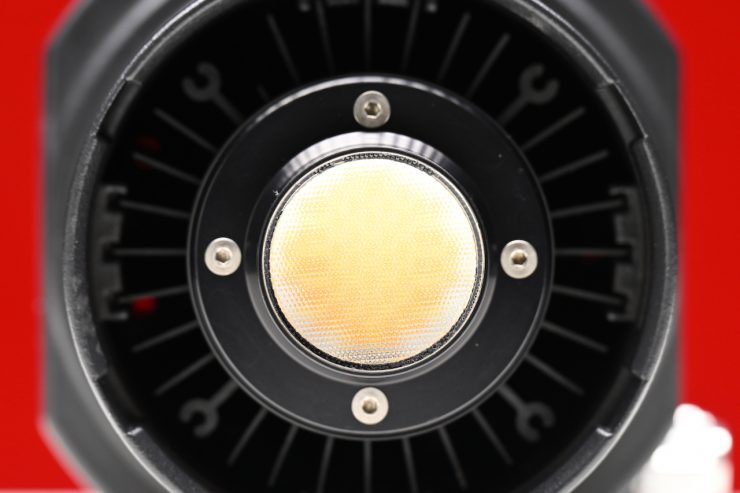
The Maxima Spectra, just like the Furiosa and Maxima 6 GaN, are the world’s first LED lamps driven by gallium nitride circuitry, which makes them capable of having a very high lux-to-weight ratio, best-in-class efficiency, and high CRI color rendition. GaN semiconductors are inherently more efficient than silicon, so less energy is expended as heat, resulting in a more efficient system with a higher power density (smaller volume).
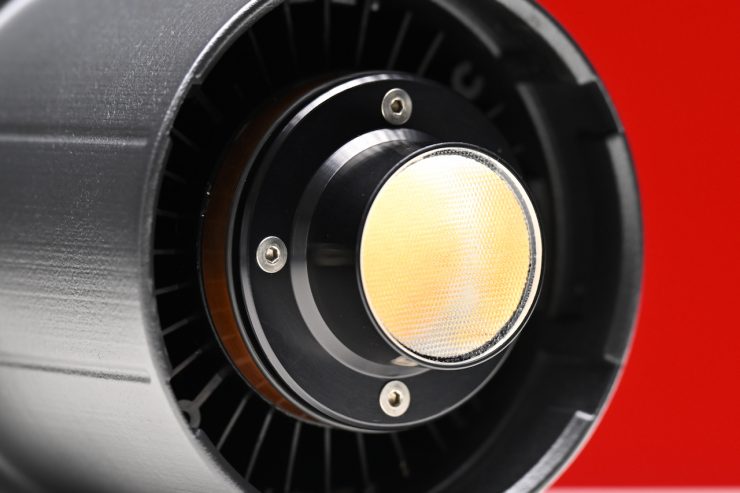
According to Maxima, the patented, full copper heatsink combined with advanced thermal management puts Maxima at the top levels of performance charts, both in terms of brightness and compactness.
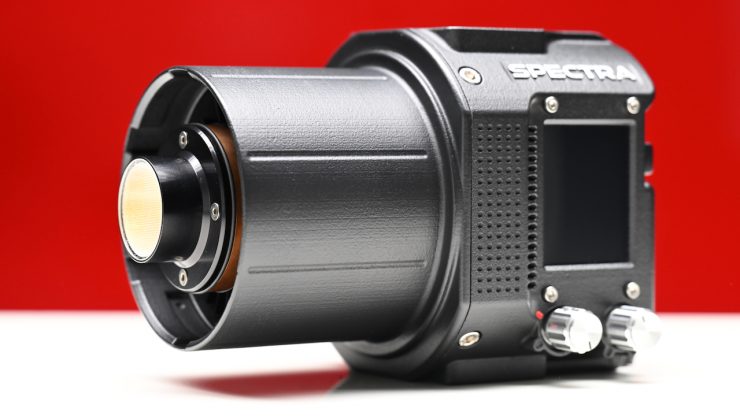
The increased efficiency obtained with GaN circuitry and the innovative thermal management subsystem is claimed to guarantee consistency and peak performance for years.
Gallium Nitride is a binary III/V direct bandgap semiconductor that is well-suited for high-power transistors capable of operating at high temperatures. Since the 1990s, it has been commonly used in light-emitting diodes (LEDs). Gallium nitride gives off a blue light used for disc-reading in Blu-ray. Additionally, gallium nitride is used in semiconductor power devices, RF components, lasers, and photonics. In the future, we will see GaN in sensor technology.
In 2006, enhancement-mode GaN transistors, sometimes referred to as GaN FETs, started being manufactured by growing a thin layer of GaN on the AIN layer of a standard silicon wafer using metal-organic chemical vapor deposition (MOCVD). The AIN layer acts as a buffer between the substrate and GaN. This new process enabled gallium nitride transistors to be produced in the same existing factories as silicon, using almost the same manufacturing processes. Using a known process allows for similar, low manufacturing costs and reduces the barrier to adoption for smaller transistors with much-improved performance.
To further explain, all semiconductor materials have what is called a bandgap. This is an energy range in a solid where no electrons can exist. Simply put, a bandgap is related to how well a solid material can conduct electricity. Gallium nitride has a 3.4 eV bandgap, compared to silicon’s 1.12 eV bandgap. Gallium nitride’s wider band gap means it can sustain higher voltages and higher temperatures than silicon MOSFETs. This wide bandgap enables gallium nitride to be applied to optoelectronic high-power and high-frequency devices.
The ability to operate at much higher temperatures and voltages than gallium arsenide (GaAs) transistors also makes gallium nitride ideal for power amplifiers for microwave and terahertz (ThZ) devices, such as imaging and sensing, the future market mentioned above.
ADVANTAGES OF GALLIUM NITRIDE
The value proposition for GaN devices consists of four major points:
Reduced energy costs – Because GaN semiconductors are inherently more efficient than silicon, less energy is expended as heat, resulting in smaller system sizes and material costs.
Higher power density (smaller volume) – Higher switching frequencies and operational temperatures than silicon result in lower cooling requirements, smaller heat sinks, conversion from liquid-cooling to air cooling, eliminating fans and reduced magnetics.
Higher switching frequency – The higher switching frequencies for GaN devices allow smaller inductors and capacitors to be used in power circuits. The inductance and capacitance scale down in proportion to the frequency – a 10X increase in frequency produces a 10X decrease in the capacitance and inductance. This can result in an enormous decrease in weight and volume, as well as cost. In addition, higher frequency can result in less acoustic noise in motor drive applications. High frequency also enables wireless power transfer at higher powers, more spatial freedom, and bigger transmit-to-receive air gaps.
Lower system cost – While GaN semiconductors are generally higher cost than silicon, system-level cost reductions result through the use of GaN by reducing the size/costs of other components such as passive inductive and capacitive circuit elements, filters, cooling, etc. Savings range from 10-20%.
Mounting & Profoto and Bowens Compatibility
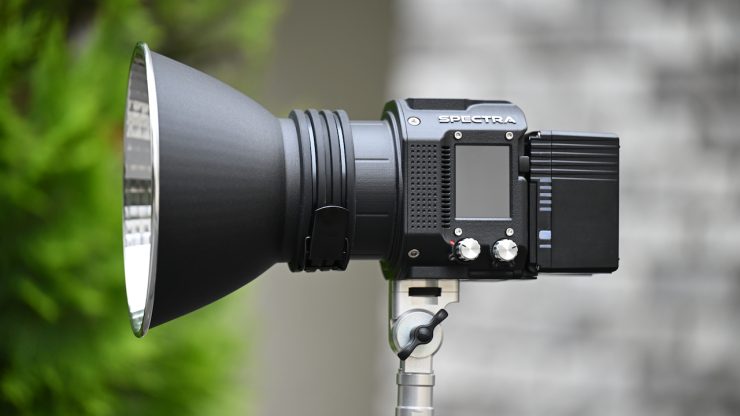
Spectra supports direct mounting of Profoto accessories and compatibility with Bowens through its Bowens Locking Ring (220 €) and other popular light modifiers.
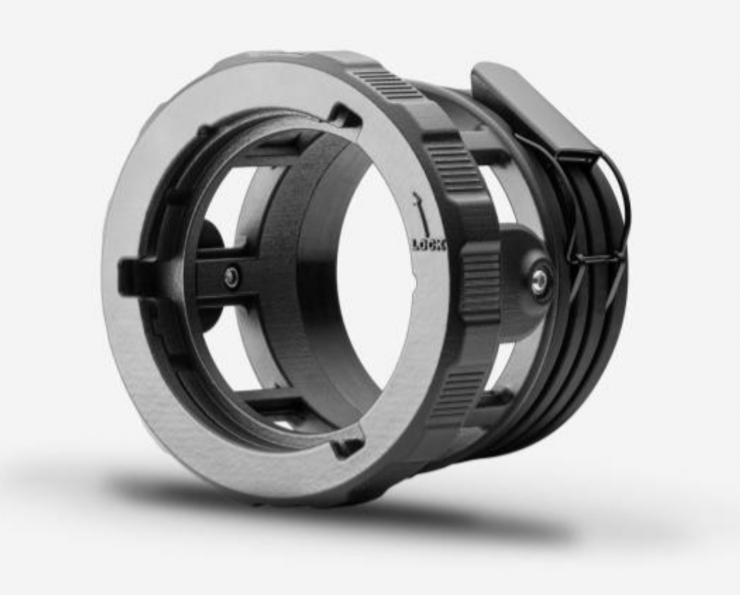
If I had a complaint, it would be that the light should really come with the Bowens Locking Ring and/or a reflector. Without them, the light’s versatility is limited.
Its 12-point, double cheese plate and integrated PivotMount 2.0 allow for versatile rigging with boom arms, stands, mini-tripods, and various accessories.
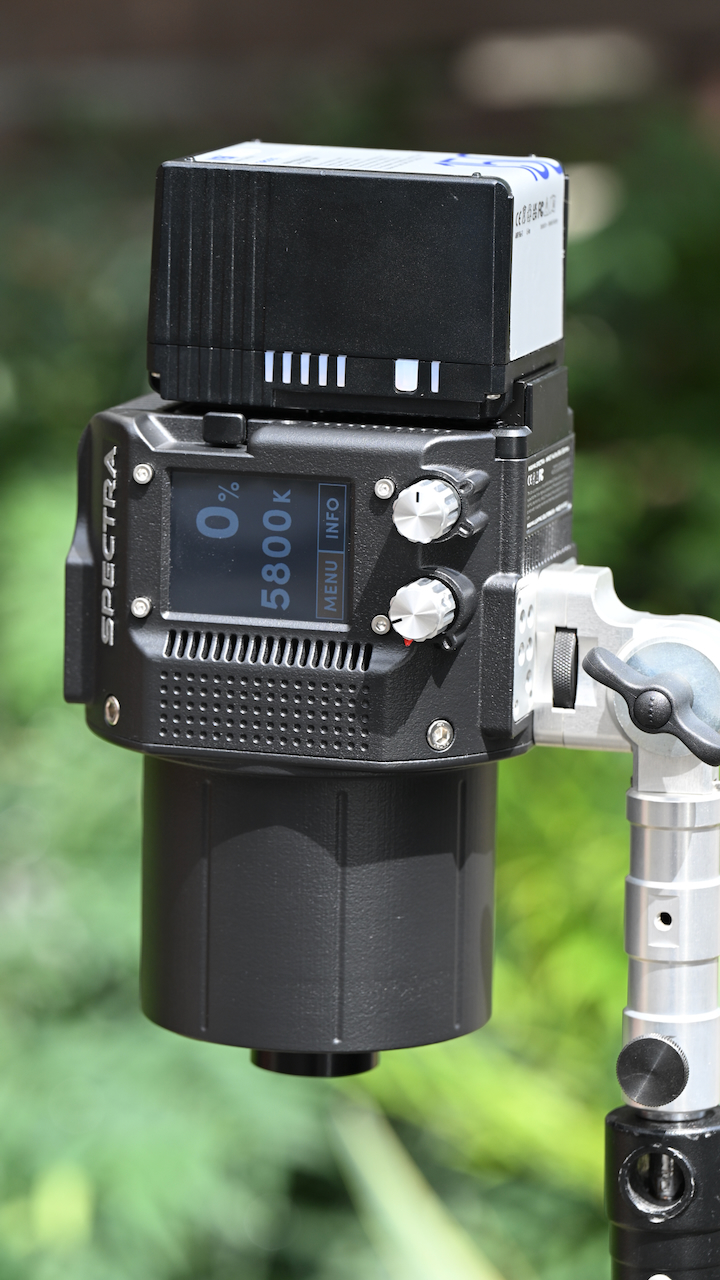
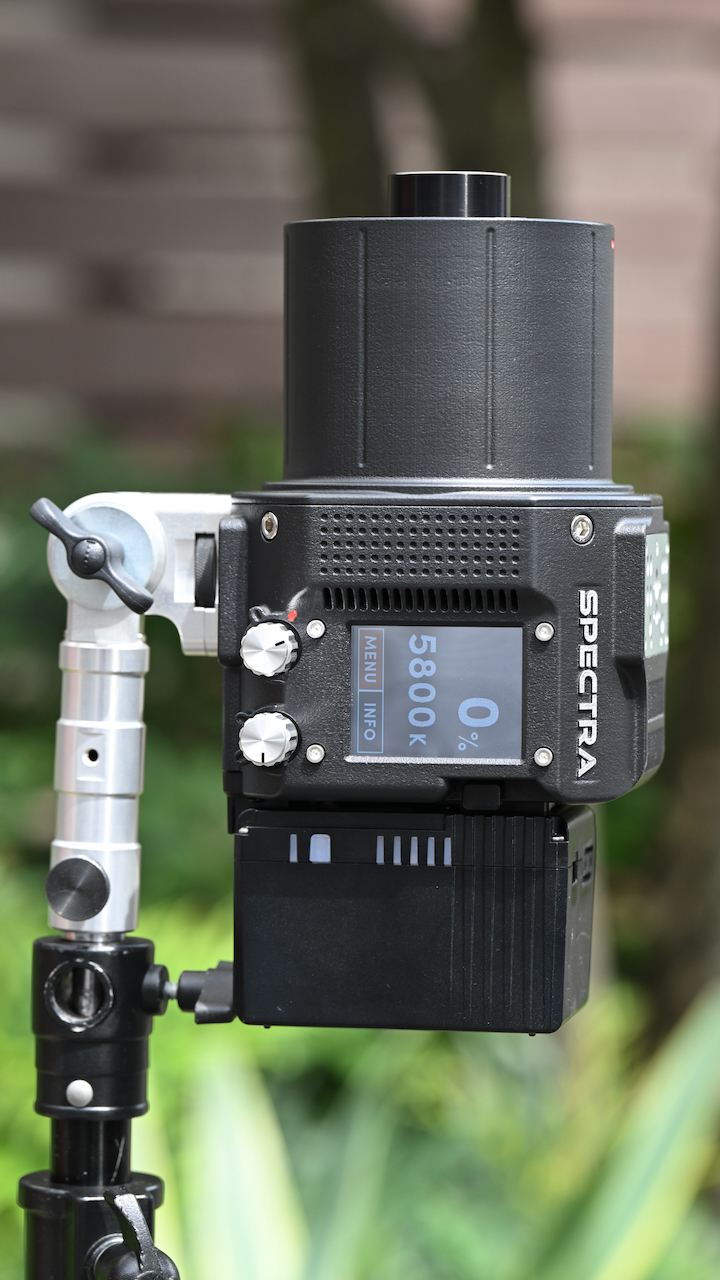
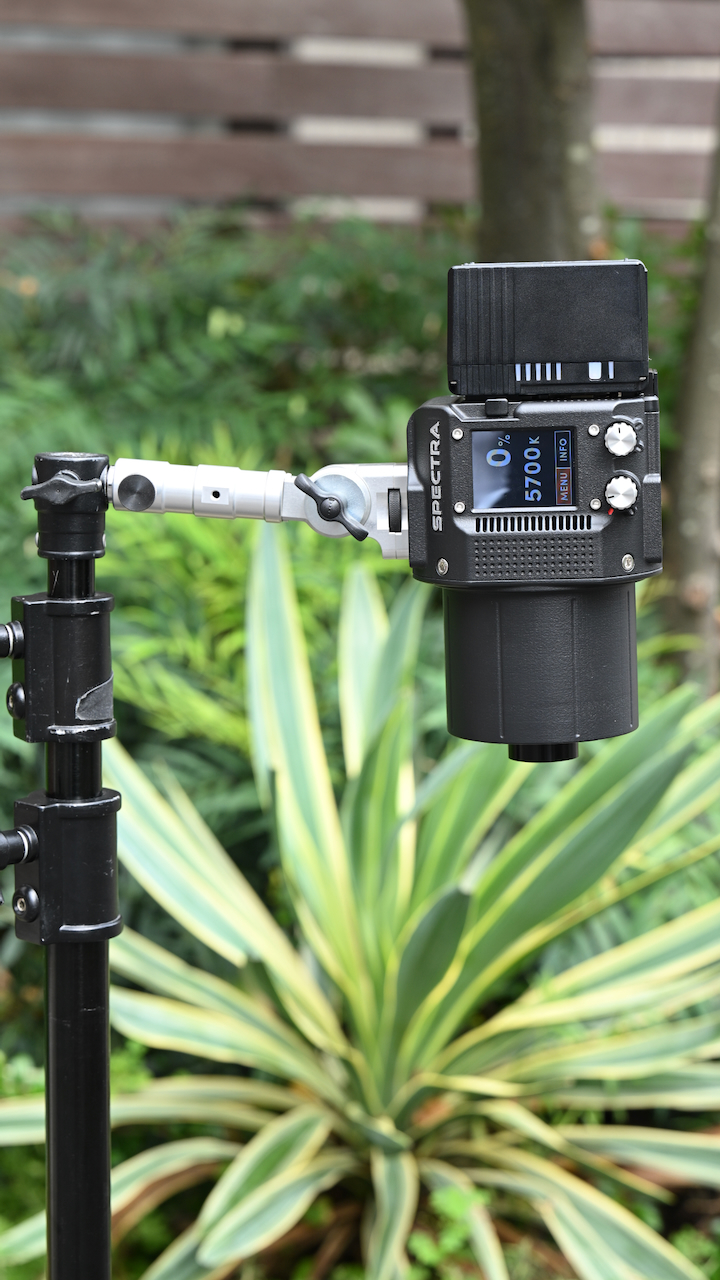
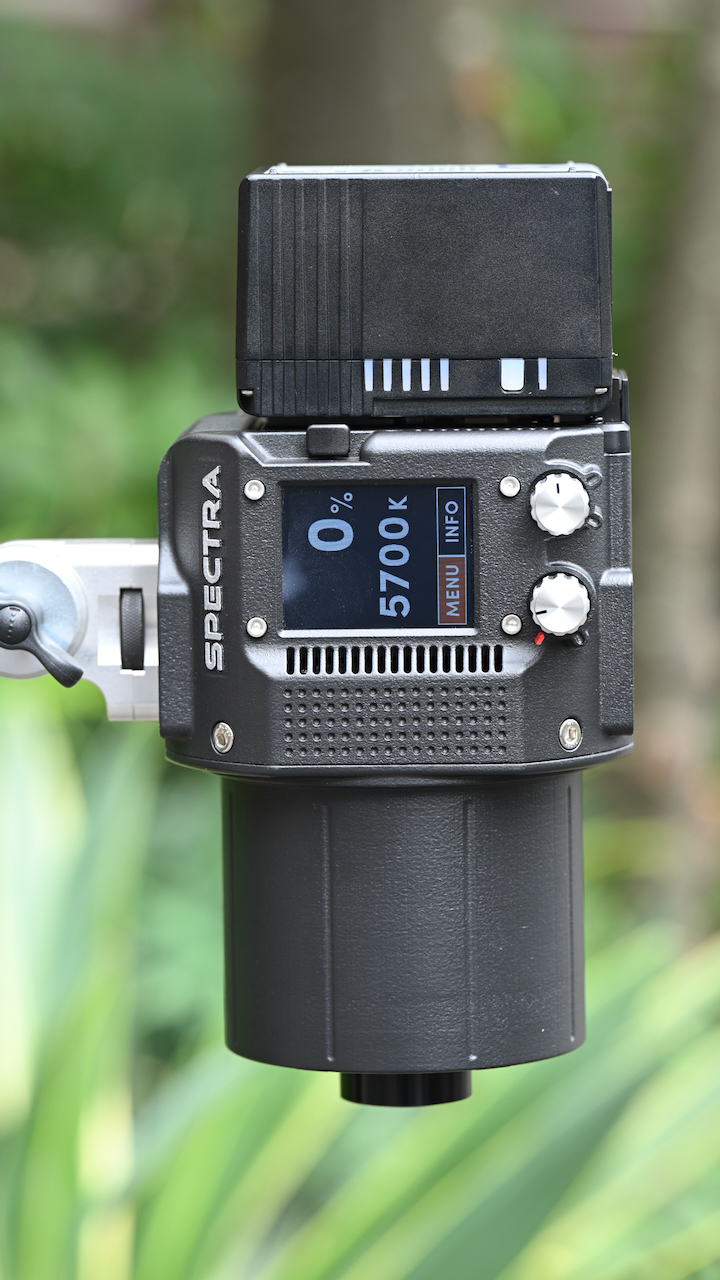
The dual aluminum cheese plates can be used for overhead and floor mounting.
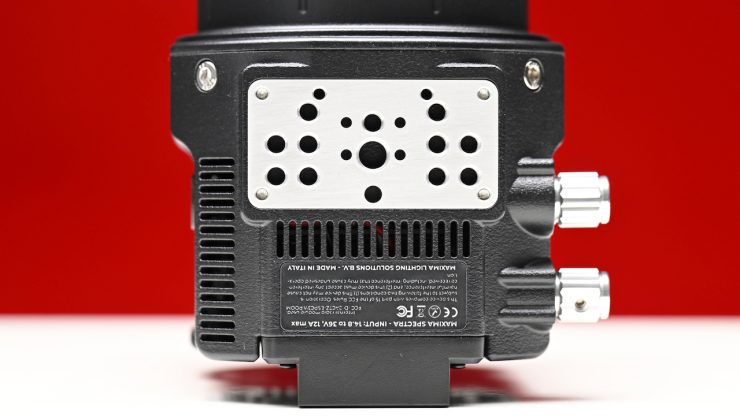
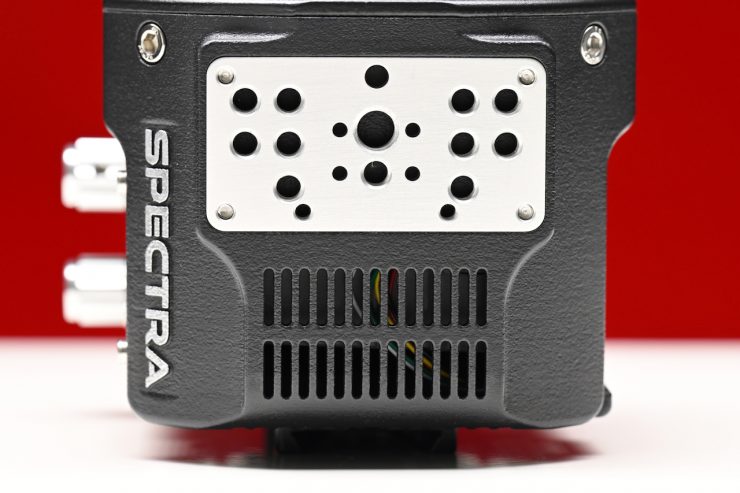
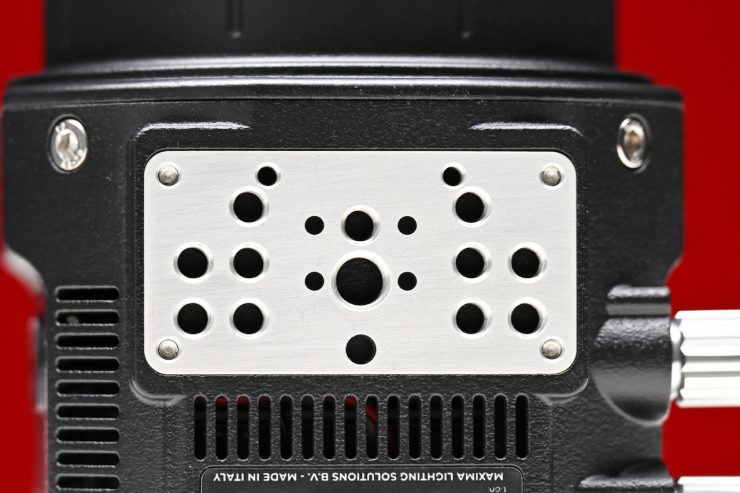
It features 12 mounting points in 1/4” and 5/8” sizes, plus 2 locating-pin points.
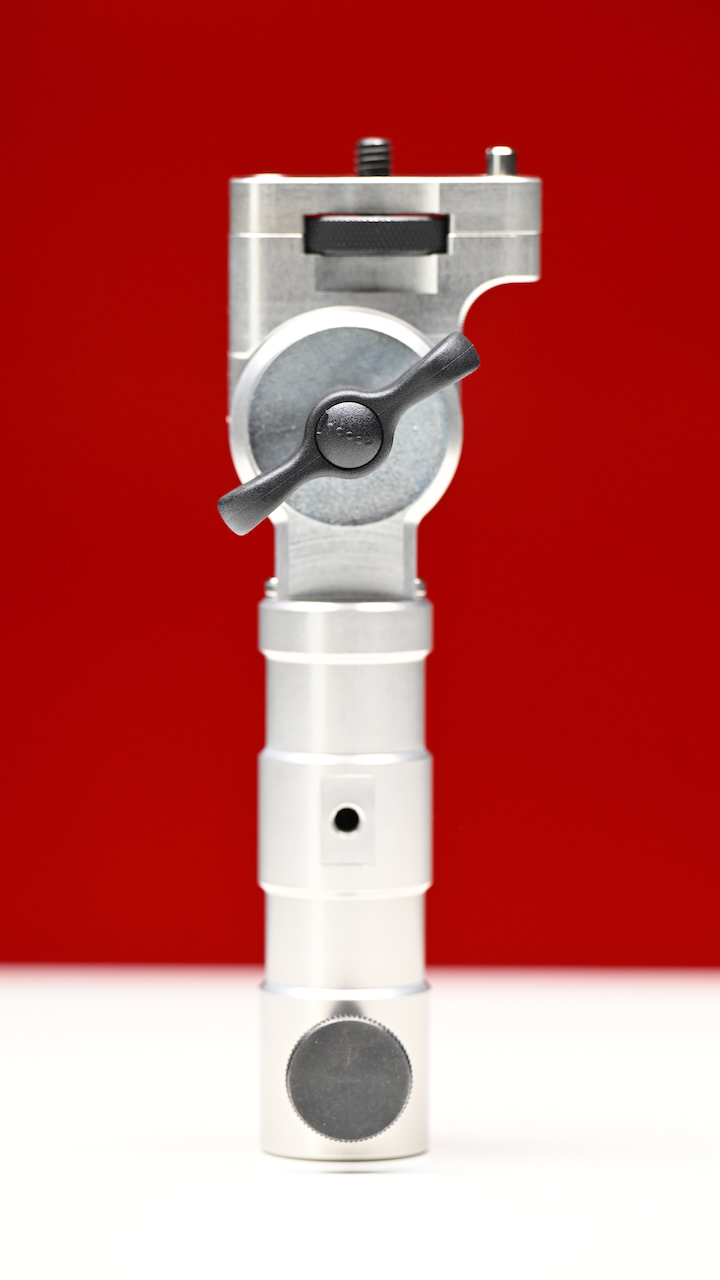
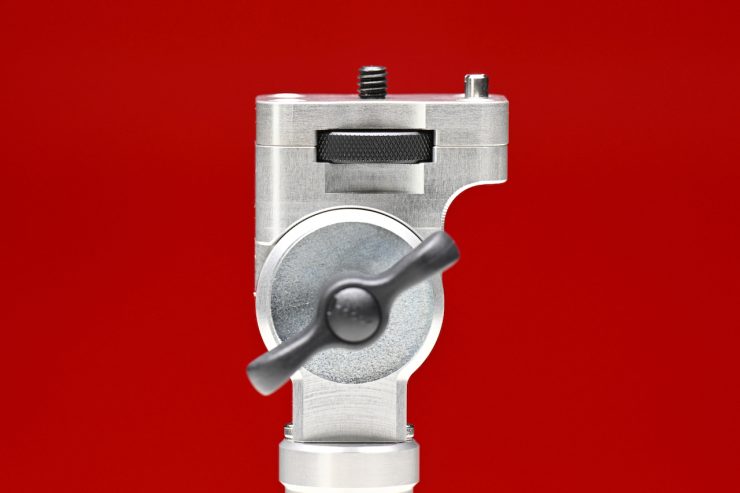
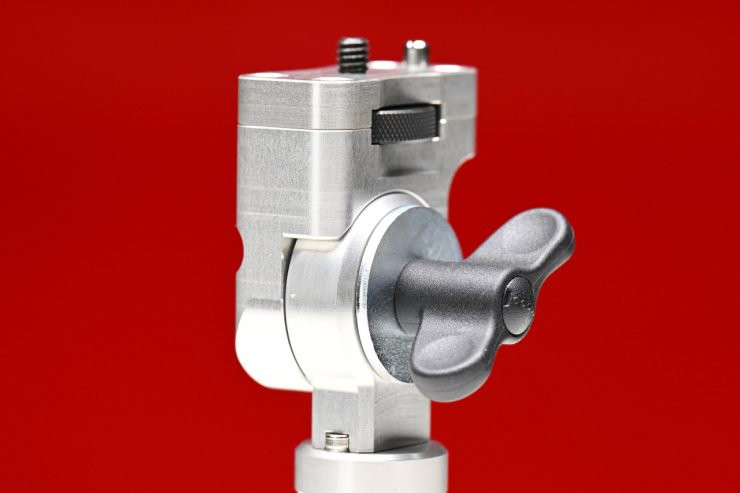
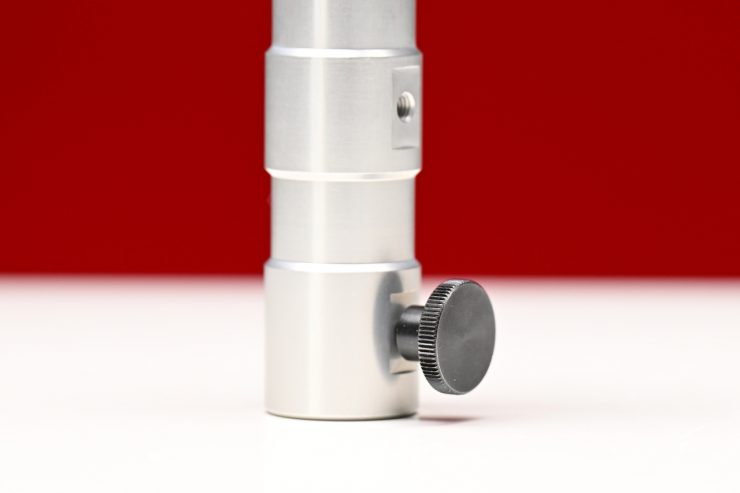
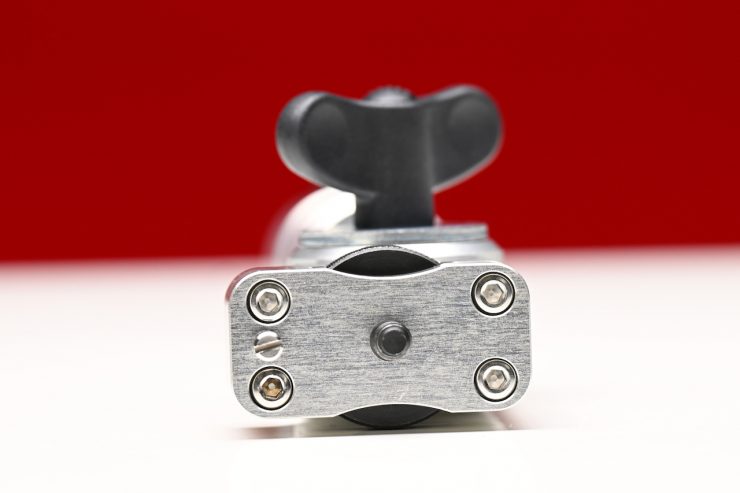
There is also a Step-less stand adapter with 180° rotation for very precise positioning and an integrated “briefcase” mode.
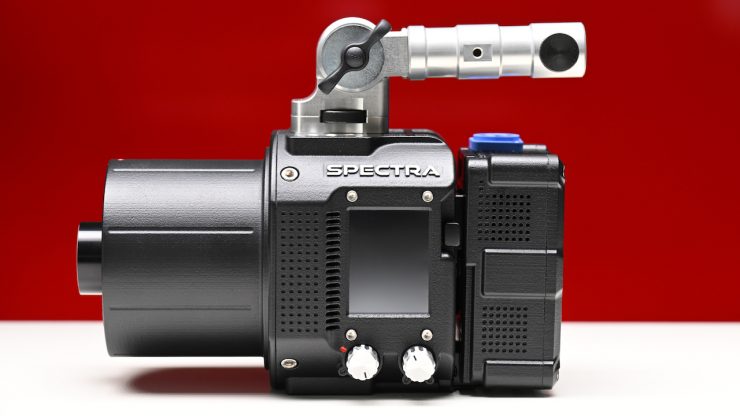
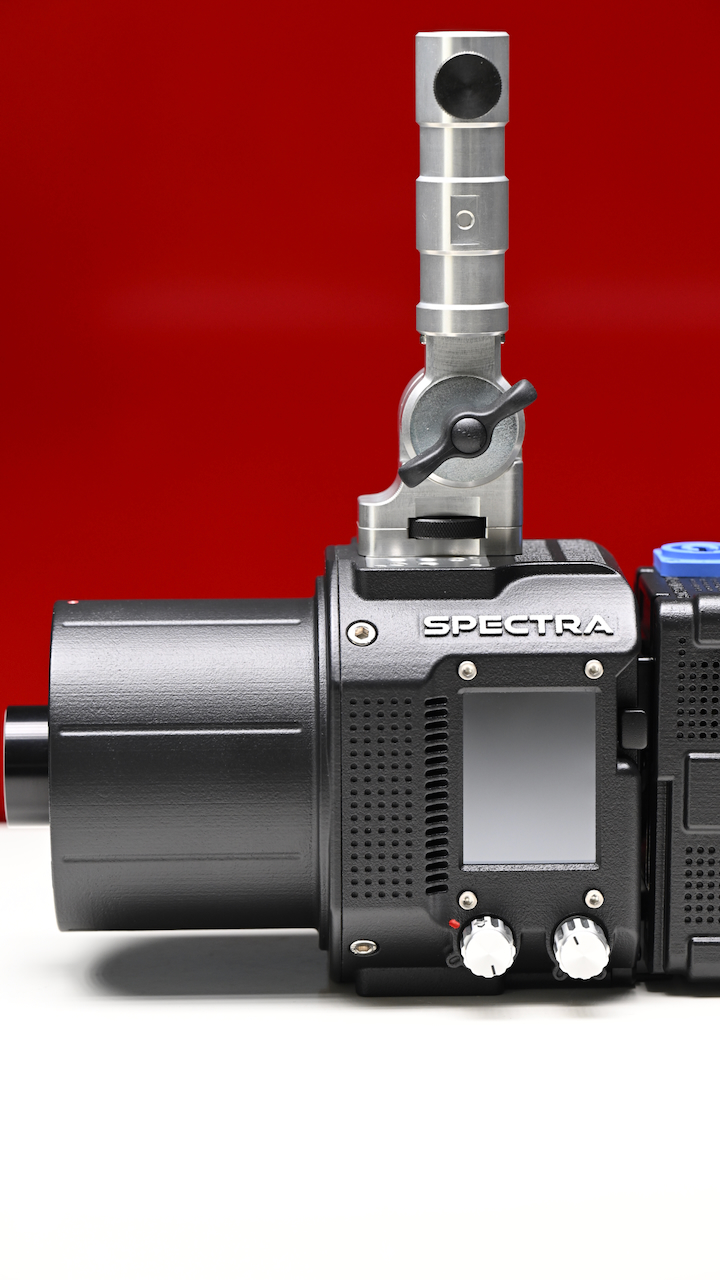
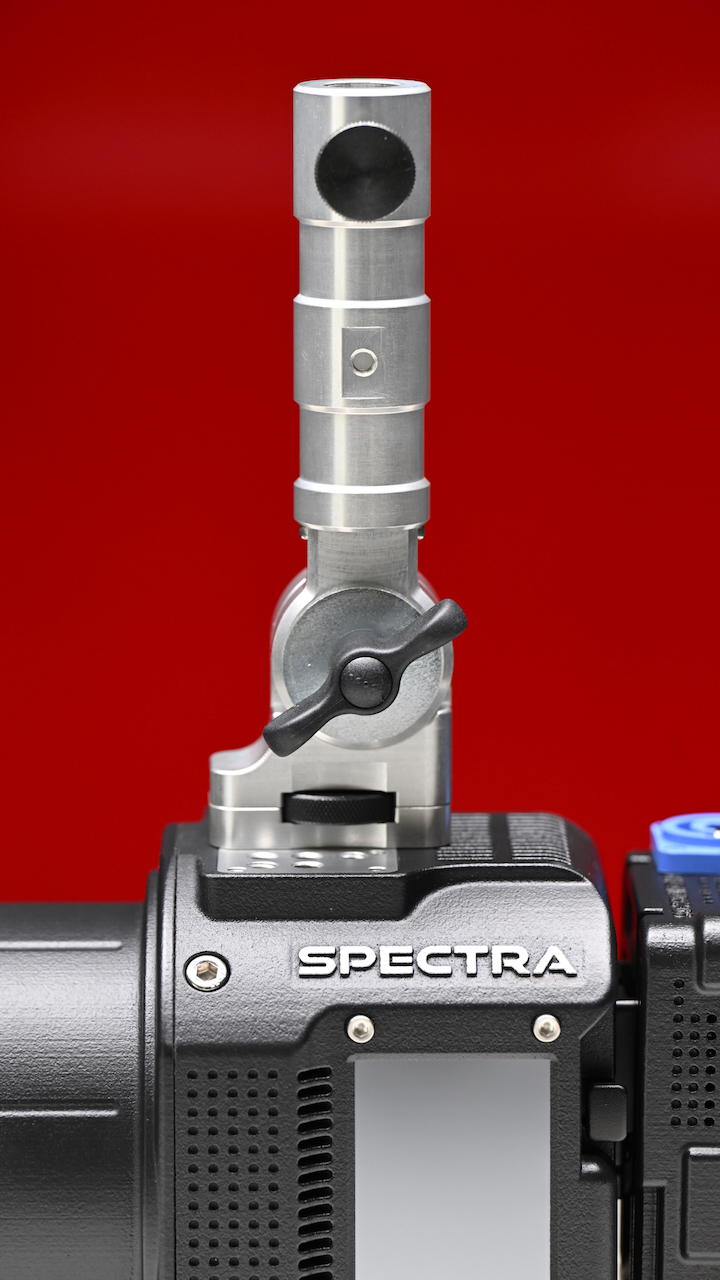
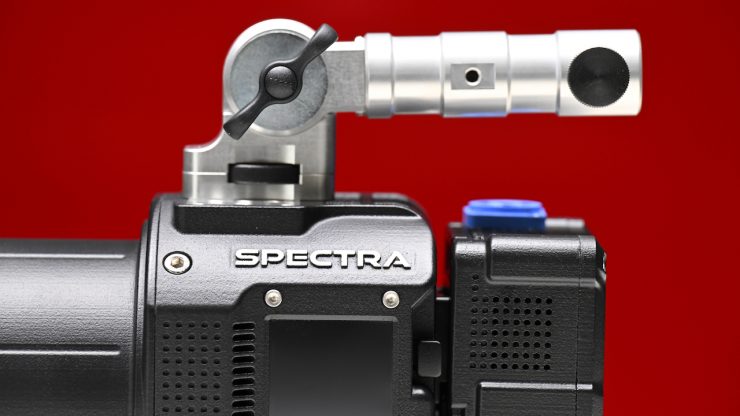
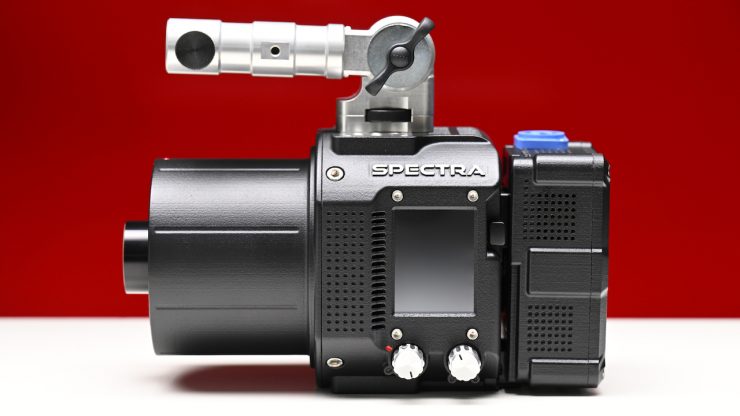
This works really well, and it gives you more mounting versatility than most other lights on the market.
Weight & Size
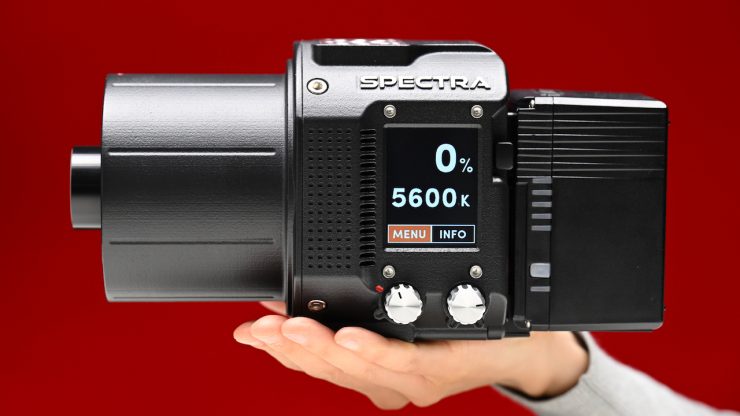
As I mentioned earlier, the Maxima Spectra weighs 1.4 kg / 3.08 lbs, and it is 19cm / 7.48″ long
The Maxima Spectra is very compact in size. It is very lightweight considering its power draw output and build quality. This all-in-one design and ability to run via flight-safe camera batteries make it an appealing prospect for anyone who travels a lot.
So how does the weight compare to some other spotlight fixtures that draw around 200W?
| TOTAL WEIGHT | |
| Maxima Spectra | 3.08 lb / 1.4 kg |
| amaran Halo 200x Bi-Color LED Monolight | 4.3 lb / 1.95 kg |
| GVM Pro SD200B Bi-Color LED Monolight (200W) | 2.7 kg / 6 lb |
| Zhiyun Molus X200 Bi-Color COB LED Light | 1.8 lb / 800g |
| Zhiyun MOLUS G200 Bi-Color LED Monolight | 4.21 lb / 1.91 kg |
| SmallRig RC 220B Pro Bi-Color LED Monolight | 3.64 lb / 1.65 kg |
| Genaray GXS-200BI 230W Bi-Color Monolight | 3.5 lb / 1.6 kg |
I found the lack of size and weight of the Spectra to be one of its biggest drawcards. It’s nice to have an all-in-one fixture that doesn’t weigh too much and doesn’t need an additional power supply/controller box. I say this because the power supply that comes with it attaches to the light itself.
The fixture is designed and manufactured in Italy, and it comes with the addition of a 2-year warranty.
Concept
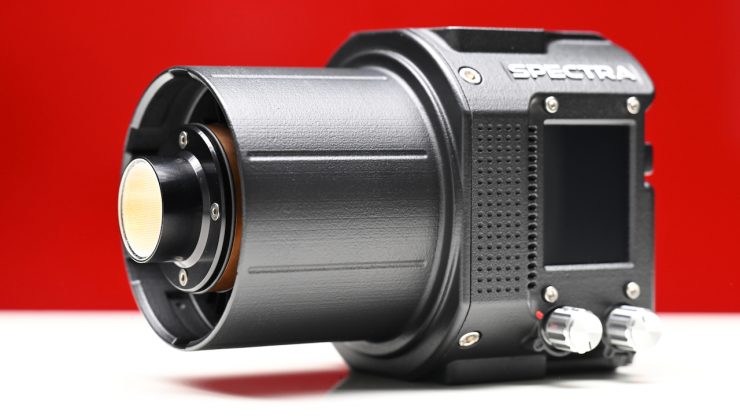
The whole concept behind the Maxima Spectra was to build a rock-solid, reliable, lightweight fixture for industry professionals. Maxima fixtures were envisaged and brought to market by working professionals in the industry. Maxima is the brainchild of Enrico and Claudio, who both work at Cinestudio in central Italy. They originally made fixtures for themselves, but then, because they became so popular, customers started requesting to buy them, and from there, a new company was born. The company is based in the Netherlands, but the manufacturing is entirely done in Italy.
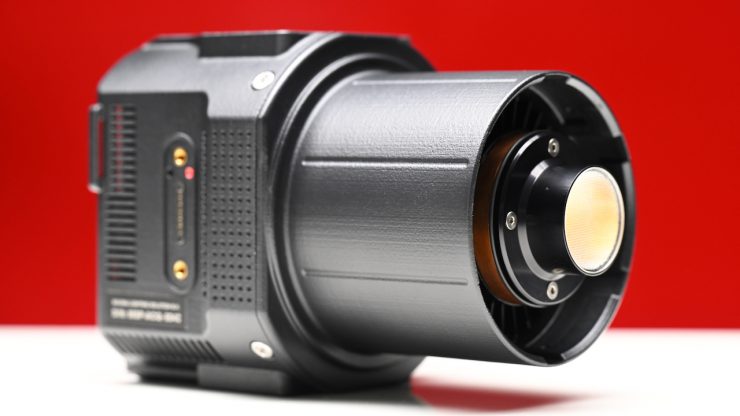
When they were envisioning the Maxima 3, Maxima 6 GaN, Maxima Furiosa, Maxima Rapida, and Maxima Spectra, they wanted to make lighting fixtures that were different from what was currently available in the market. There are hundreds of lights available, and there is little point in making a light that is exactly the same as something that already exists. While there are always going to be some similarities with other point source lights, nobody wants to see a blatant copy of something that already exists.
Just like other fixtures that the company has made, the Spectra had to meet certain goals such as high build quality, high performance, and good usability because it is being targeted at professionals.
If you are going to make a big investment in a lighting fixture, you want that lighting fixture to have a long shelf life. This is especially true for rental houses.
Build Quality
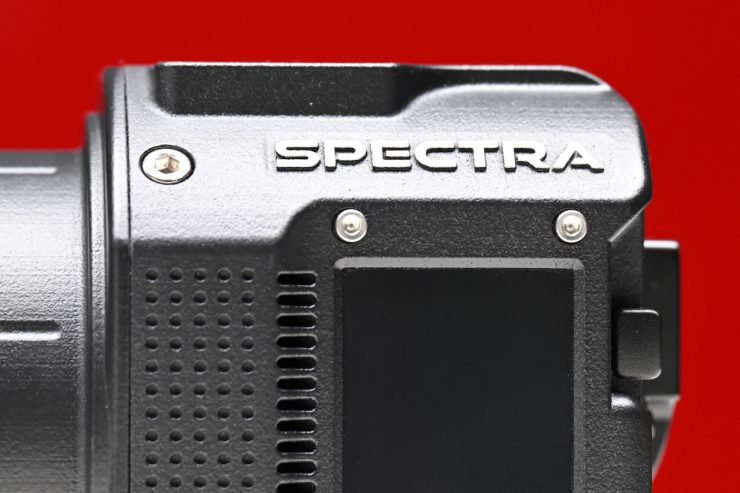
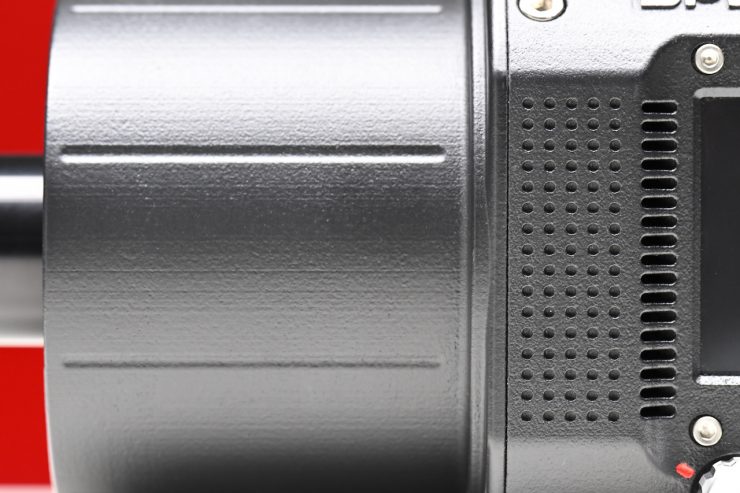
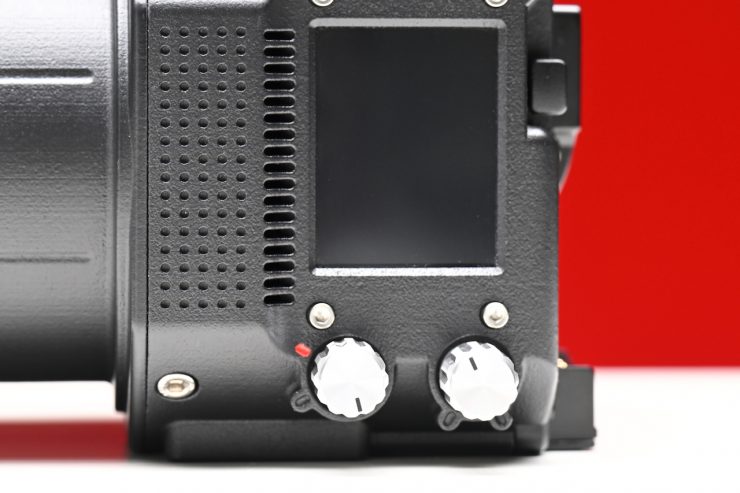
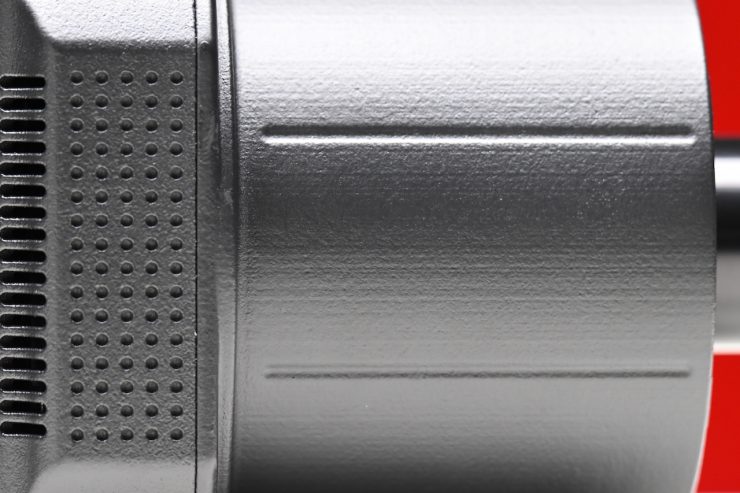
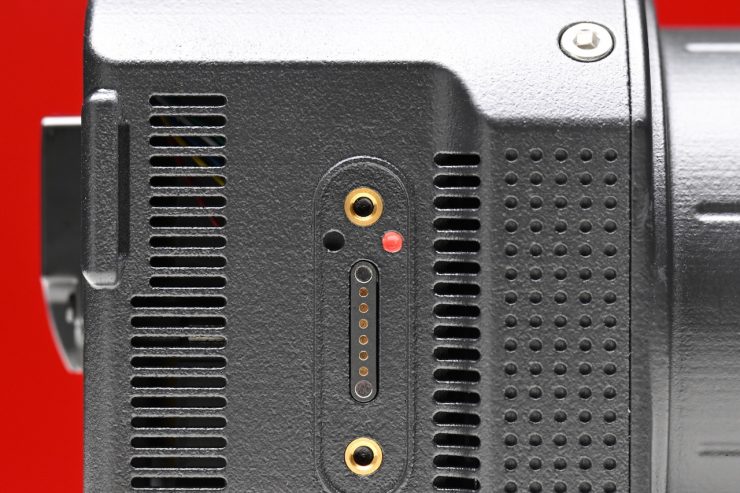
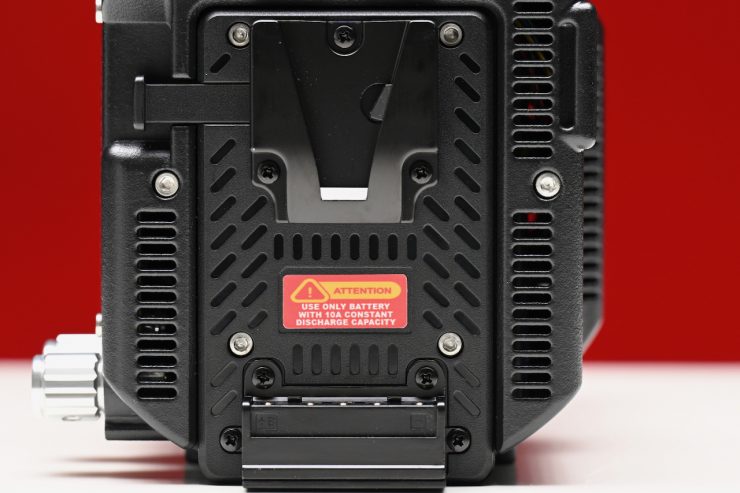
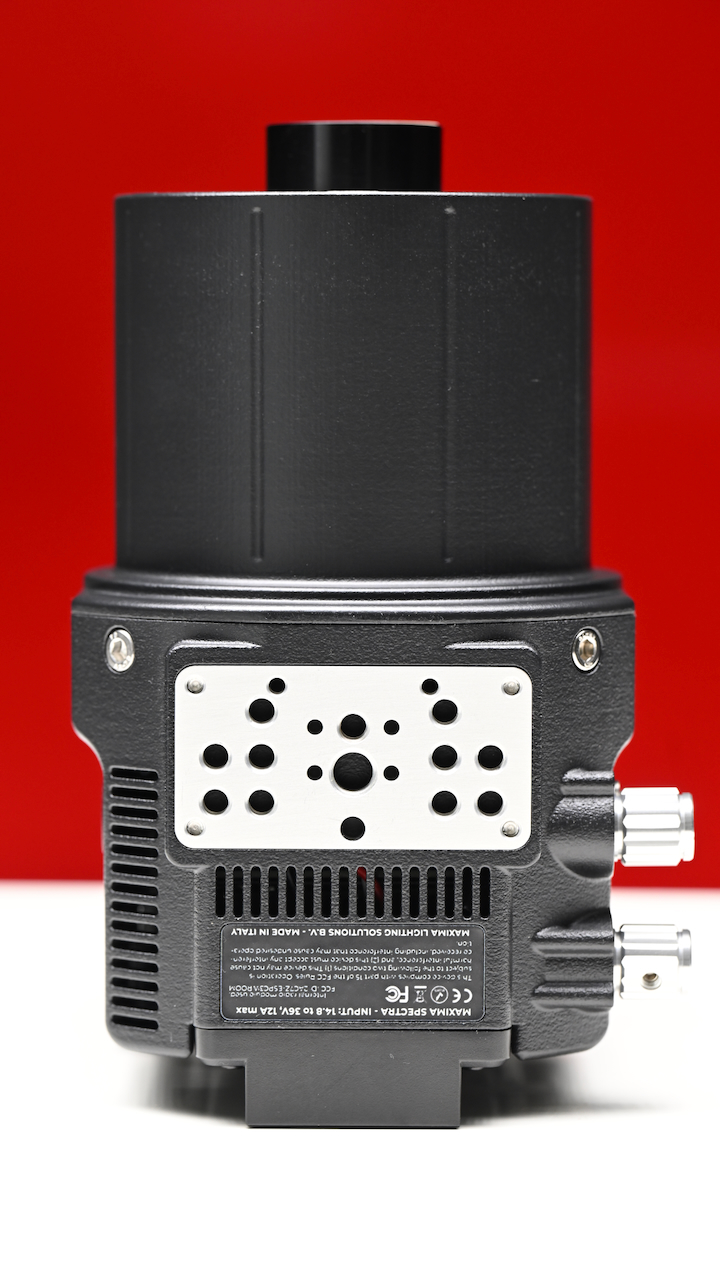
Just like the Maxima 3 and Maxima 6 GaN, the build quality of the Spectra is extremely good. It has a very industrial feel to it, and the entire light is manufactured in Acqualagna PU, Italy. The only component that doesn’t come from Italy is the LEDs, which come from Japan.
The benefit of making almost everything in-house is that you aren’t relying on other companies and supply chains. This gives you greater control over your product when it comes to quality control, and you aren’t waiting on stock to come out of some other country.
Every Maxima fixture, including the Spectra, is hand-built from start to finish by a single engineer.
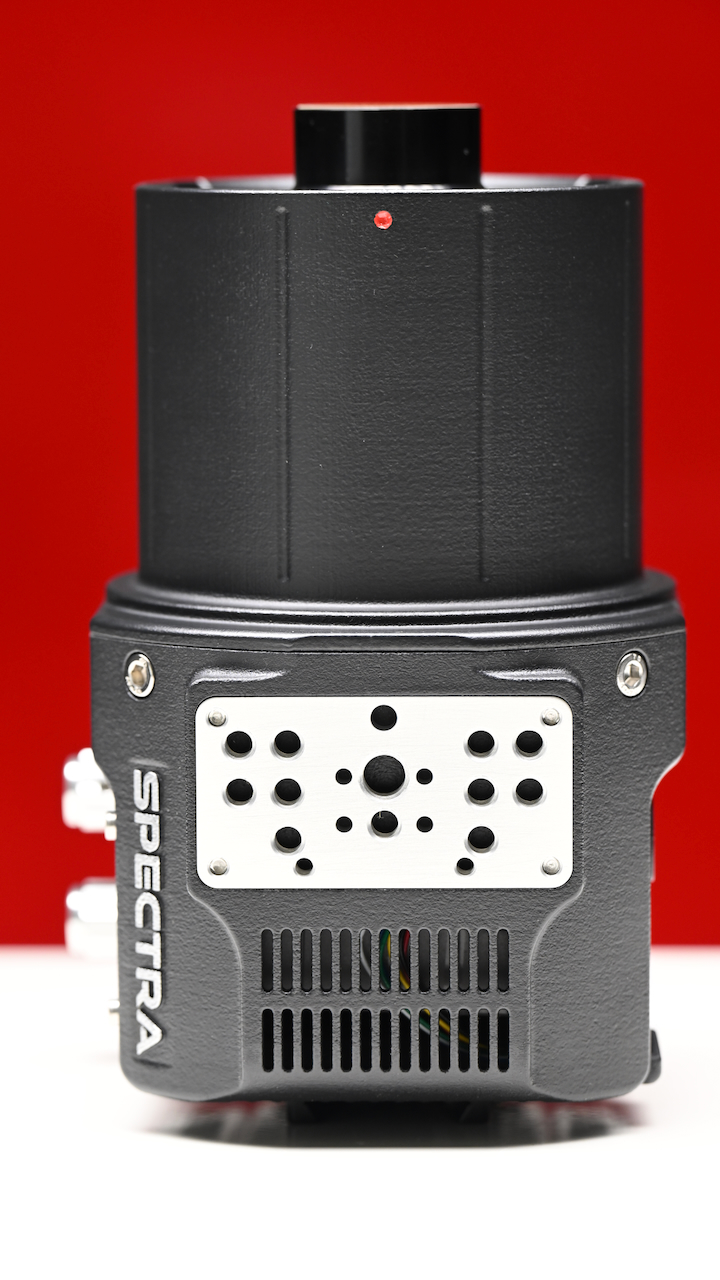
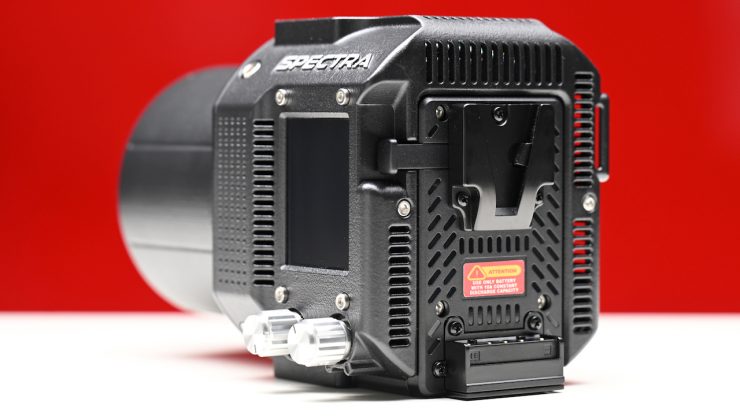
The overall build quality of the Spectra is very good and there wasn’t anything I came across that concerned me.
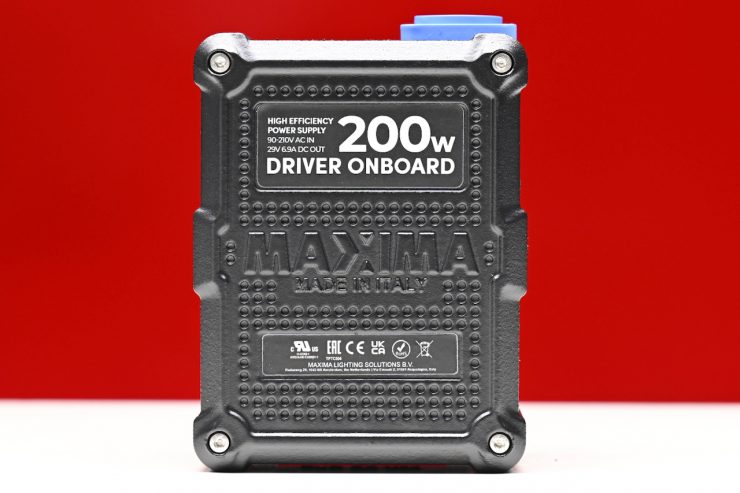
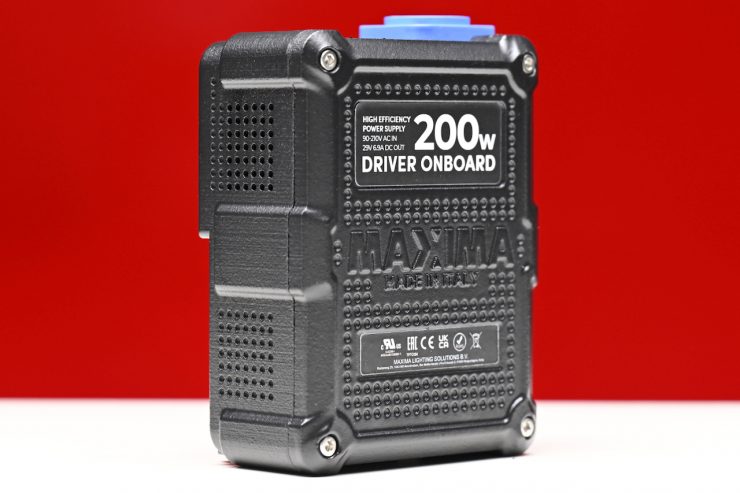
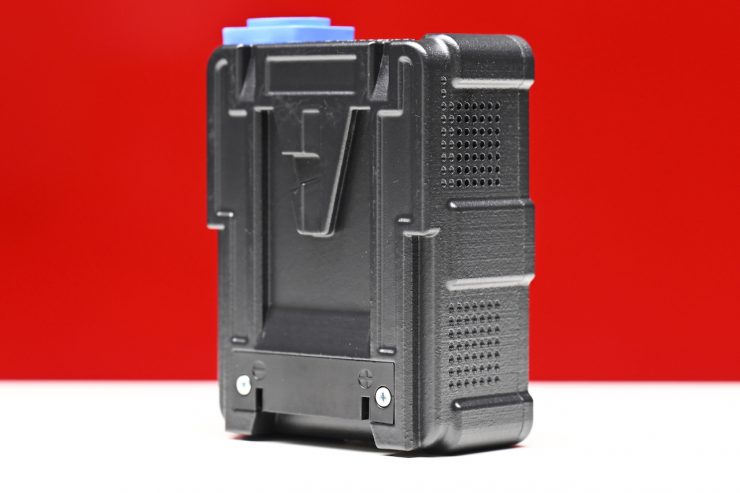
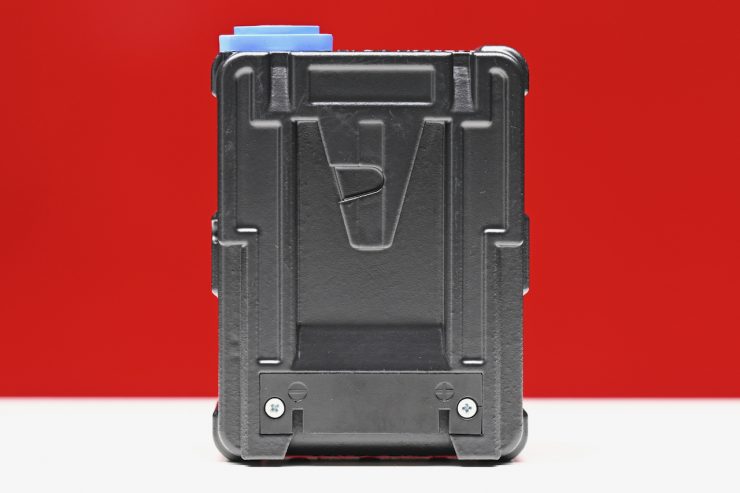
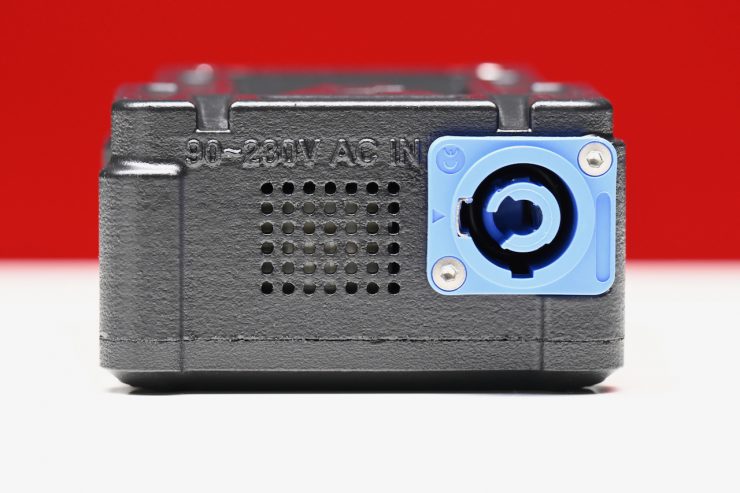
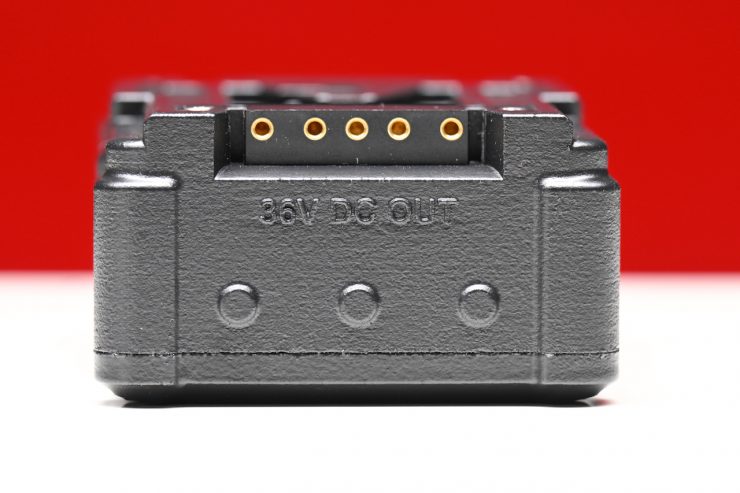
The power supply is nicely made, and Maxima has managed to keep it very lightweight.
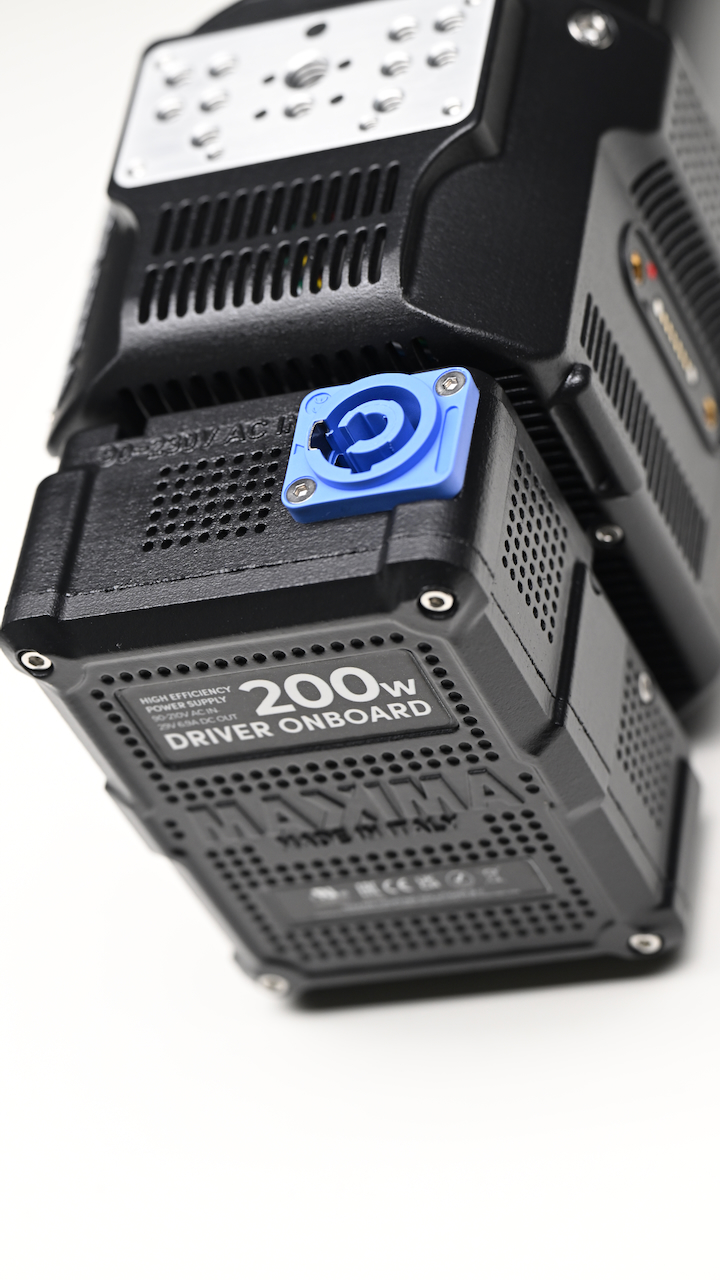
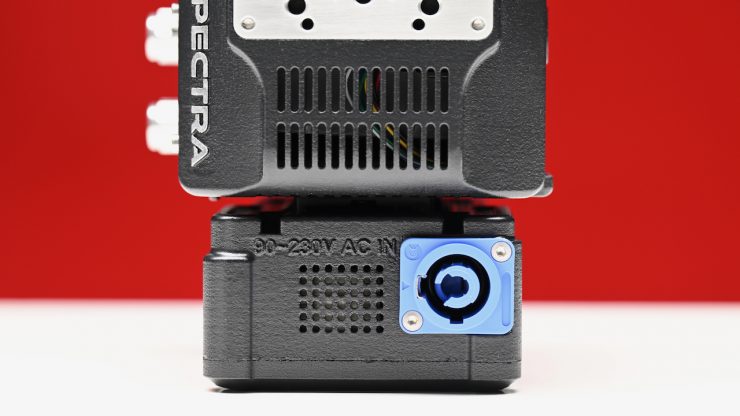
It attaches to the Spectra with no wobble or movement, and it is easy to put on or remove.
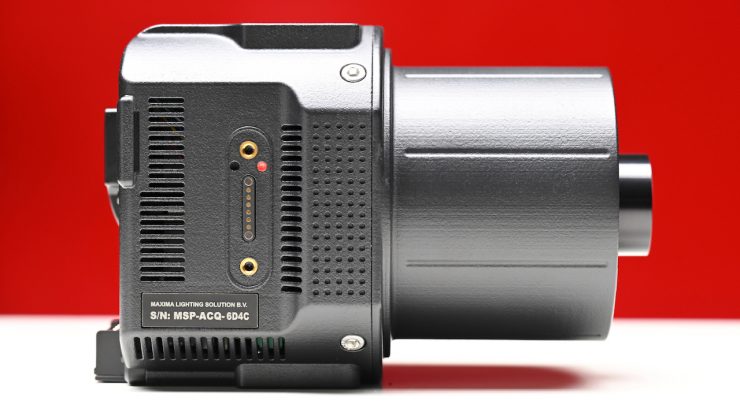
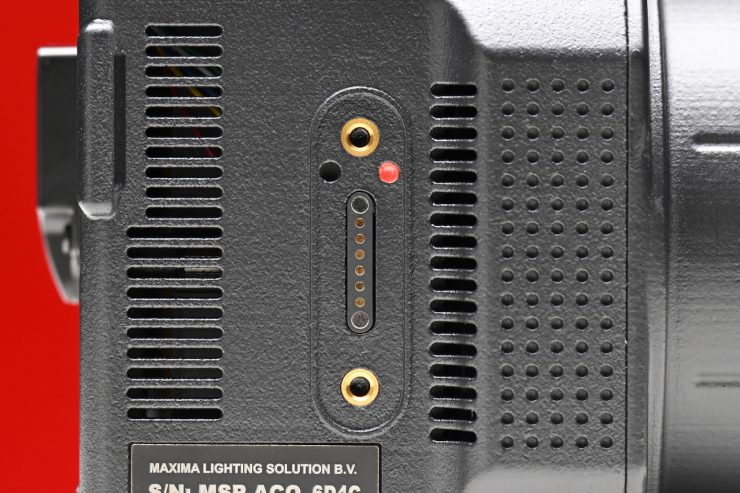
You may have noticed a strange-looking connector on the side of the Spectra and wondered what it was for. This is for attaching optional modules, including an upcoming DMX unit.
The nice aspect of the Spectra, as I mentioned earlier, is that it is a self-contained unit, albeit with a power supply that attaches to the fixture. There is no separate controller or power supply that you have to tangle with. As the fixture isn’t very heavy, you can use it with lightweight lighting stands, which is a big help, especially if you are traveling. It also makes the setup a lot quicker because you aren’t attaching multiple cables.
Power Draw
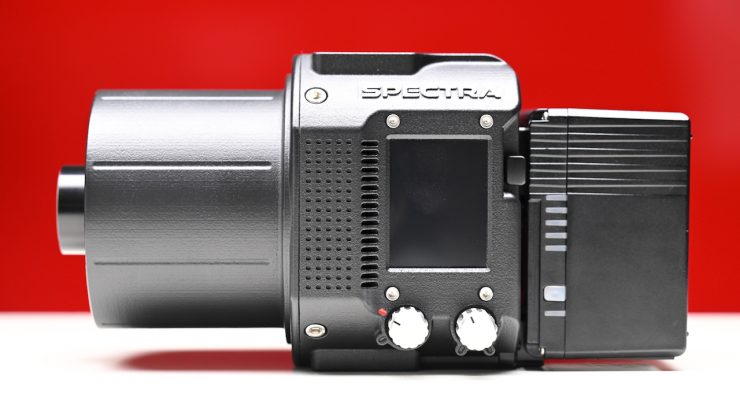
The Maxima Spectra draws a maximum of 200W. It is almost strange that we keep talking about lights based on their power draw because all it essentially means is how much power is being drawn by that particular fixture. The power draw is never directly correlated with how much output or how efficient a fixture is.
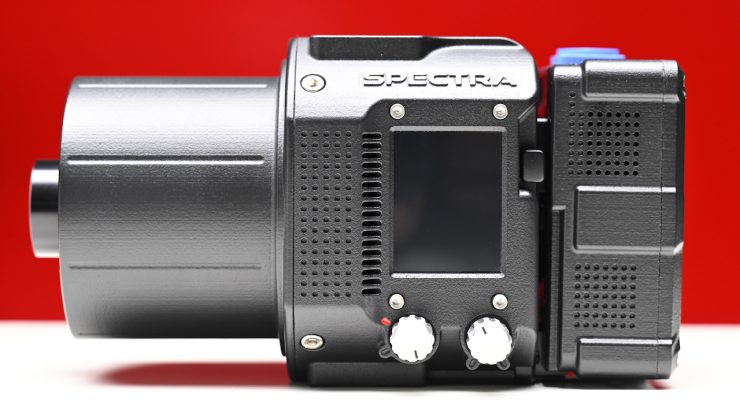
The Spectra has a power supply that attaches directly to the V-mount plate on the fixture. You then just attach the power cable. If you want to power it remotely, you just remove the power supply and attach a battery; it’s as simple as that.
What is nice about the Maxima Spectra is that you can use flight-safe batteries, and it will still run at a reduced output.
So how does the power draw compare to some other fixtures that could be considered competition?
| POWER DRAW | |
| Maxima Spectra | 200W |
| amaran Halo 200x Bi-Color LED Monolight | 200W |
| GVM Pro SD200B Bi-Color LED Monolight (200W) | 200W |
| Zhiyun Molus X200 Bi-Color COB LED Light | 209W |
| Zhiyun MOLUS G200 Bi-Color LED Monolight | 320W |
| SmallRig RC 220B Pro Bi-Color LED Monolight | 220W |
| Genaray GXS-200BI 230W Bi-Color Monolight | 230W |
Controls & Operating Modes
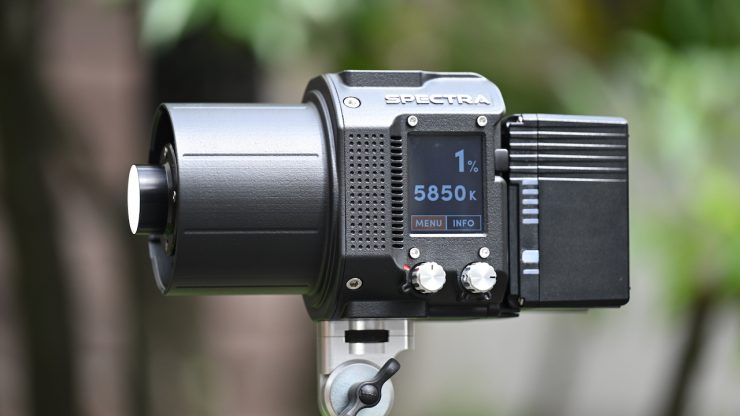
Unlike previous Maxima fixtures, the Spectra has an integrated LCD display, which is good to see. Even with the addition of the screen, Maxima has continued with their philosophy of making its lights simplistic and easy to use. Because this is a Bi-color fixture, you don’t need to have a lot of complicated menus or operating modes like you would with an RGBWW fixture.
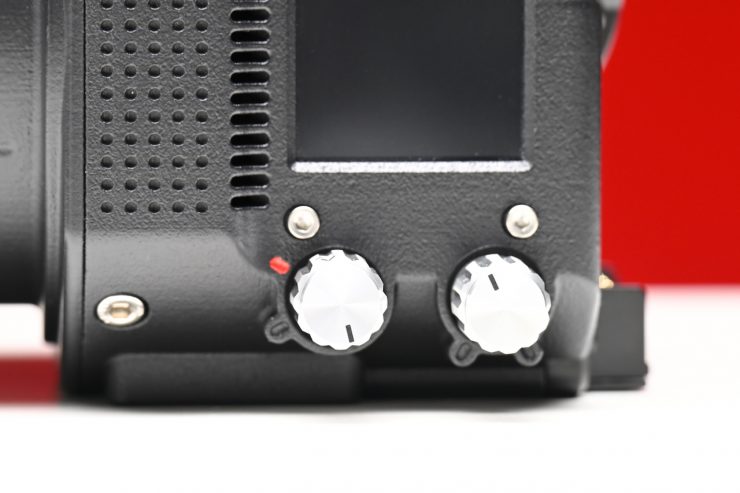
There is a CCT dial and a Dimming dial. To turn the light On/Off you turn the Dimming dial until you hear a click. It is Italian simplicity. Sometimes there is no need to make anything more complicated than it needs to be.
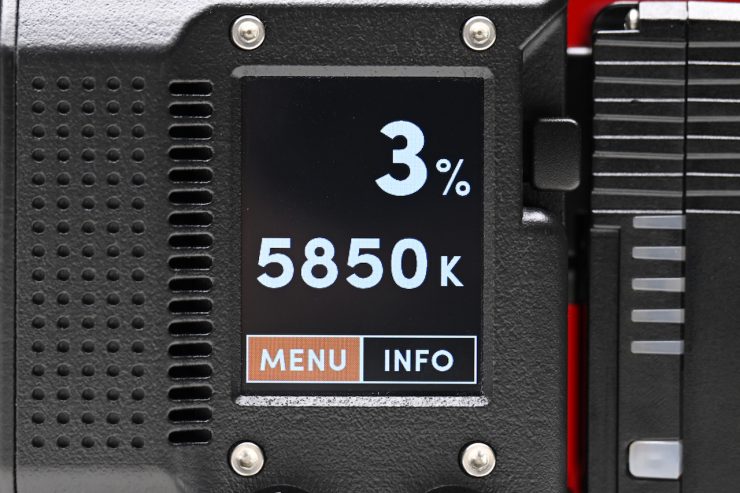
The touchscreen is very responsive and easy to use. It clearly shows you the dimming and CCT settings.
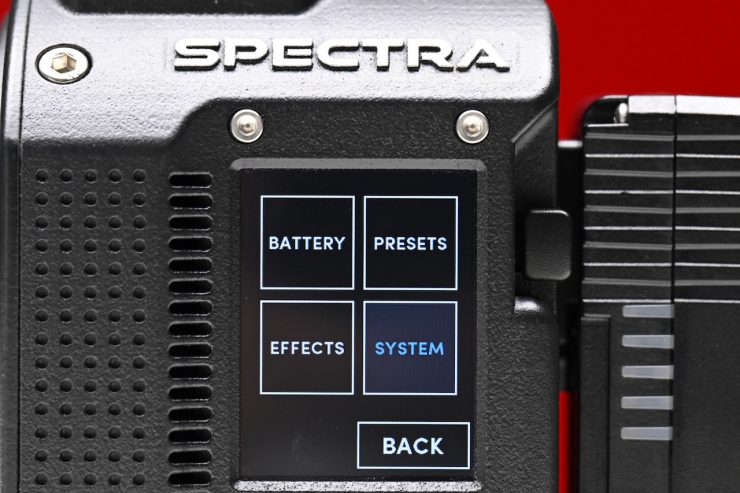
When you press the Menu icon on the screen, you get the following choices:
- Battery
- Presets
- Effects
- System
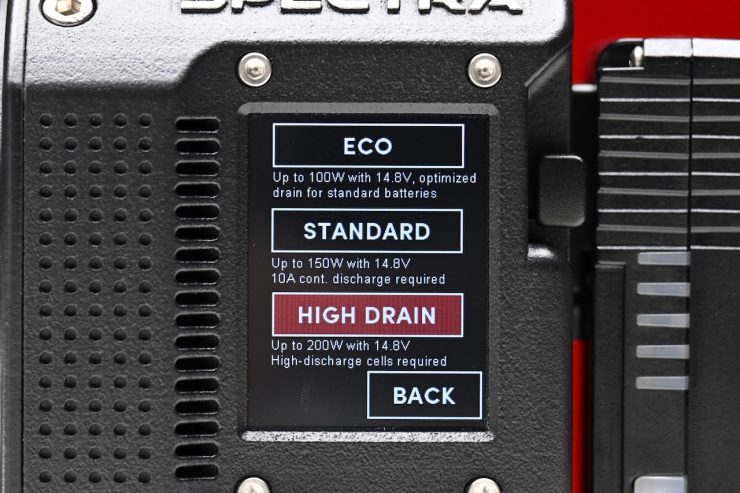
In Battery, you can choose from Eco, Standard, or High Drain. In Eco, it will support 14.8V batteries up to 100W. In Standard, it will support 14.8V batteries at up to `150W as long as they can supply 10A. In High Drain, it can support batteries up to 200W.
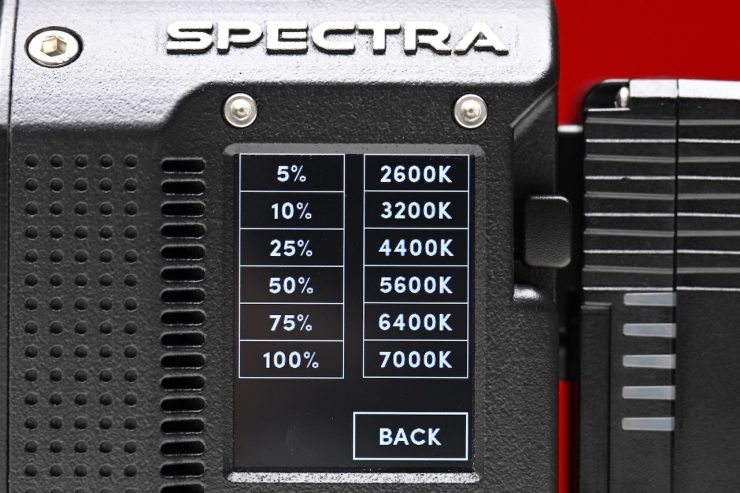
In Presets, you can select from various combinations of dimming levels and CCT values, which is handy.
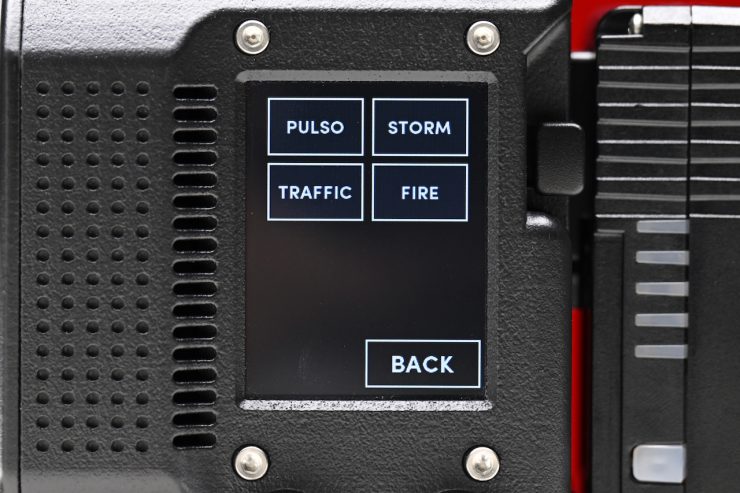
In Effects, you can choose from Pulso, Storm, Traffic, or Fire. You can also adjust their parameters.
In System, you can choose from Display, Dock, and Update options.
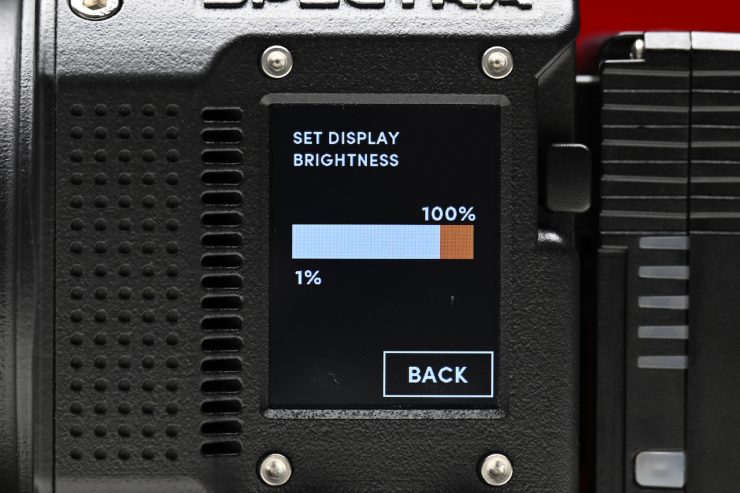
In Display, you can set the display brightness from 1% to 100%.
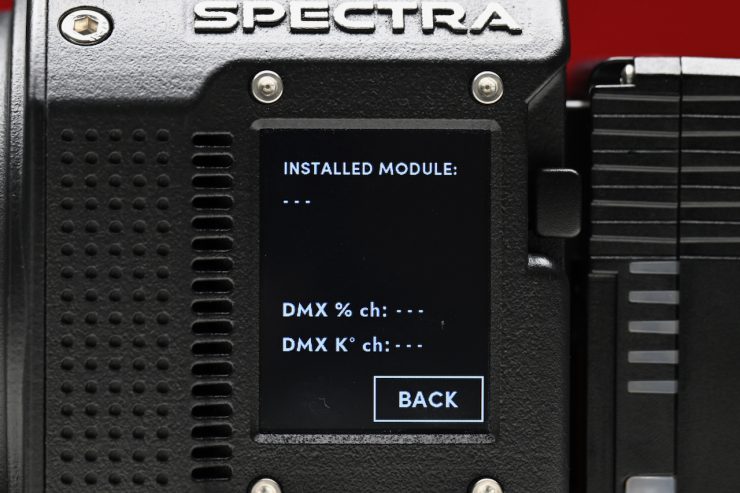
In Dock, you can choose the DMX settings. Please note that the module that allows you to do this doesn’t come as standard with the light.
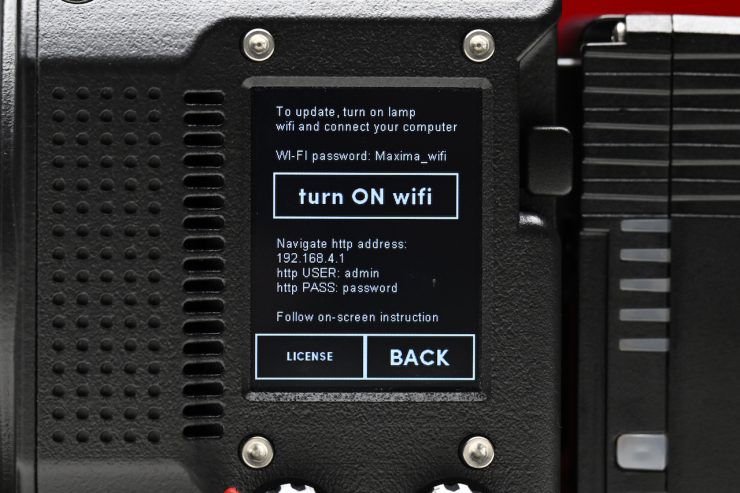
In Update, you can turn on WiFi that allows you to connect the fixture directly to your computer to do firmware updates, etc.
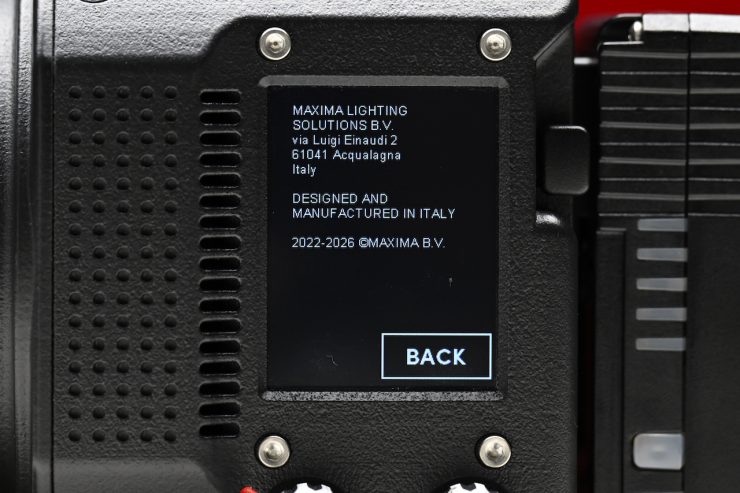
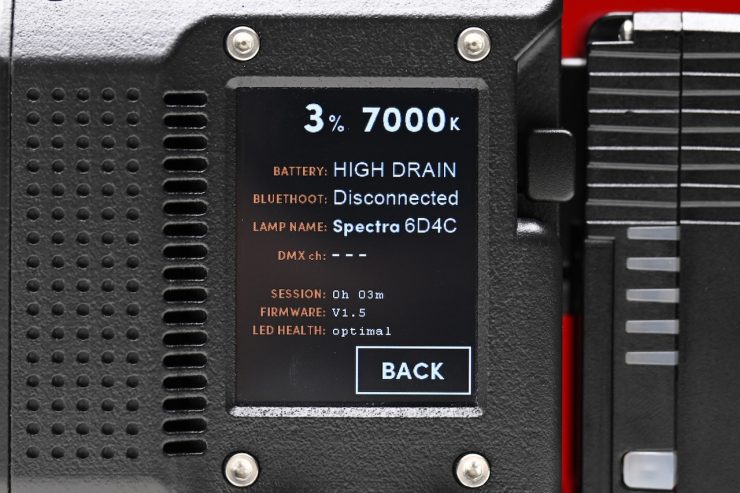
You can also see additional information about the fixture.
How loud is it?
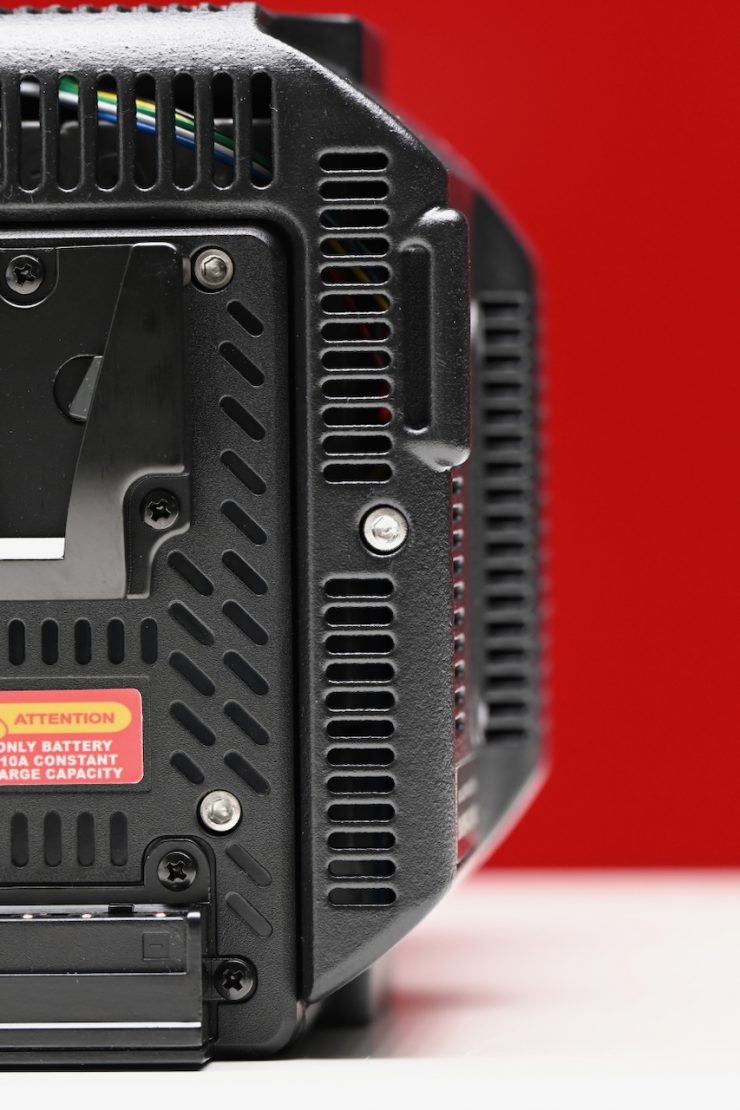
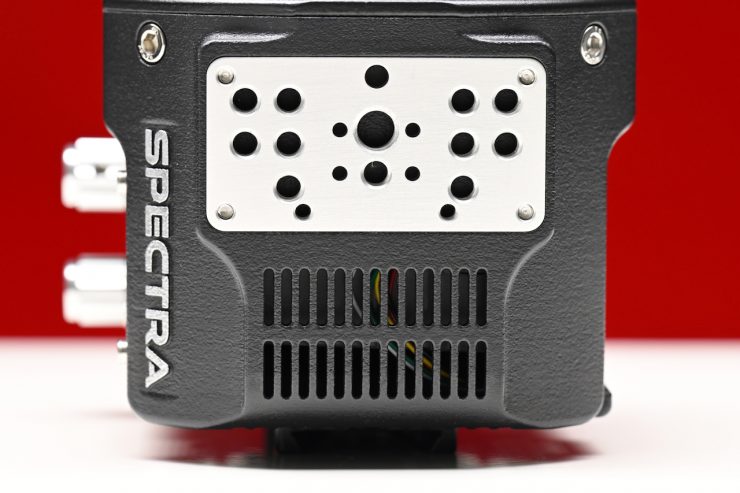
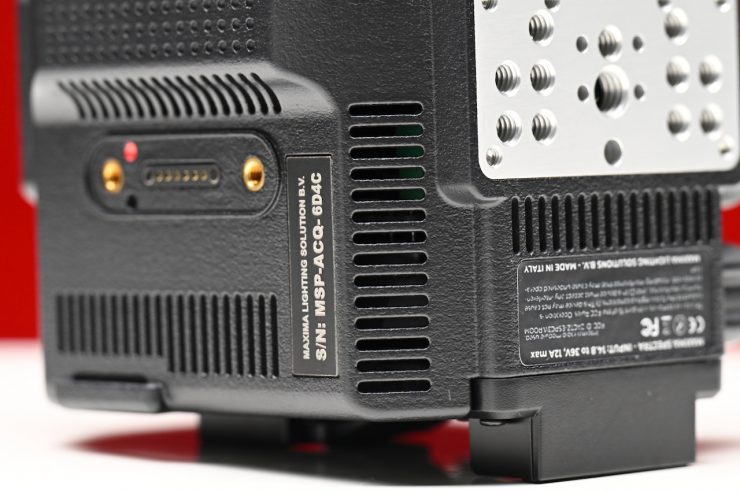
The Spectra does feature an in-built fan and plenty of cooling vents. There are no fan controls available.
I did a few tests to see how much noise the Maxima Spectra generated at a distance of 3m / 9.84′.
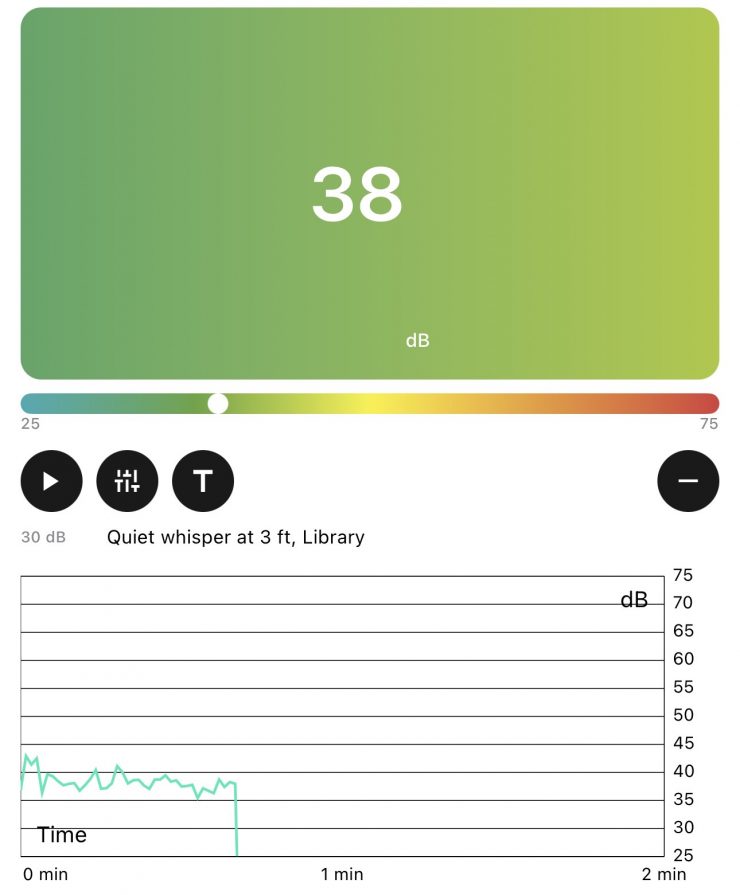
Above, you can see some measurements I took with the light operating at 100% output.
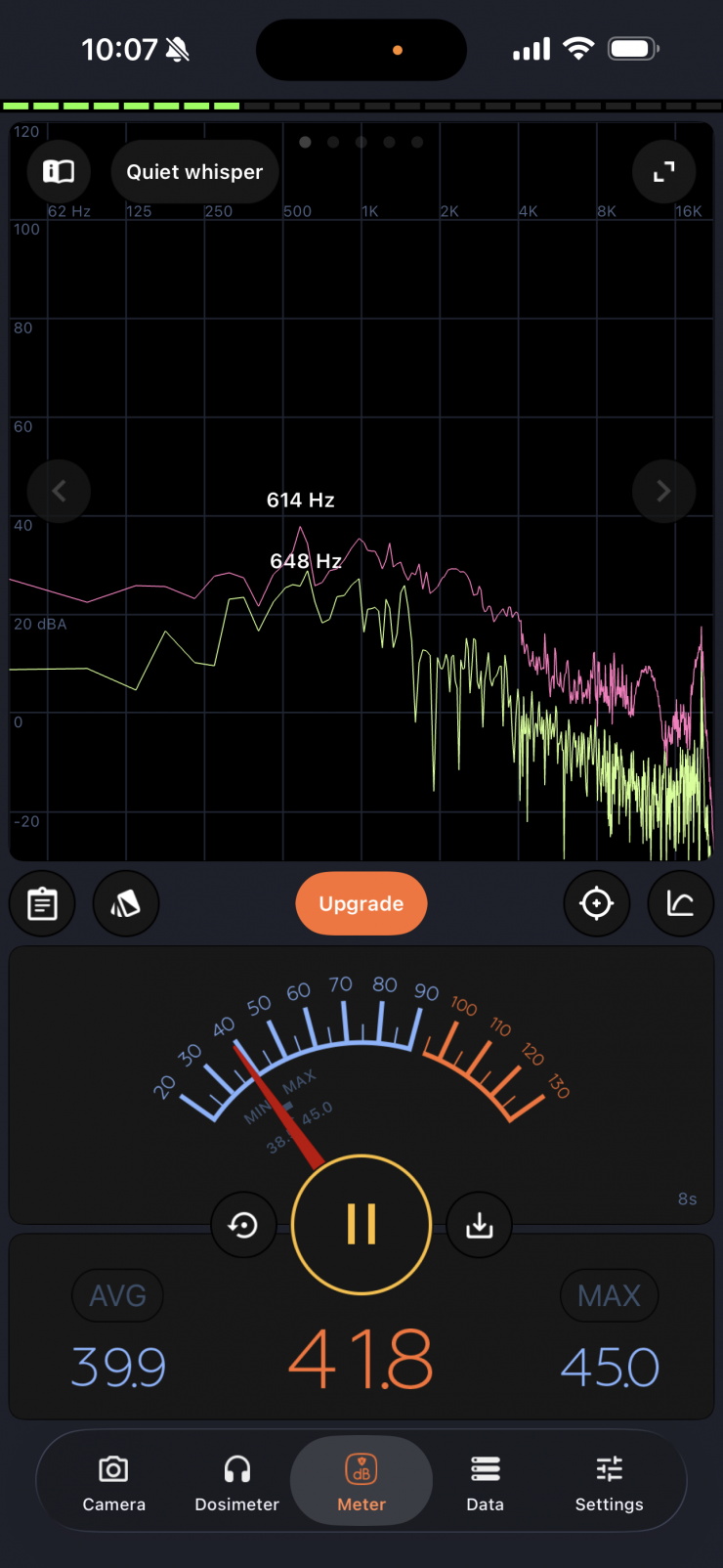
I also decided to leave it on for an extended period of time at 100% output when running on mains power in a temperature of around 26 degrees Celsius and do another fan noise test. As you have no ability to control the fan speed, it does get louder when left on for a reasonable length of time at full output. You really need to put it down to under about 75% to make it quieter.
Not being able to control the fan means you can’t plan for how loud it will be. If you are using it at 100%, it might be fairly low at the start, but then it will get louder, which is something you need to consider carefully. If the light is running at 100% output, you don’t want it to be close to where critical audio is being recorded.
Maxima Control iOS & Android App
If you want, you can use the free Maxima Control app that is available for iOS and Android devices. This app gives you full wireless control over the fixture.
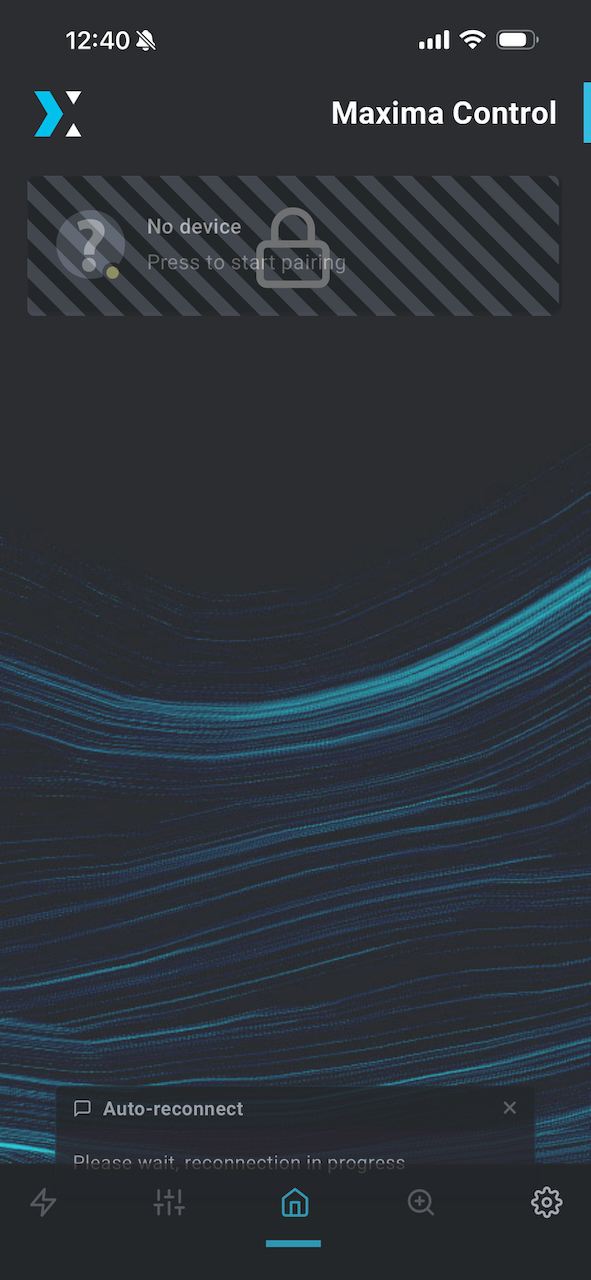
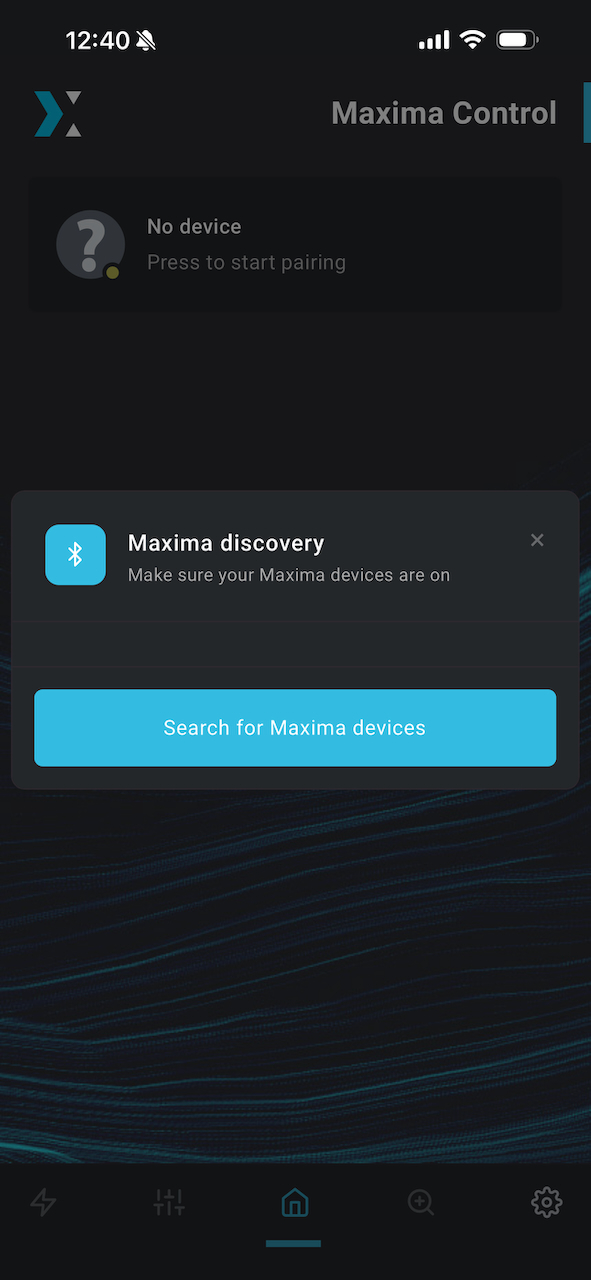
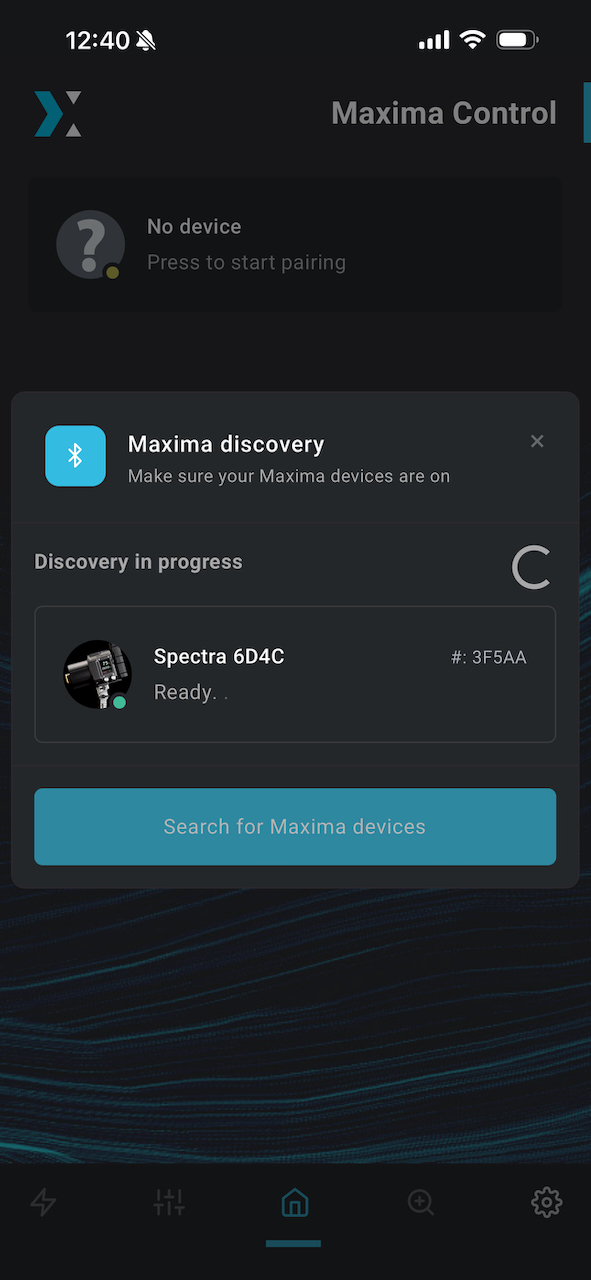
The app is reasonably straightforward to use and operate. Set up and pairing are extremely quick. All you need to do is turn the light on, open the app, select the fixture, and that’s it.
There are several different pages that you can access in the app.
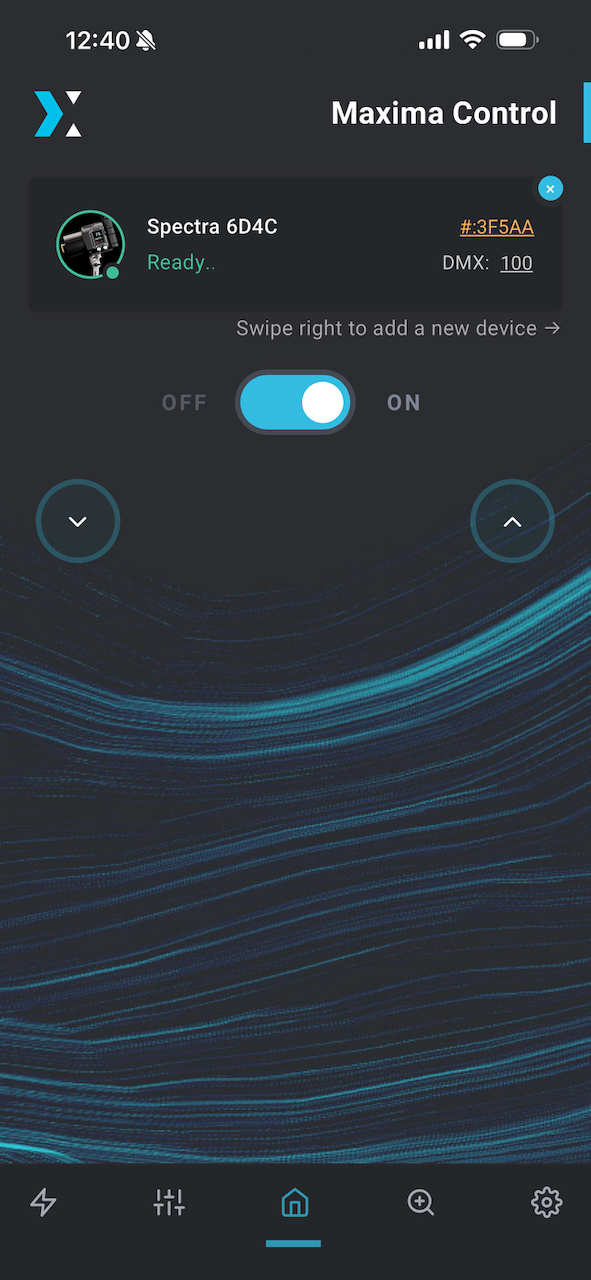
The Maxima Control Home page lets you turn the fixture On/Off, switch between the three different operating modes, and go into a settings and help page.
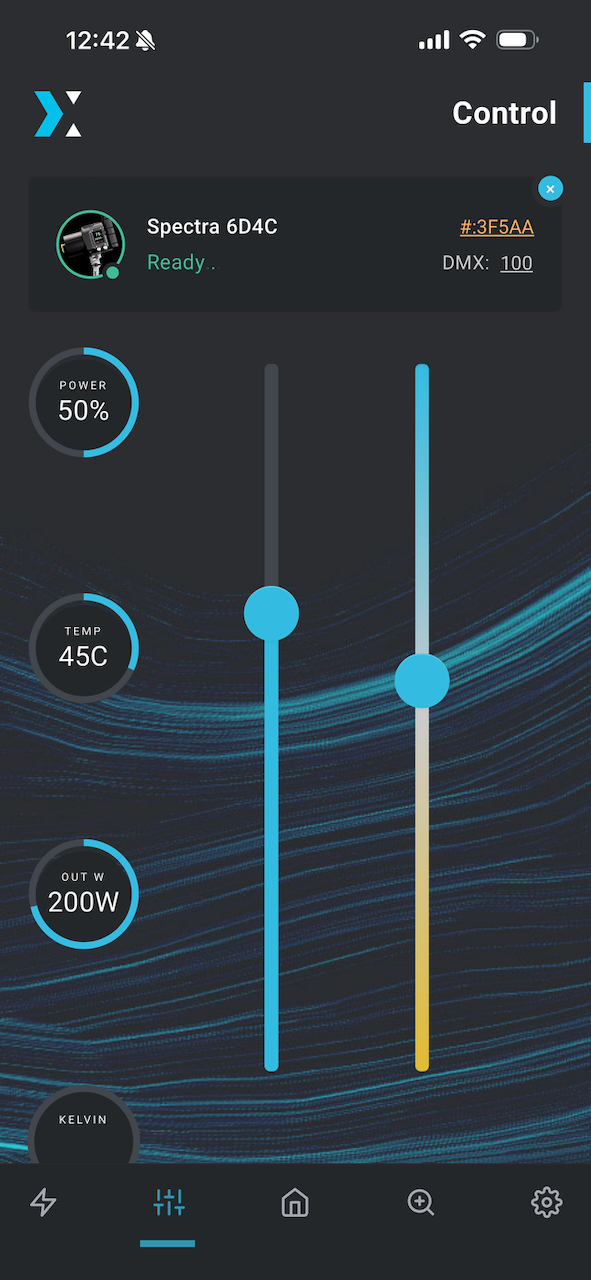
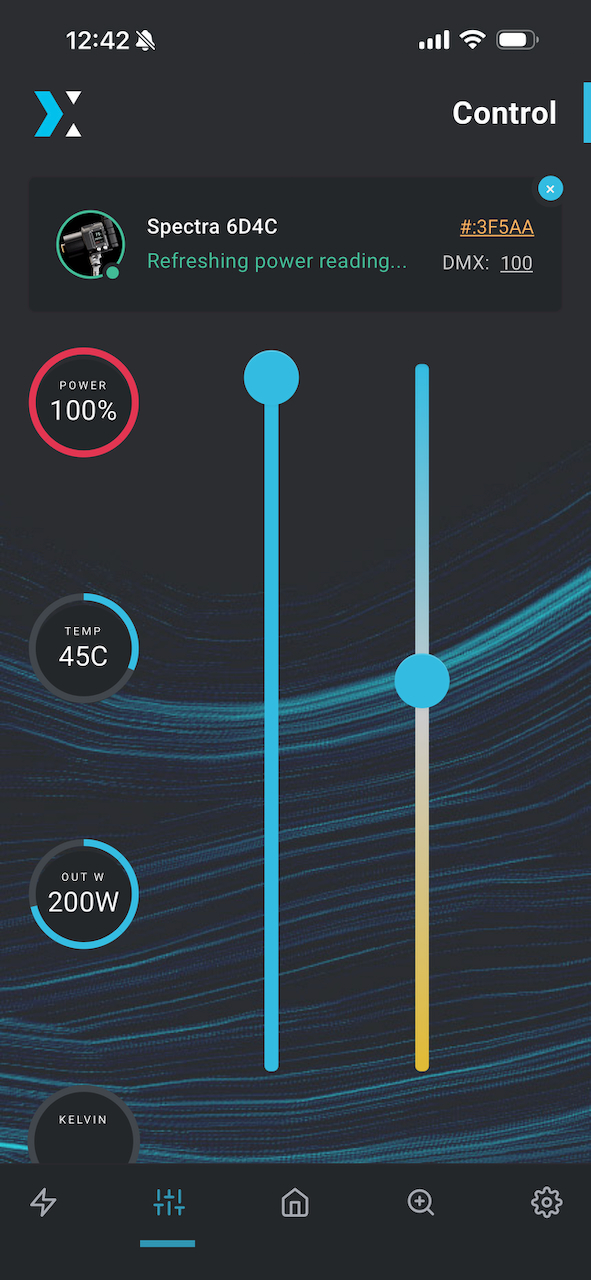
On the Control page, you will see simple sliders for adjusting the intensity and CCT. You can also see the temperature and output draw of the fixture.
I would have liked to have seen some preset intensity buttons so you could quickly move the light between various settings, such as 25%/50%/75%, etc. There are also no battery settings available.
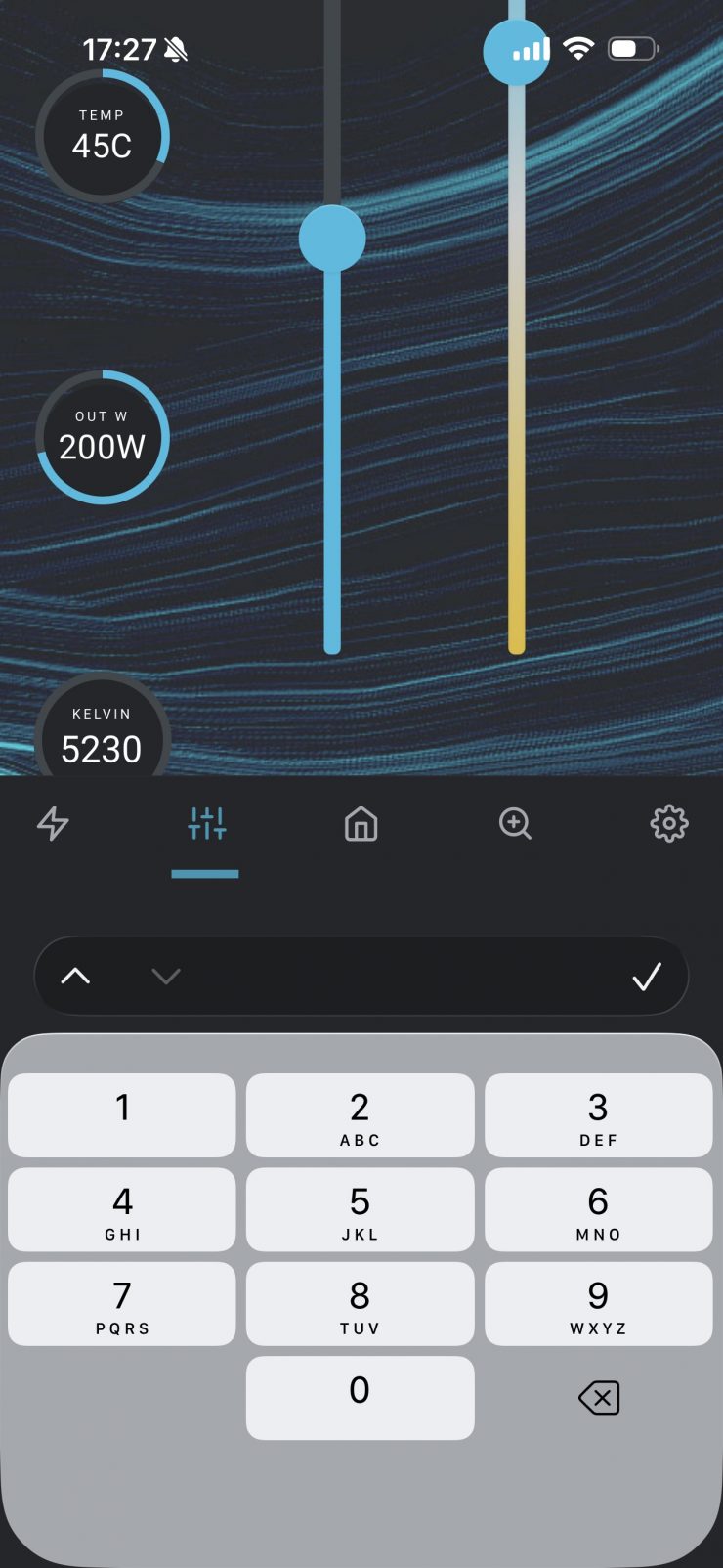
While you can manually enter a CCT, you can’t do the same for the intensity, and this does make it hard to set an exact value.
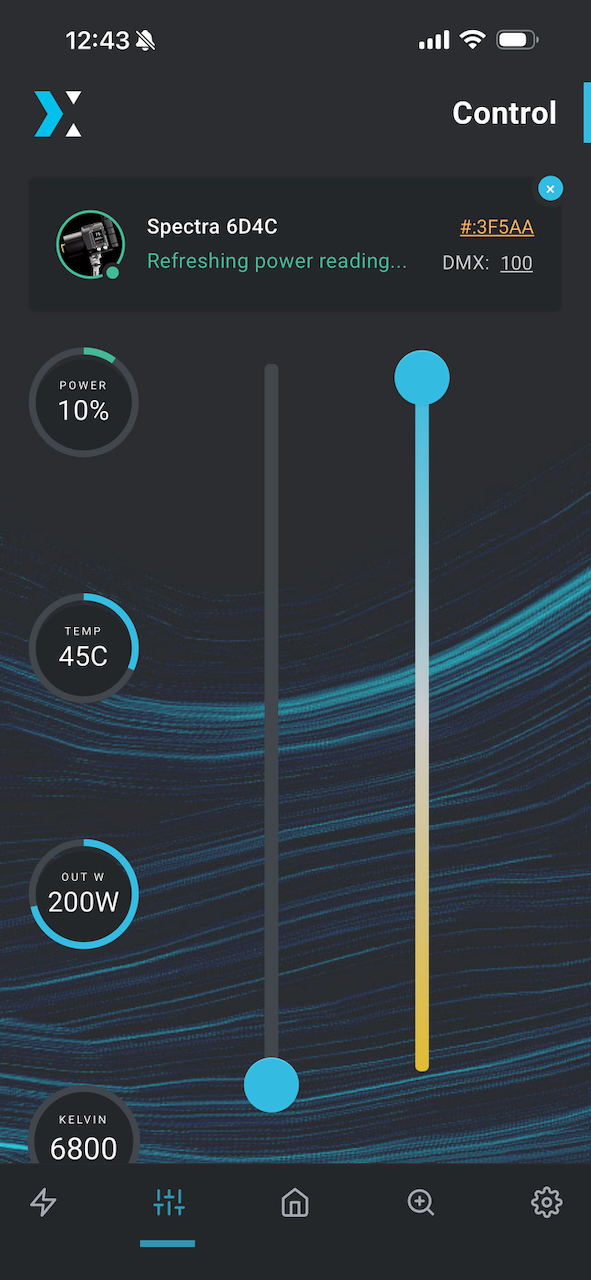
An issue I also encountered was that when using the app, you could only set the CCT as high as 6800K, even though the Spectra goes up to 7000K. You also couldn’t seem to set the dimming level to anything below 10%.
With a good app, you should be able to have all of the same access and controls as you do on the fixture itself.
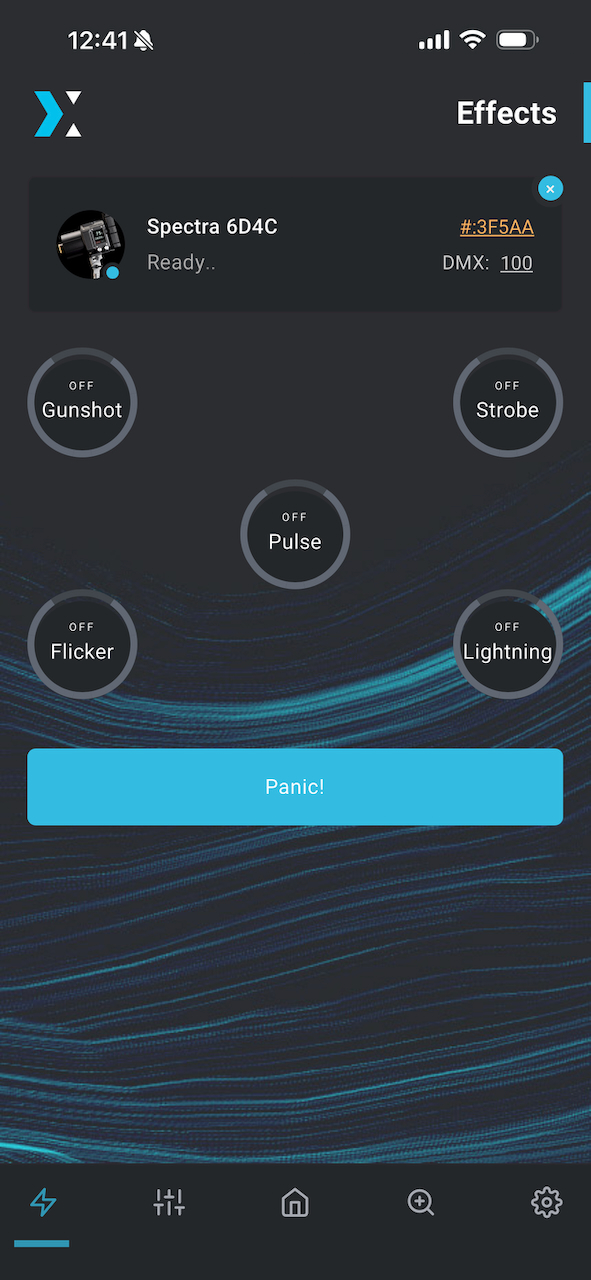
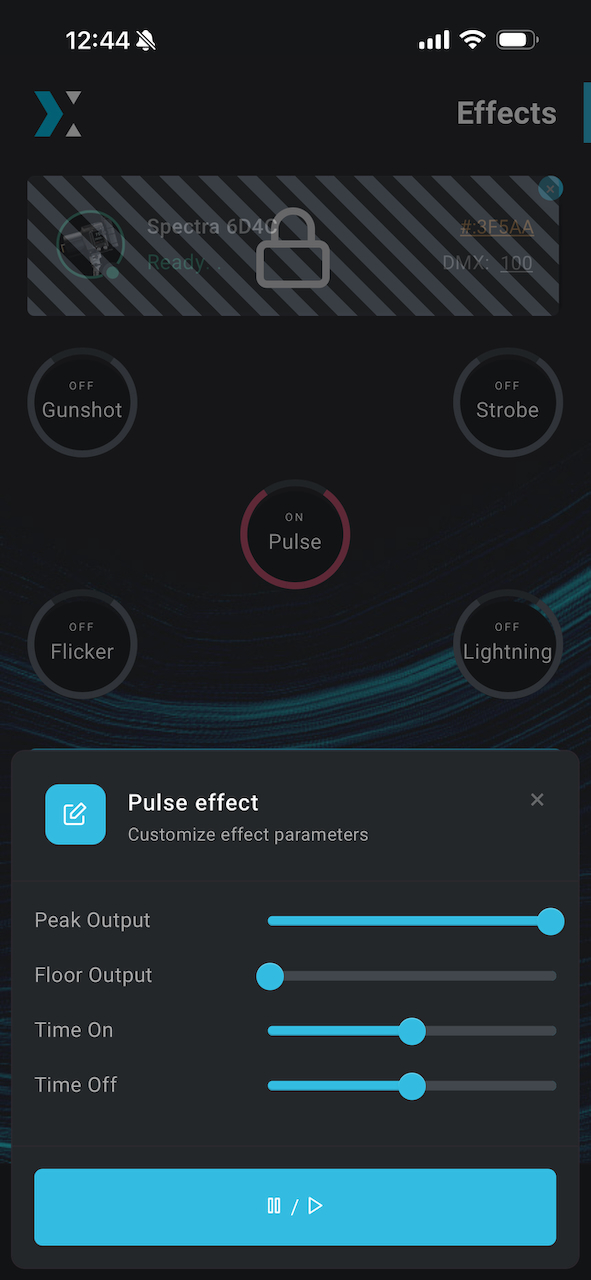
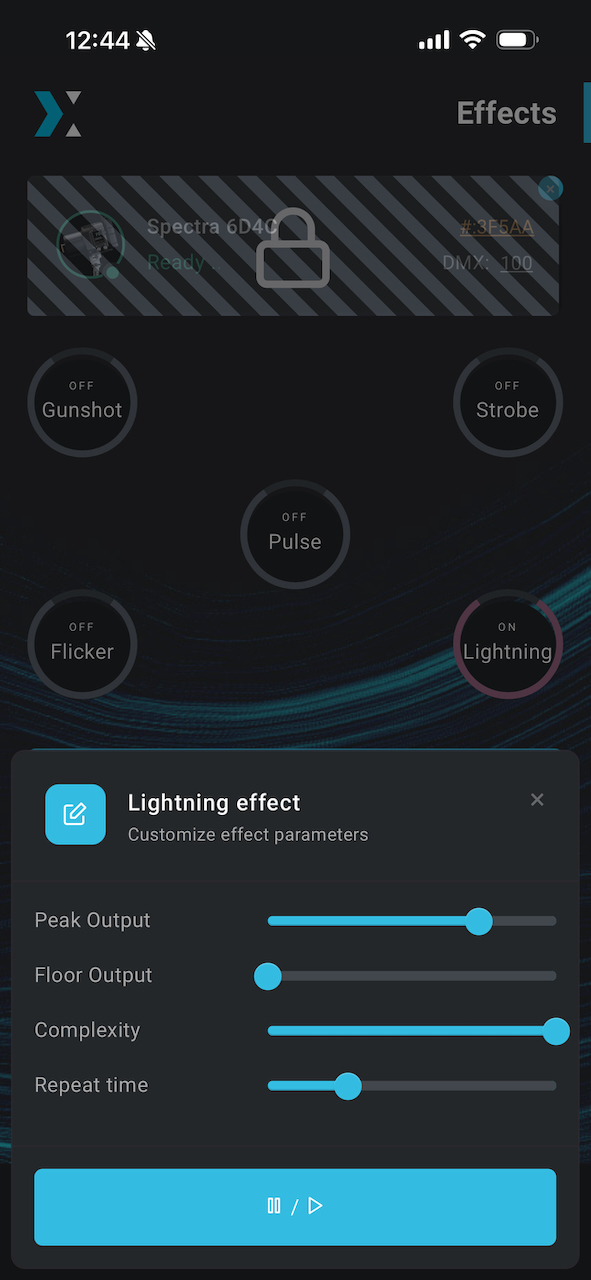
On the Effects page, you can choose from several different effects, which can all be individually adjusted.
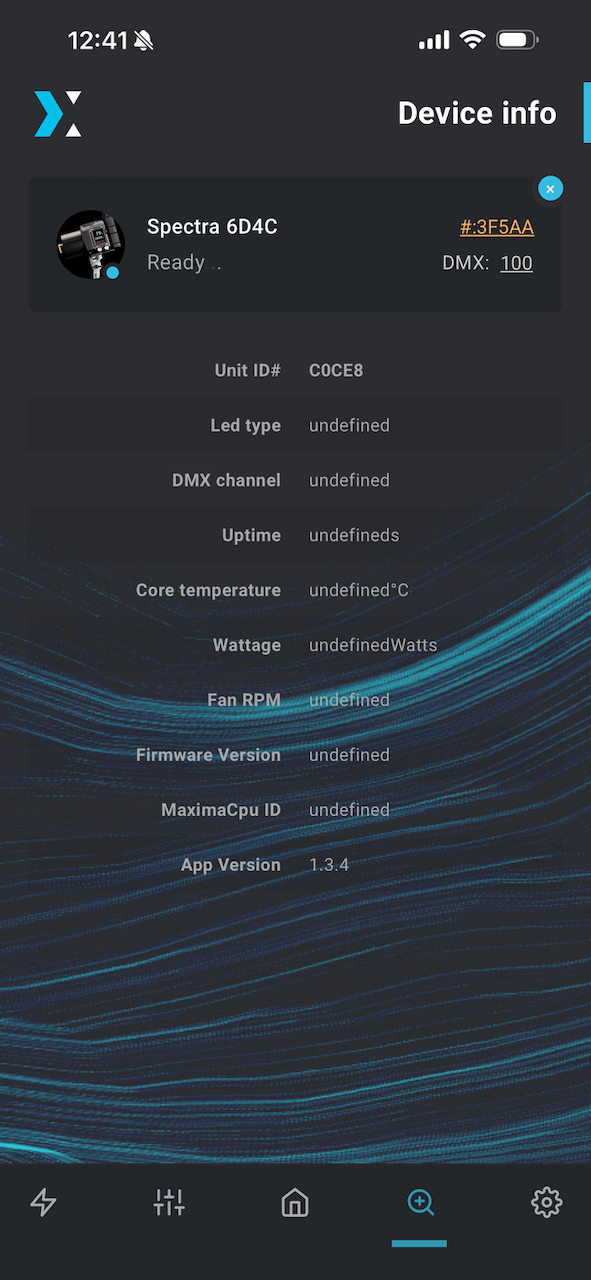
On the Device Info page, you can see the status of the light and what firmware version it is running, etc.
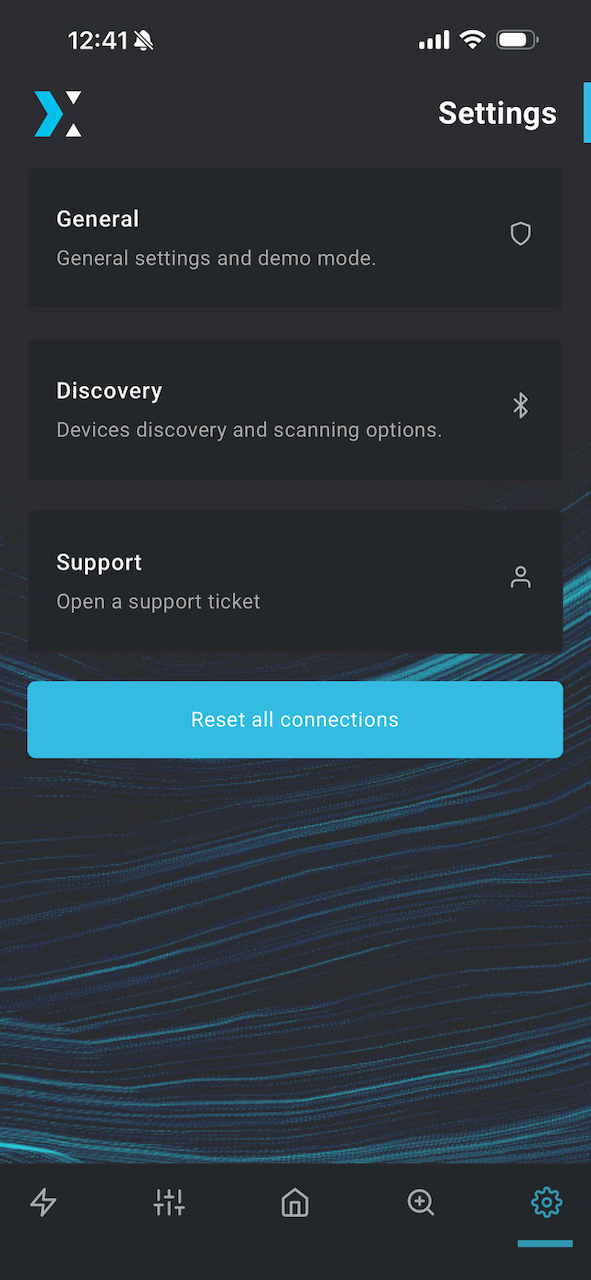
On the Settings page, you can choose to turn On/Off Auto-reconnect, put the light in Demo mode, and even open a Support ticket if you have an issue with the light.
The app works reasonably well, and it is easy and reliable to use, but there is certainly room for some further improvement.
Maximum accuracy for excellent reproductions

Light is fundamental to both art and photography. Artists, collectors, and experts understand the crucial role of light in faithfully rendering works for viewing or reproduction. High color rendition is essential for assessing the colors of materials and artworks accurately. Light with a broad color spectrum allows for vibrant, precise, and detailed representation, ensuring fidelity, enhancing shadow details, and providing stability—all of which contribute to the appreciation of the original piece.
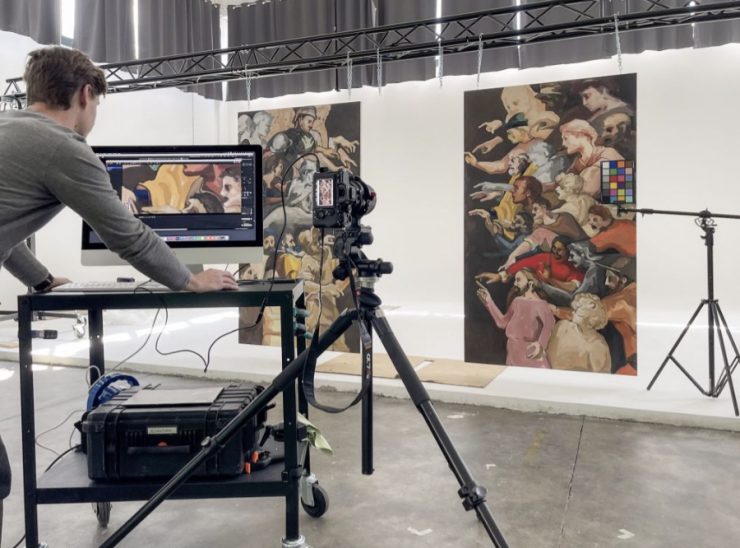
From its inception, Maxima has focused on achieving the most precise color rendition and fidelity, also collaborating with experts and independent laboratories to ensure the highest levels of accuracy and precision. Maxima Fixtures are now being used by many renowned museums and galleries across various applications.
Photometrics
So now let’s get to the photometric results. I always test lights in this way so that I get a reference for how they compare to other fixtures. Results only tell part of the story and should never be used alone to judge a light. I have found from extensive testing over the years that certain lights that have good photometric results don’t always look good, and lights that have worse photometric scores can sometimes look better than their results indicate.
You need to look at a whole series of photometric tests to come to a conclusion. You can’t make an accurate assessment by looking at one individual test. You wouldn’t just read one chapter in a book and know the entire story, so don’t do it with light results either!
Output & CCT Accuracy
I tested the Maxima Spectra using a Sekonic C-800 Spectrometer to find out how much output the light had and how accurate the CCT reproduction was.
So let’s see my independent testing results. All my readings were taken at a distance of 1m / 3.3′ in a controlled environment. I do all my testing using the same parameters so I can directly compare other lights. My figures are not going to replicate the manufacturer’s quoted figures because of the difference in testing methods. Also, because I am in Japan and the voltage is 100V, the figures I am getting, in theory, should be about 10% less because the light isn’t running on 230V power like it was when it was tested by the manufacturer.
Maxima Spectra 5600K 90° Mains Power
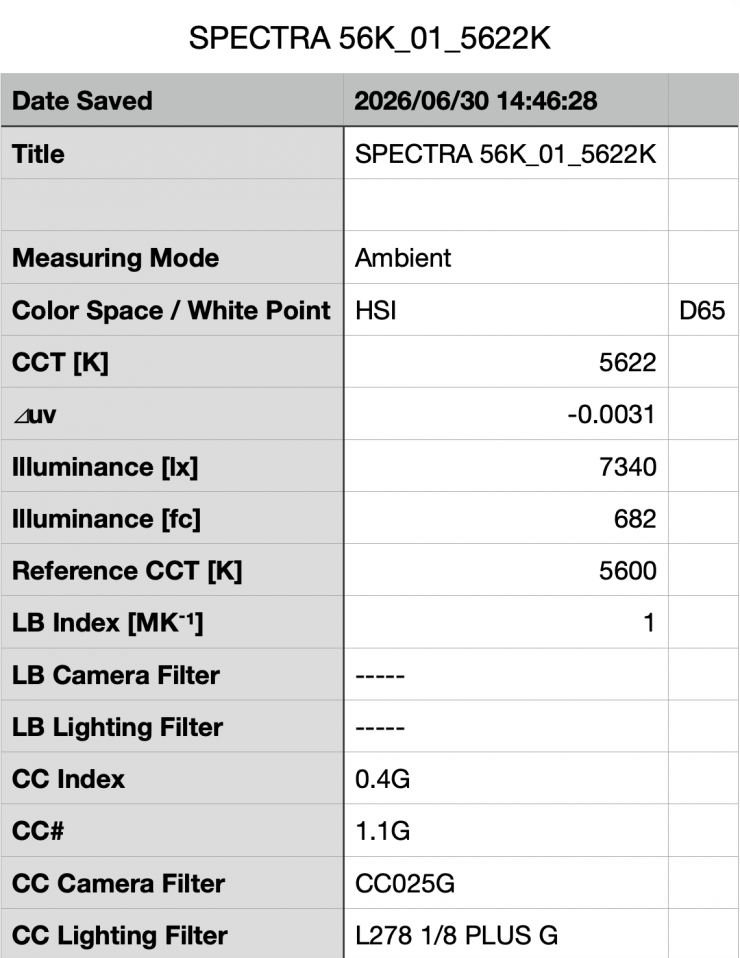
Above you can see the Maxima Spectra recorded an output of 7340 lx (682 fc) without any lighting modifiers attached to it at a distance of 1m / 3.3′ when run via mains power.
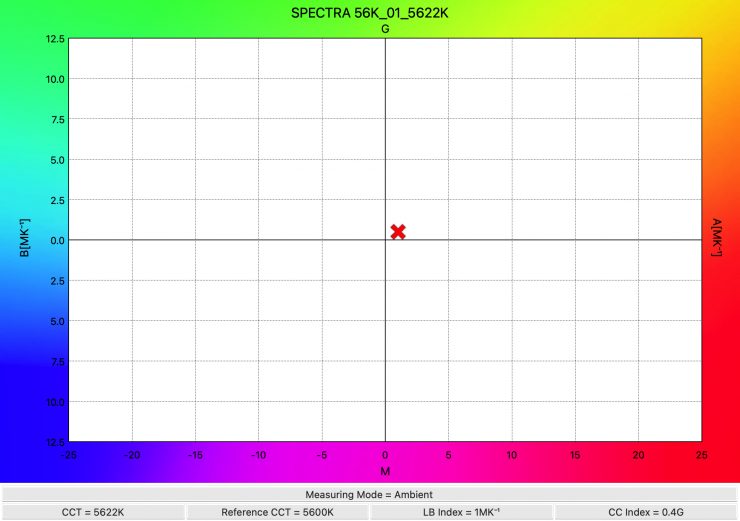
The light recorded a CCT reading of 5622K, which was an excellent result.
Maxima Spectra 3200K 90° Mains Power
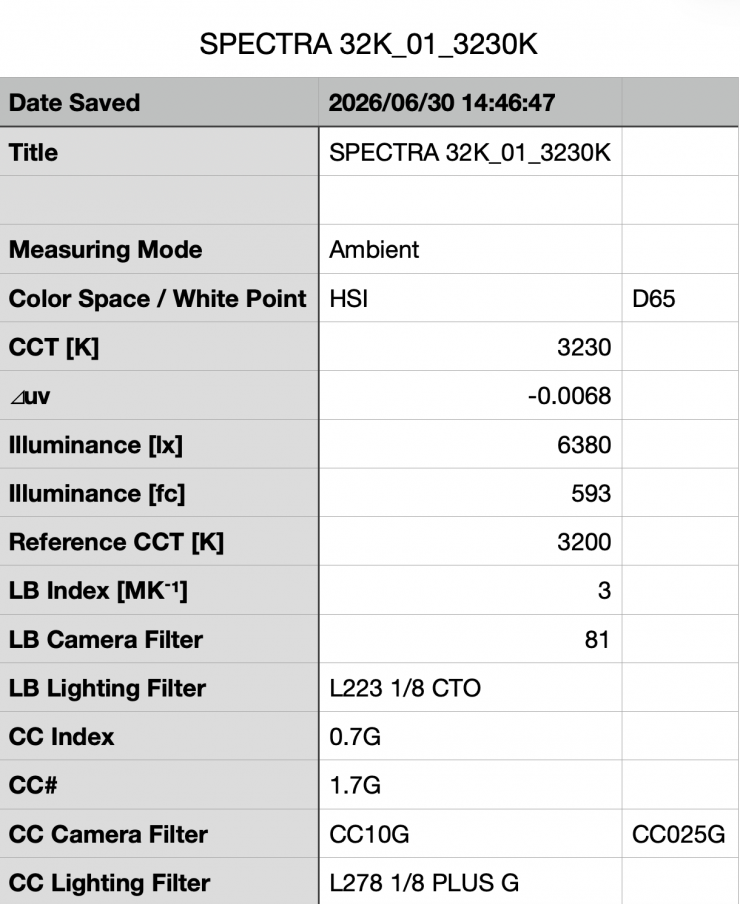
Above you can see the Maxima Spectra recorded an output of 6380 lx (593 fc) when set at 3200K without any lighting modifiers attached to it at a distance of 1m / 3.3′ when run via mains power. This was 13.07% less than the output at 5600K.
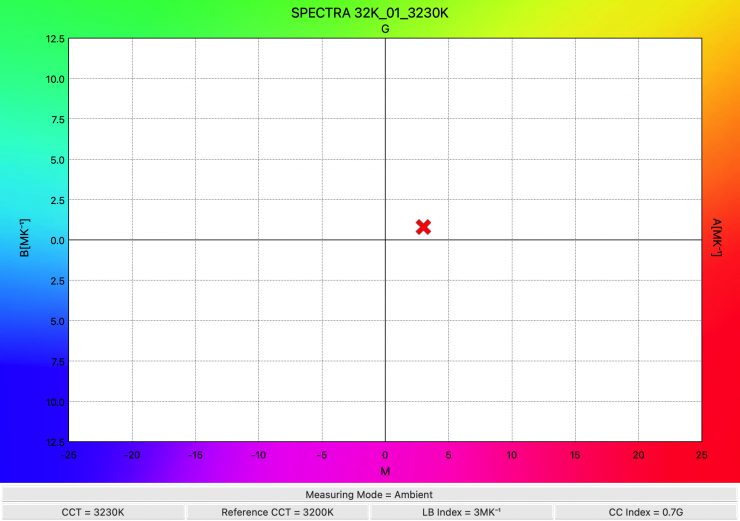
The light recorded an excellent CCT reading of 3230K.
How does it perform at various CCT settings?
Summary of results 90°
| SETTING | OUTPUT | CCT READING |
| 2600K | 5430 lx | 2680K |
| 3200K | 6380 lx | 3230K |
| 4500K | 7180 lx | 4564K |
| 5600K | 7340 lx | 5622K |
| 6500K | 6540 lx | 6755K |
| 7000K | 6450 lx | 6964K |
These results show me that the light’s output varies by 26.02% across the CCT range. The consistency of the output across the CCT range was pretty good from 3200-7000K. Only at 2600K was it a bit lower. The CCT results were excellent from 2600-5600K, but at 6500K and 7000K, it wasn’t as good.
Maxima Spectra 90° 5600K 99Wh Battery
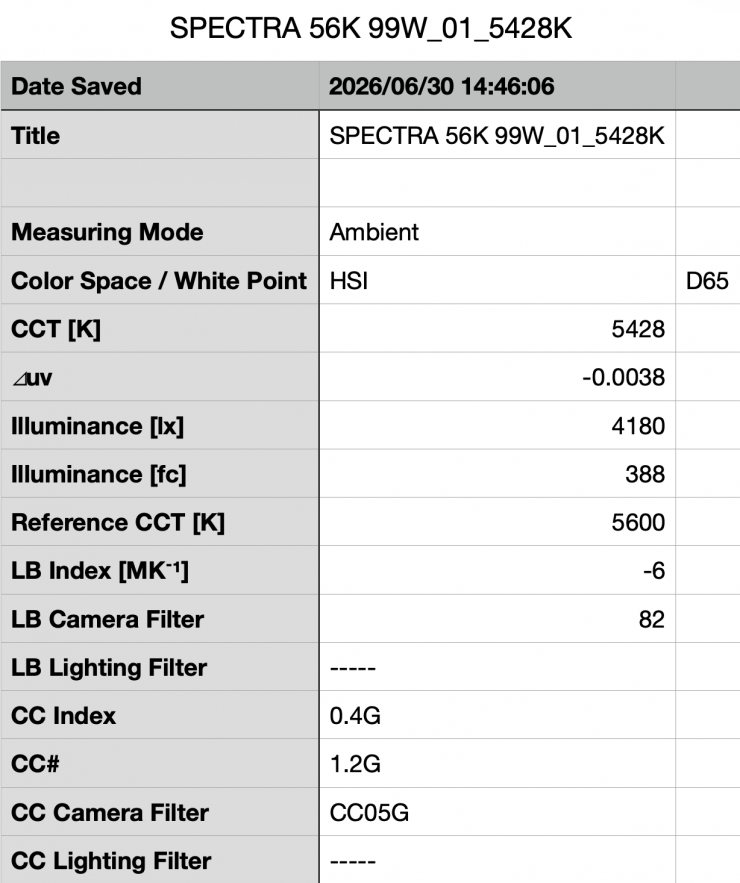
Above you can see that when the fixture was run via 99Wh battery in its ECO battery setting, it recorded an output of 4180 lx (388 fc), which was 43.05% less than when it was run via mains power.
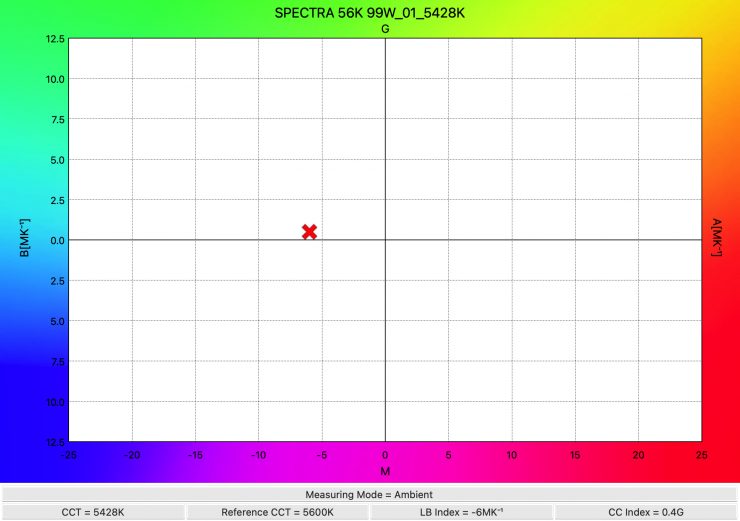
As far as its CCT reading was concerned, it recorded 5428K, which wasn’t as good as when it was run via mains power.
Maxima Spectra 90° 5600K 150Wh Battery
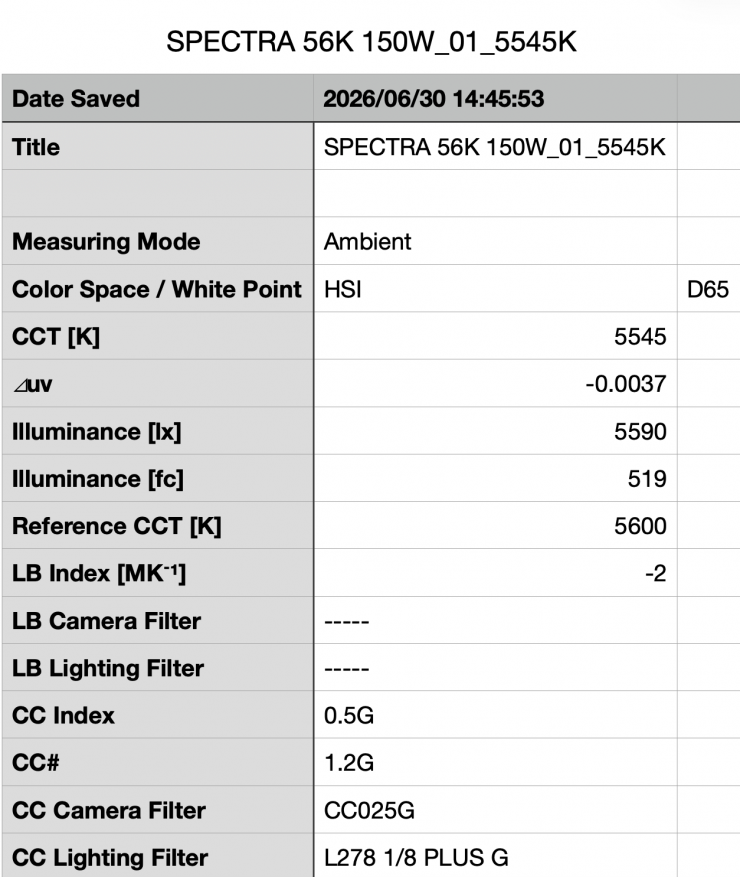
Above you can see that when the fixture was run via 150Wh battery in its STANDARD battery setting, it recorded an output of 5590 lx (519 fc), which was 23.84% less than when it was run via mains power.
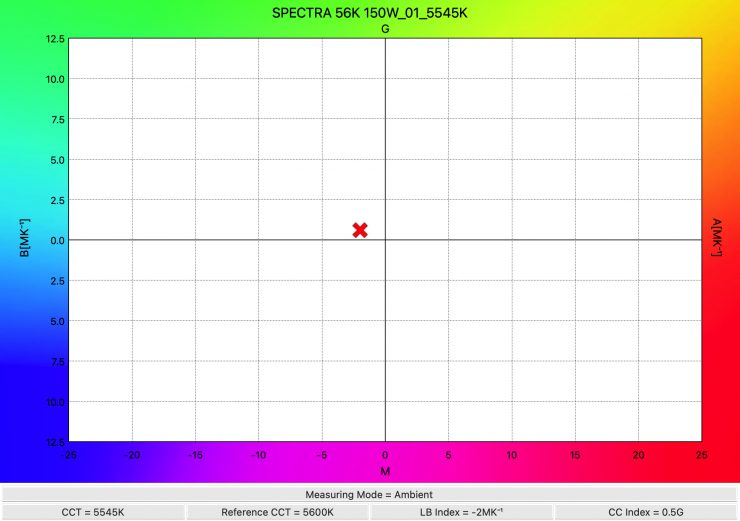
As far as CCT color temperature accuracy goes, it recorded a reading of 5545K, which was a very good result.
Maxima Spectra 5600K using the Profoto MaxiZoom Reflector
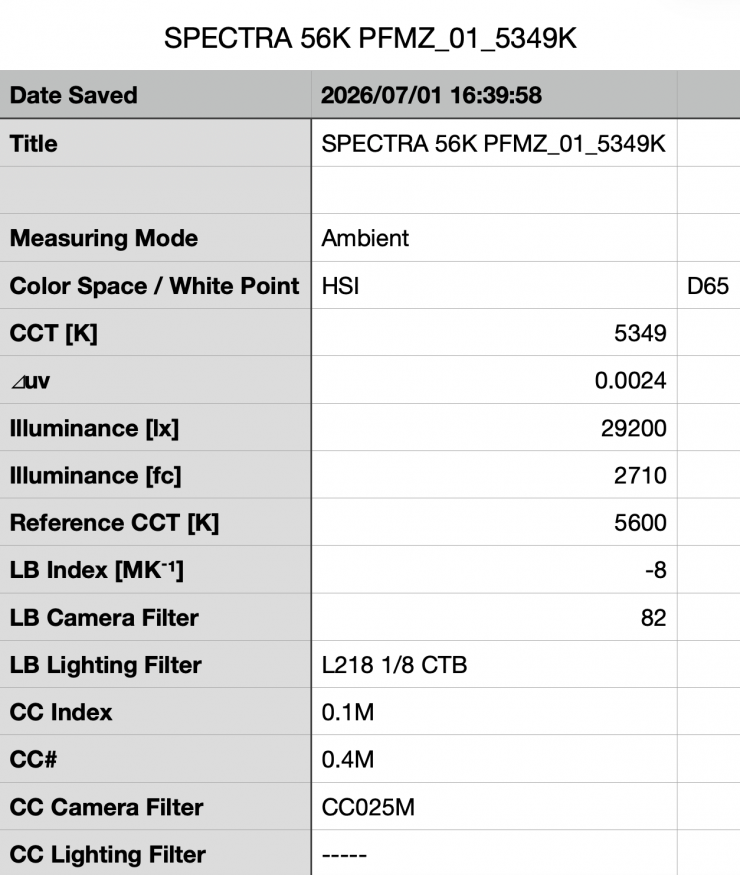
Above, you can see that when the fixture was using the Profoto MaxiZoom Reflector, it recorded an output of 29,200 lx (2710 fc). I don’t have any way of knowing exactly what the beam angle was with this reflector and light combination, but I can make an educated guess that it was around 45 degrees.
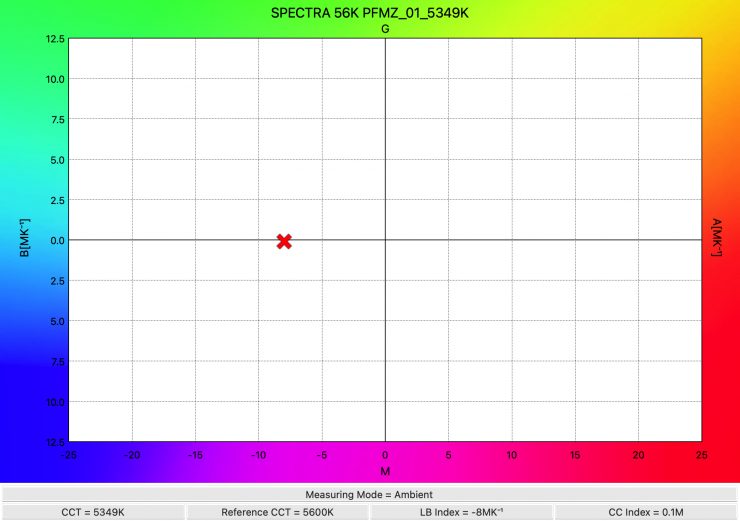
As far as CCT color temperature accuracy goes, it recorded a reading of 5349K.
Maxima Spectra 3200K using the Profoto MaxiZoom Reflector
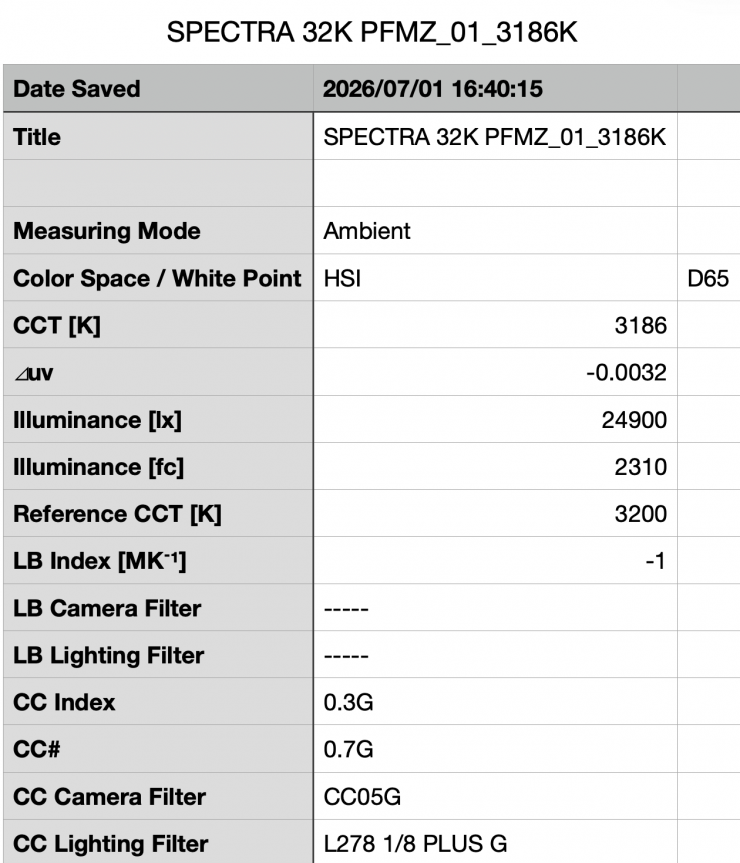
Above, you can see that when the fixture was using the Profoto MaxiZoom Reflector at 3200K, it recorded an output of 24,900 lx (2310 fc).
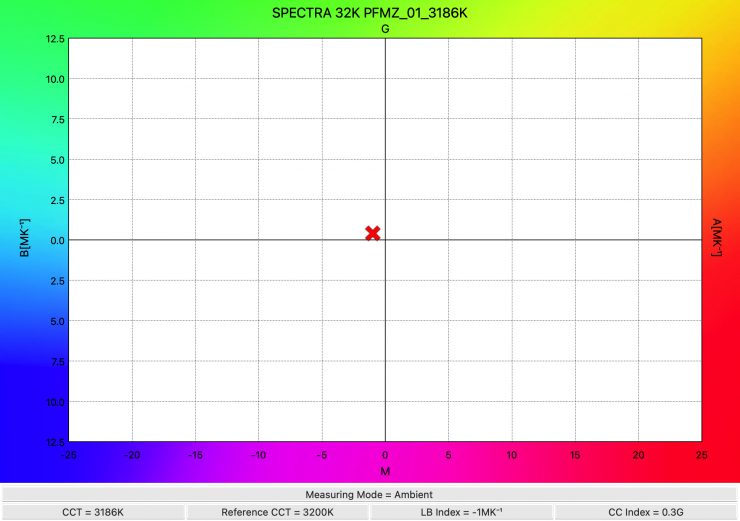
As far as CCT color temperature accuracy goes, it recorded a reading of 3186K.
Maxima Spectra 90° 5600K 212Wh Battery
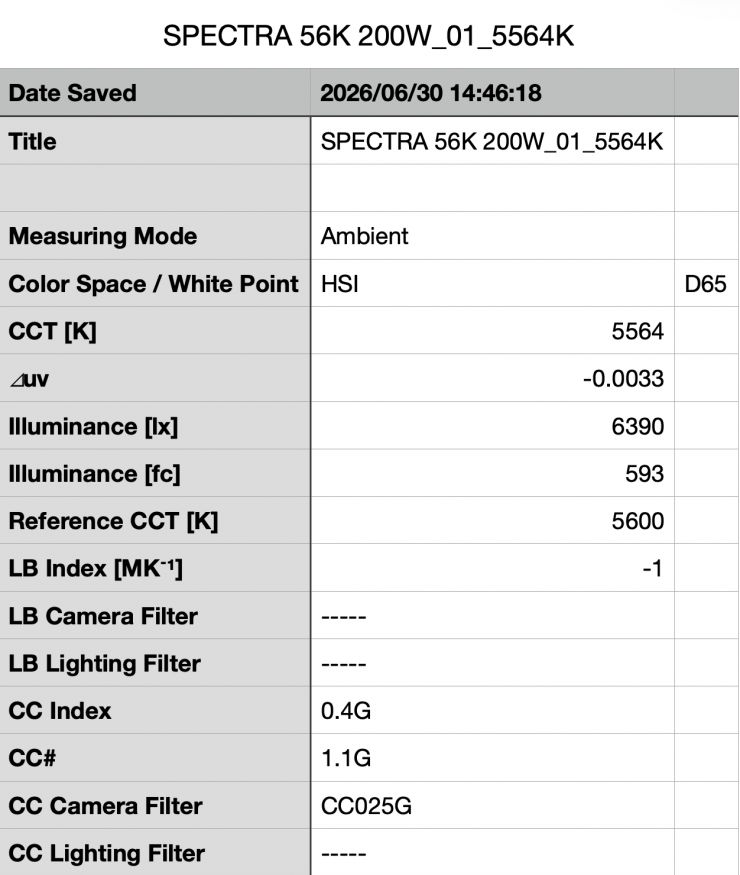
Above you can see that when the fixture was run via 212Wh battery in its HIGH DRAIN battery setting, it recorded an output of 6390 lx (593 fc), which was 12.94% less than when it was run via mains power. Now, in theory, it should have been able to produce the same amount of output as when it was run via mains power, but this may have been a limitation of the SmallRig VB212 Mini V-Mount Battery.
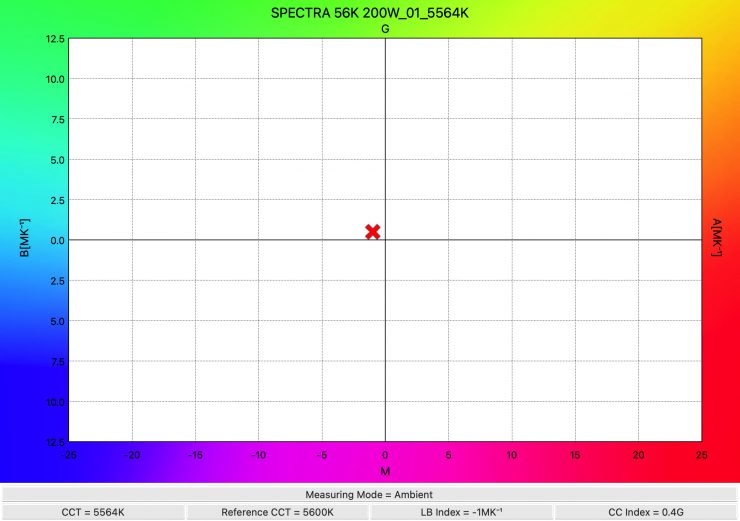
As far as CCT color temperature accuracy goes, it recorded a reading of 5564K, which was a very good result.
Maxima Spectra DoPChoice Octa 3 Softbox with double diffusion 5600K
I also wanted to see how much output the Maxima Spectra had when using it in conjunction with a DoPChoice Octa3 softbox with two layers of diffusion. All measurements were taken 1m / 3.3′ from the front of the softbox.
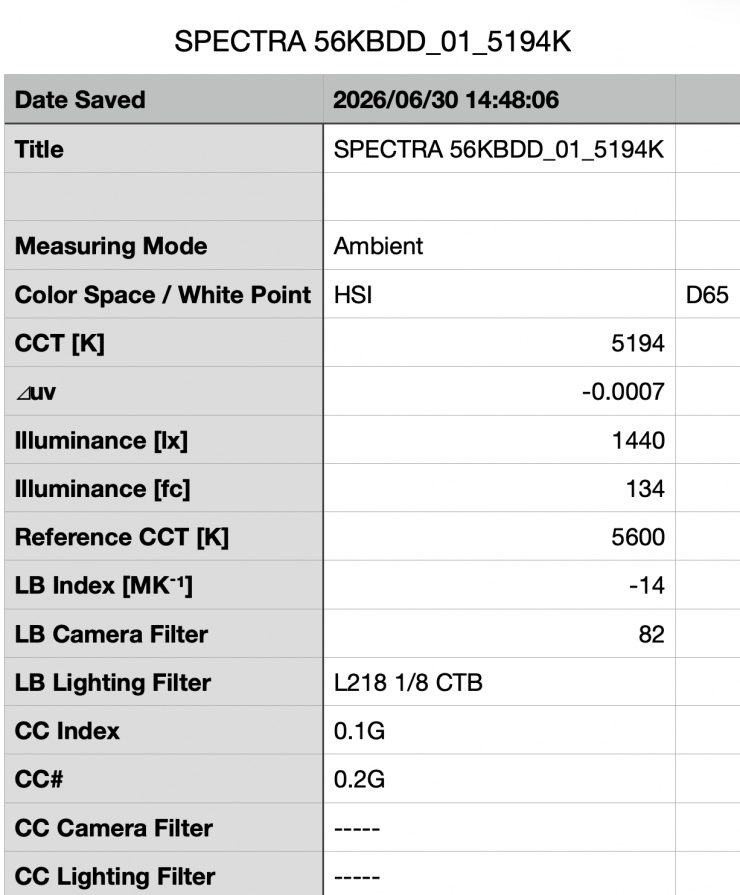
Above, you can see that when the fixture was using a DoPChoice Octa3 softbox with two layers of diffusion and set to 5600K, it recorded an output of 1440 lx (134 fc).
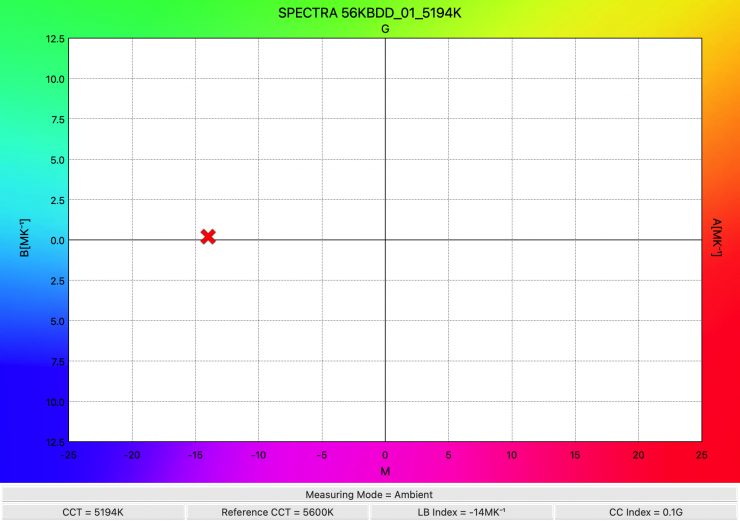
As far as its CCT reading was concerned, it recorded 5194K. The CCT will almost always inevitably change when using any type of lighting modifier, especially softboxes and diffusion.
What if you start dimming the light?
Nobody uses a light at 100% output every time they turn it on. It is important to test the CCT accuracy of a light when it is used at reduced outputs.
Below you can see a series of tests at 100%/75%/50%/25%10% to see if the CCT being recorded changed. This was done at a distance of 1m / 3.3′ using a Sekonic C-800. These tests were done at 5600K.
| CCT READING | OUTPUT | INTENSITY % |
| 5622K | 7340 lx | 100 |
| 5630K | 6570 lx | 75 |
| 5505K | 3490 lx | 50 |
| 5229K | 1730 lx | 25 |
| 5357K | 660 lx | 10 |
The Maxima Spectra’s CCT consistency was ok, but it could have been better. My testing showed that the CCT readings varied by 401K.
As far as how linear the output is when you start dimming the light, at 50% output, it had 52.45% less output than when used at 100%. At 25%, it had 76.43% less output than when used at 100%. At 10% output, it had 91% less output than when used at 100%. This shows me that the light’s dimming curve is very linear.
Color Rendering
So now that we have seen how much output the Maxima Spectra produces, how does it perform when it comes to replicating accurate color? The Spectra has a lot to live up to, as its siblings, the Maxima 6 GaN and Maxima 3, produced some of the best results I have ever seen from any LED light. Now, I don’t for one second expect the Spectra to be as good, as it is a bi-color fixture and not daylight only, but anyway, let’s find out.
Maxima Spectra 5600K
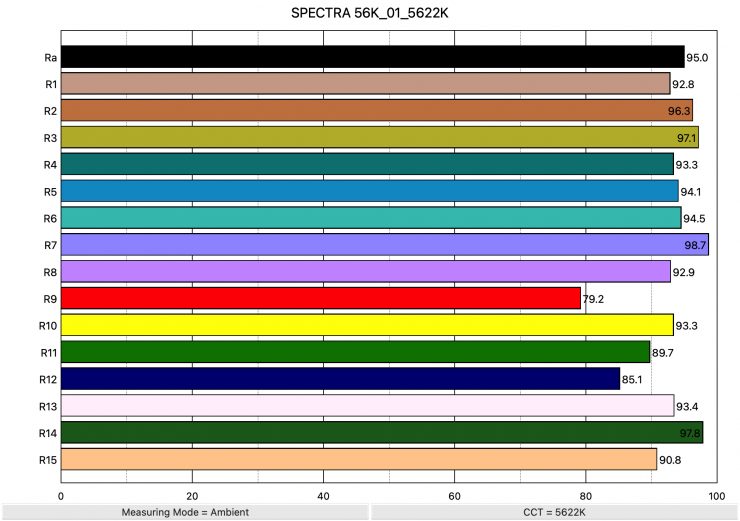
Above you can see that when the light was used with no modifiers, it recorded an average CRI (R1-R8) of 95.0 and an extended CRI (R1-R15) of 92.6. For replicating accurate skin tones, it recorded 79.2 for R9 (red), 93.4 for R13 (closest to caucasian skin tones), and 90.8 for R15 (closest to Asian skin tones). R9 (Red), R11 (Green), and R12 (Blue) were all below 90. While these are pretty good results, they are not as good as the Maxima 6 GaN or Maxima 3. This shouldn’t come as any huge surprise, given that both of those fixtures are daylight only.
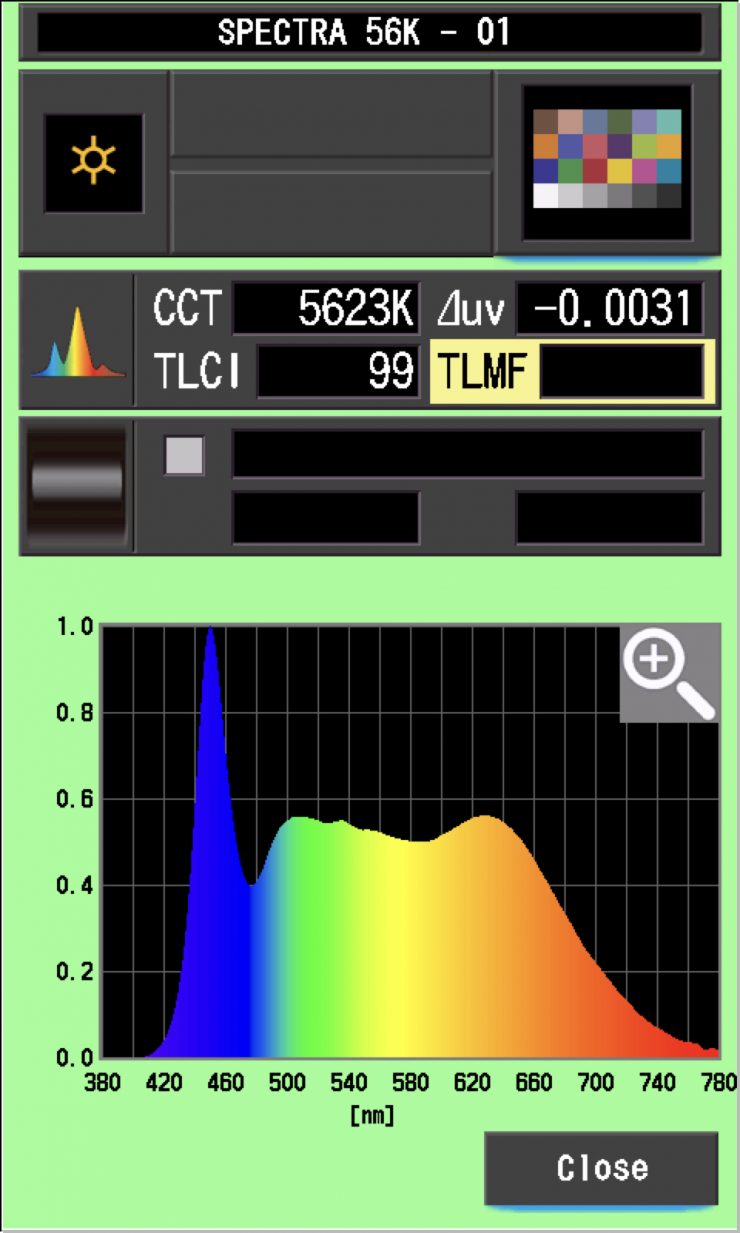
The light, when set at 5600K, recorded a TLCI score of 99.
These are decent results, but they weren’t quite as good as the results I got from the Maxima 3. As a comparison, below you can see the results from the Maxima 3.
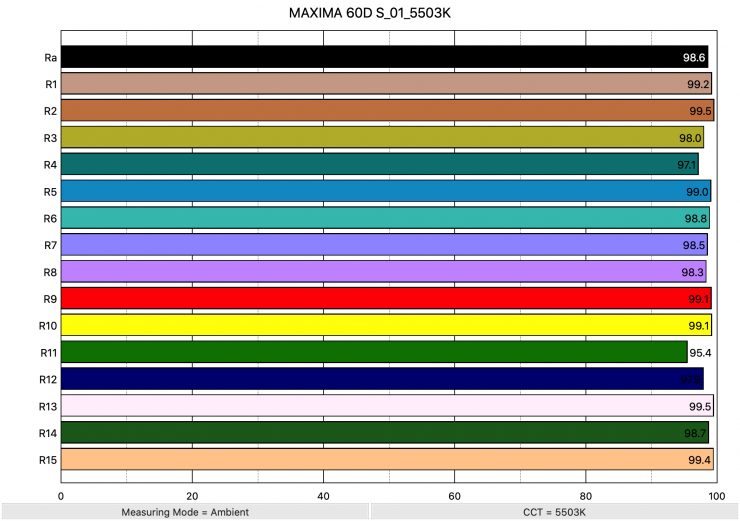
Above, you can see that when the Maxima 3 was in its Silent Mode and set at 60°, it recorded an average CRI (R1-R8) of 98.6 and an extended CRI (R1-R15) of 98.5. For replicating accurate skin tones, it recorded 99.1 for R9 (red), 99.5 for R13 (closest to caucasian skin tones), and 99.4 for R15 (closest to Asian skin tones).
The results from the Maxima 3 were the best results I have ever seen from an LED spotlight, period. Every Ra value was above 95, and the lowest score was 95.4. The extended CRI (R1-R15) of 98.5 was the highest score I have ever recorded from any light. This light is exceptionally accurate, and the color rendering scores set a new benchmark.
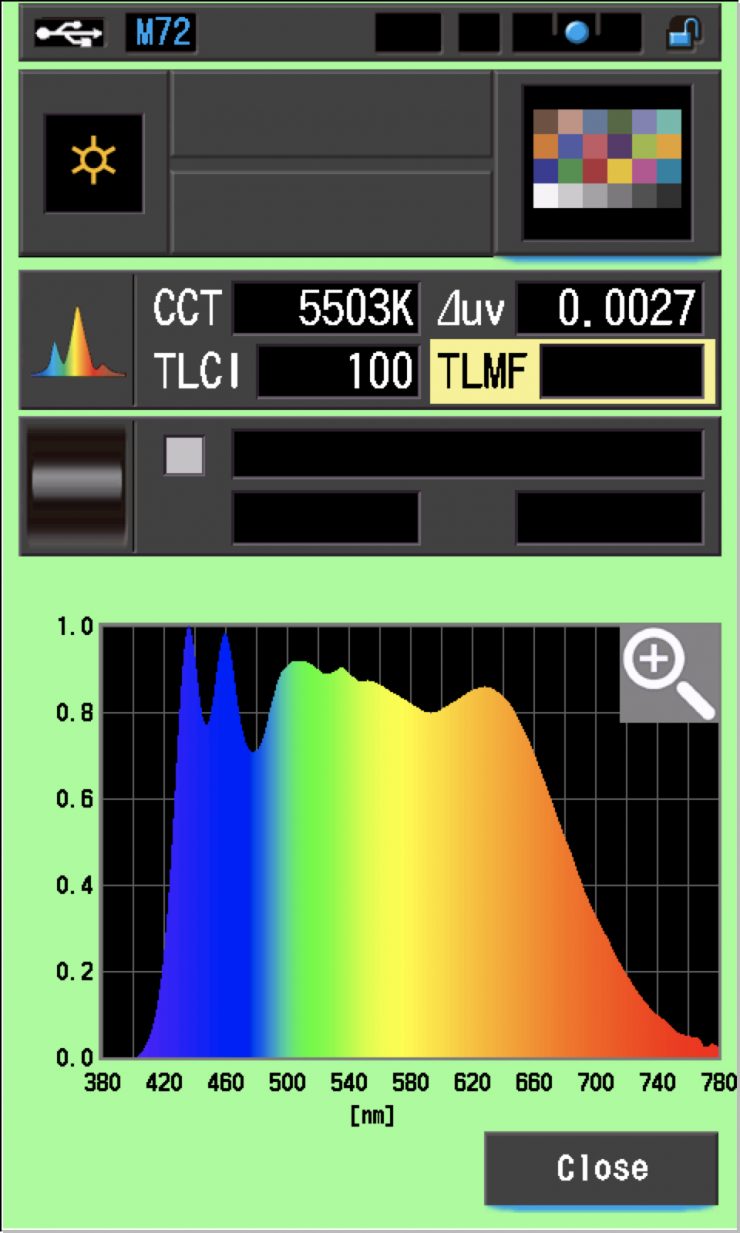
The Maxima 3, when set at 5600K, recorded a perfect TLCI score of 100. This is the first light I have ever tested to receive a perfect score.
So, how do the results from the Maxima Spectra compare to some of the best lights I have ever tested?
| EXTENDED CRI | R9 | R13 | R15 | |
| Maxima Spectra | 92.6 | 79.2 | 93.4 | 90.8 |
| Maxima Furiosa | 95.62 | 93.1 | 98.7 | 97.6 |
| Maxima 6 GaN | 97.38 | 96.3 | 97.5 | 97.0 |
| Maxima 3 | 98.5 | 99.1 | 99.5 | 99.4 |
| ARRI Orbiter | 98.1 | 86.3 | 98.9 | 97.4 |
| Kelvin Epos 600 | 96.06 | 95.9 | 98.4 | 98.0 |
| Aputure STORM 1200x | 97.34 | 95.5 | 97.9 | 98.4 |
| NANLUX EVOKE 600C | 97.75 | 96.5 | 98.6 | 99.1 |
| Profoto LS600C | 98.04 | 92.8 | 99.5 | 99.1 |
Above you can see that the Maxima Spectra scores were ok, but not as good as its daylight-only siblings, the Maxima 3 and Maxima 6 GaN. Still, no fixture I have tested has been able to top the Maxima 3. In saying this, all of these lights I just mentioned perform very well when it comes to color rendering.
Maxima Spectra 3200K
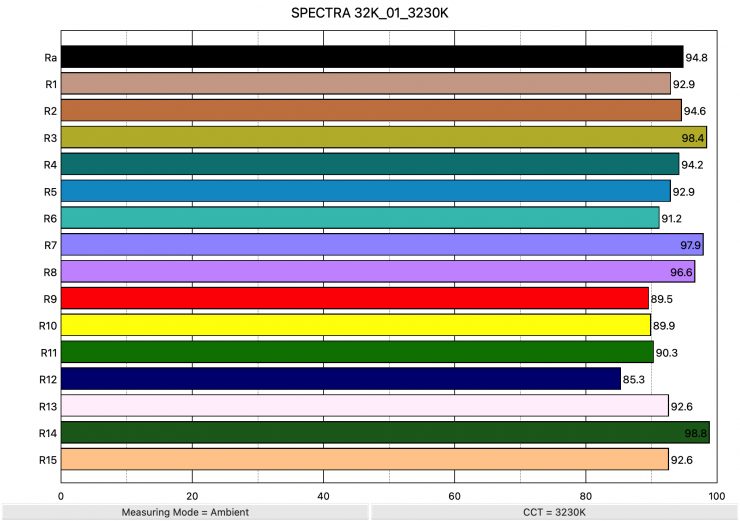
Above, you can see that when the light was used with no modifiers at 3200K, it recorded an average CRI (R1-R8) of 94.8 and an extended CRI (R1-R15) of 93.18. For replicating accurate skin tones, it recorded 89.5 for R9 (red), 92.6 for R13 (closest to caucasian skin tones), and 92.6 for R15 (closest to Asian skin tones). These were decent results, but R9 (Red), R10 (Yellow), and R12 (Blue) were all slightly under 90.
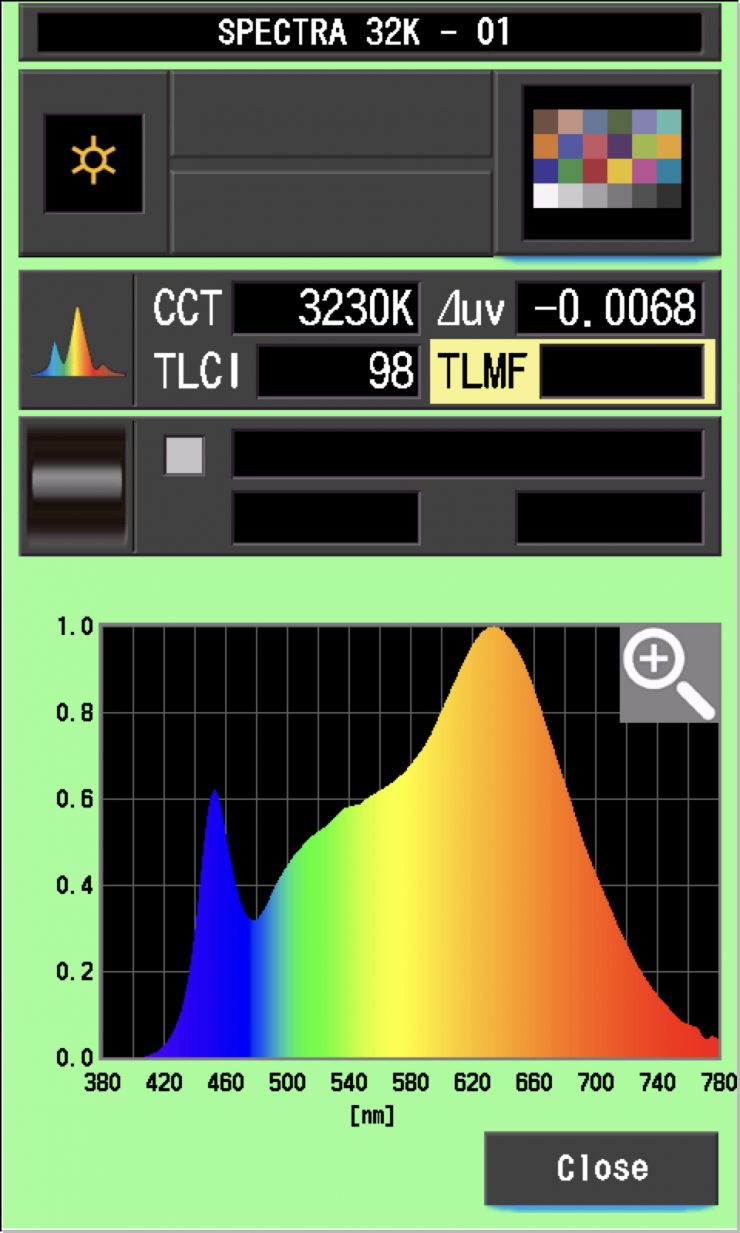
The light, when set at 3200K, recorded a TLCI score of 98.
So, how do the results from the Maxima Spectra, when used at 3200K, compare to some of the best lights I have ever tested?
| EXTENDED CRI | R9 | R13 | R15 | |
| Maxima Spectra | 93.18 | 89.5 | 92.6 | 92.6 |
| Maxima Furiosa | 95.62 | 93.1 | 98.7 | 97.6 |
| ARRI Orbiter | 96.89 | 80.7 | 99.9 | 96.9 |
| Kelvin Epos 600 | 97.42 | 91.7 | 99.3 | 97.6 |
| Aputure STORM 1200x | 93.52 | 94.4 | 93.3 | 97.2 |
| Aputure LS 600x | 96.71 | 89.9 | 99.1 | 99.3 |
| Profoto LS600C | 97.34 | 98.0 | 97.2 | 98.2 |
| Neewer AS600B | 96.63 | 91.6 | 98.4 | 98.2 |
| ZHIYUN MOLUS B500 | 95.58 | 98.2 | 95.1 | 96.7 |
Above, you can see that the Maxima Spectra scores were pretty decent, but still, no fixture I have tested has been able to top the Kelvin Epos 600 when set at 3200K. In saying this, all of these lights I just mentioned perform very well when it comes to color rendering.
CC Index & ⊿uv
The CC Index displays the CC correction value and whether any magenta or green need to be added or subtracted. 1 CC corresponds to 035 Kodak CC values or 1/8 Rosco filter values. Any reading less than +1.00 or -1.00 and you’re probably not going to need to make any kind of adjustment. The ⊿uv is the value to show how much this light is away from being an ideal light source (black body radiation = incandescent lamp). As with the CC Index you want this number to theoretically be zero. Kelvin is not a linear value, so we need to convert from Kelvin to MK-1 to compare the values of color temperature. To calculate from Kelvin to Mired is MK-1= 1*1000000/Kelvin. While this may sound confusing, it is the only way of measuring if the Kelvin shift is significant enough to warrant having to use a filter for correction. Below are the results for the Maxima Spectra.
Maxima Spectra Kelvin Vs MK-1
| Kelvin | Difference in K | MK-1 | Difference in MK-1 | |
| SET VALUE | 2600K | 0 | 384.61 | 0 |
| ACTUAL READING | 2680K | 80 | 373.13 | 11.48 MK-1 |
| SET VALUE | 3200K | 0 | 312.5 | 0 |
| ACTUAL READING | 3230K | 30 | 309.59 | 2.91 MK-1 |
| SET VALUE | 4500K | 0 | 222.22 | 0 |
| ACTUAL READING | 4546K | 46 | 219.97 | 2.25 MK-1 |
| SET VALUE | 5600K | 0 | 178.57 | 0 |
| ACTUAL READING | 5622K | 22 | 177.87 | 0.70 MK-1 |
| SET VALUE | 6500K | 0 | 153.84 | 0 |
| ACTUAL READING | 6755K | 255 | 148.03 | 5.81 MK-1 |
| SET VALUE | 7000K | 0 | 142.85 | 0 |
| ACTUAL READING | 6964K | 36 | 143.59 | -0.74 MK-1 |
These figures might look confusing, but what they tell me is that the light is pretty good when it comes to CCT accuracy across its range, except for when it was used at 2600K. Any MK-1 score that is under -9/9 means you wouldn’t have to use any color correction gels. The MK-1 scores for this light were very good at 3200K, 4500K, 5600K, and 7000K. As I just mentioned, at 2600K, it wasn’t very good. Any MK-1 score that is under -6/6 is a very good result.
Maxima Spectra CC INDEX & ⊿uv
| CC INDEX | ⊿uv | |
| 2600K | 0.2G | 0.0011 |
| 3200K | 0.7G | -0.0068 |
| 4500K | 0.8G | -0.0081 |
| 5600K | 0.4G | -0.0031 |
| 6500K | 0.5G | -0.0019 |
| 7000K | 0.5G | -0.0014 |
The CC Index and ⊿uv results across the board were ok, but they could have been better. In saying that, the CC Index was at least consistent.
TM-30
TM-30 is a relatively new color rendering standard that was developed to deal with the limitations of CRI. TM-30 looks at 99 individual colors. These 99 colors are categorized into seven groups: nature, skin color, textiles, paints, plastics, printed material, and color systems.
TM-30 scores go from 0 – 100. The higher the score, the more accurate a light is at producing colors. Any TM-30 Rf score in the ’90s is considered to be good. What is interesting, and something that you need to be very aware of, is that two separate light sources with the exact same CRI scores can render colors very differently. A light with a high CRI rating could have a low TM-30 score. Conversely, a light with a good TM-30 score could have a bad CRI score.
Now, there are two measurements associated with TM-30, Rf and Rg.
Rf (Color Fidelity)
Rg (Color Gamut)
With Rf value, ideally, you want a score in the 90’s.
With Rg value, a score below 100 indicates that the light source renders colors with less saturation than the reference source. So ideally you want this score to be at 100.
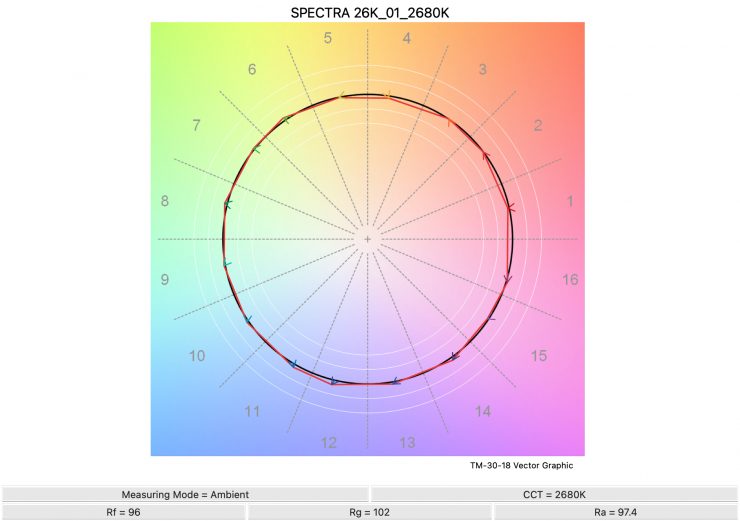
2600K 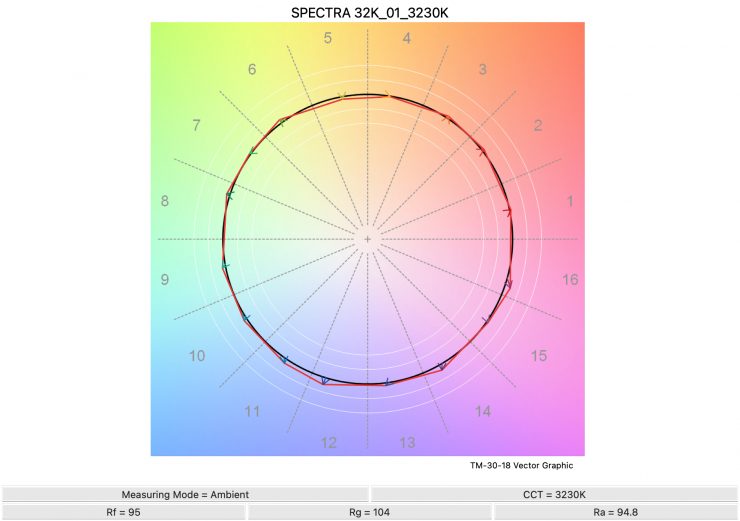
3200K 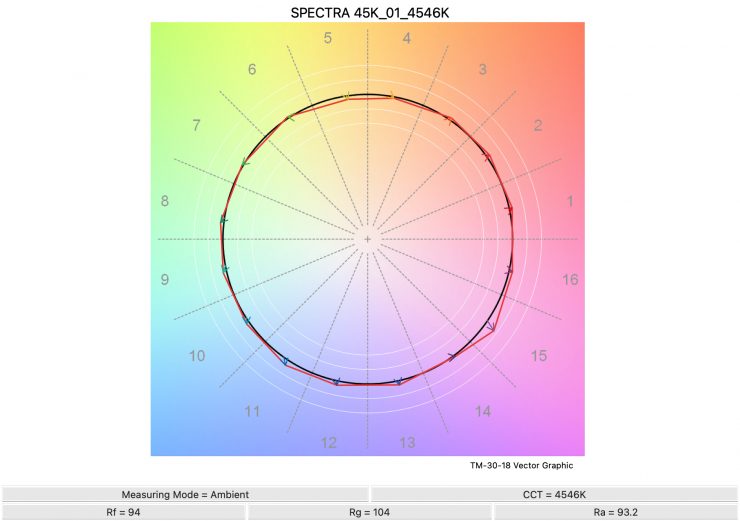
4500K 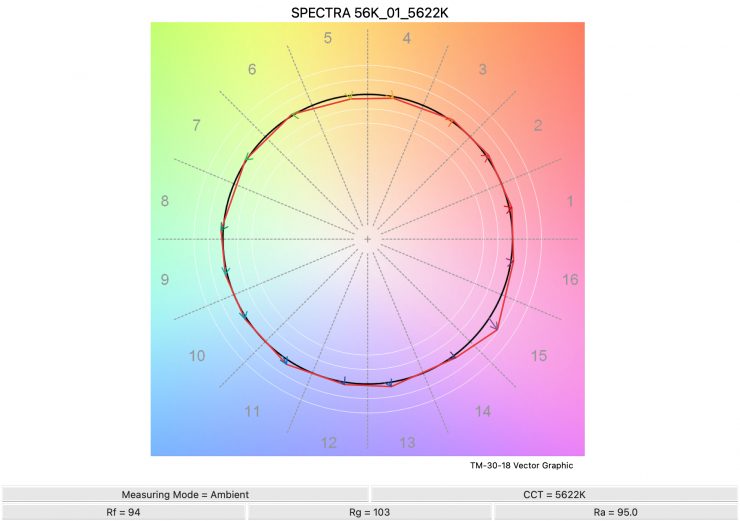
5600K 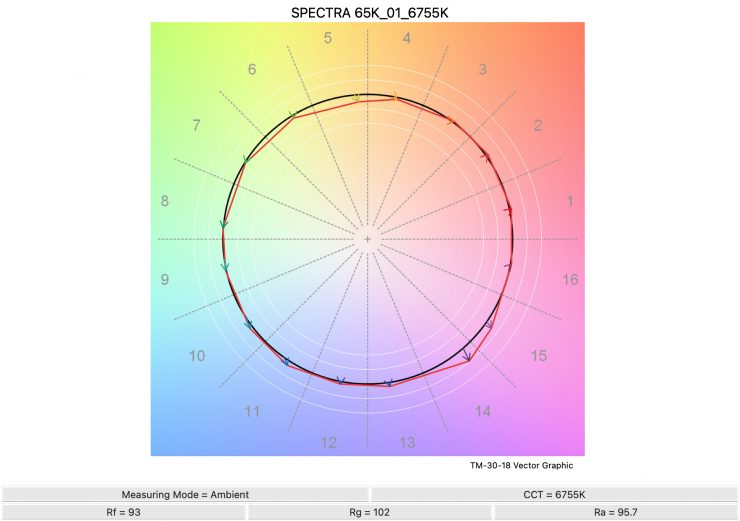
6500K 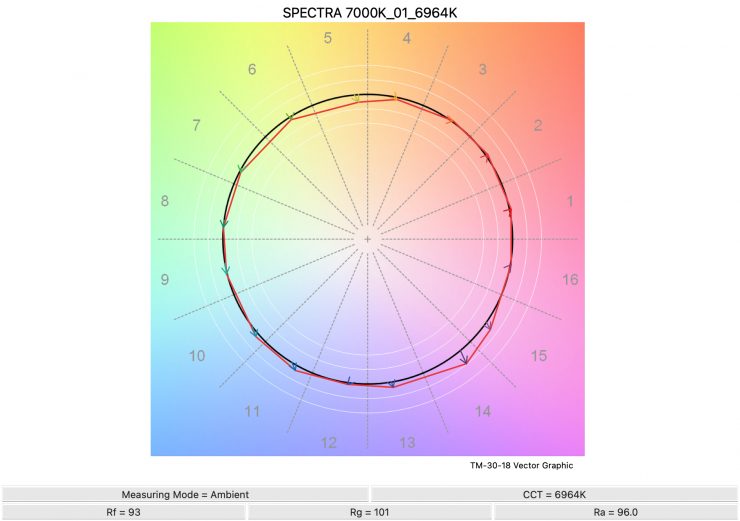
7000K
Above you can see the scores for Maxima Spectra. Below, I have listed the figures as well.
Here are the results:
| Rf | Rg | |
| 2600K | 96 | 102 |
| 3200K | 95 | 104 |
| 4500K | 94 | 104 |
| 5600K | 94 | 103 |
| 6500K | 93 | 102 |
| 7000K | 93 | 101 |
The TM-30 scores are all very good, and it shows me that the light is very consistent at replicating accurate colors with full saturation, although it was slightly oversaturating colors.
SSI
SSI (Spectral Similarity Index) was developed by the Sci-Tech Council of the Academy. SSI gives me the ability to set any light as a standard, or use predefined standards (such as CIE D55) and then give other lights an SSI score based on how well they will match standards such as CIE D55. This way, I can measure spectral response and compare it directly against an ideal light source. This is actually a much better test than recording CRI scores.
Maxima Spectra 5600K
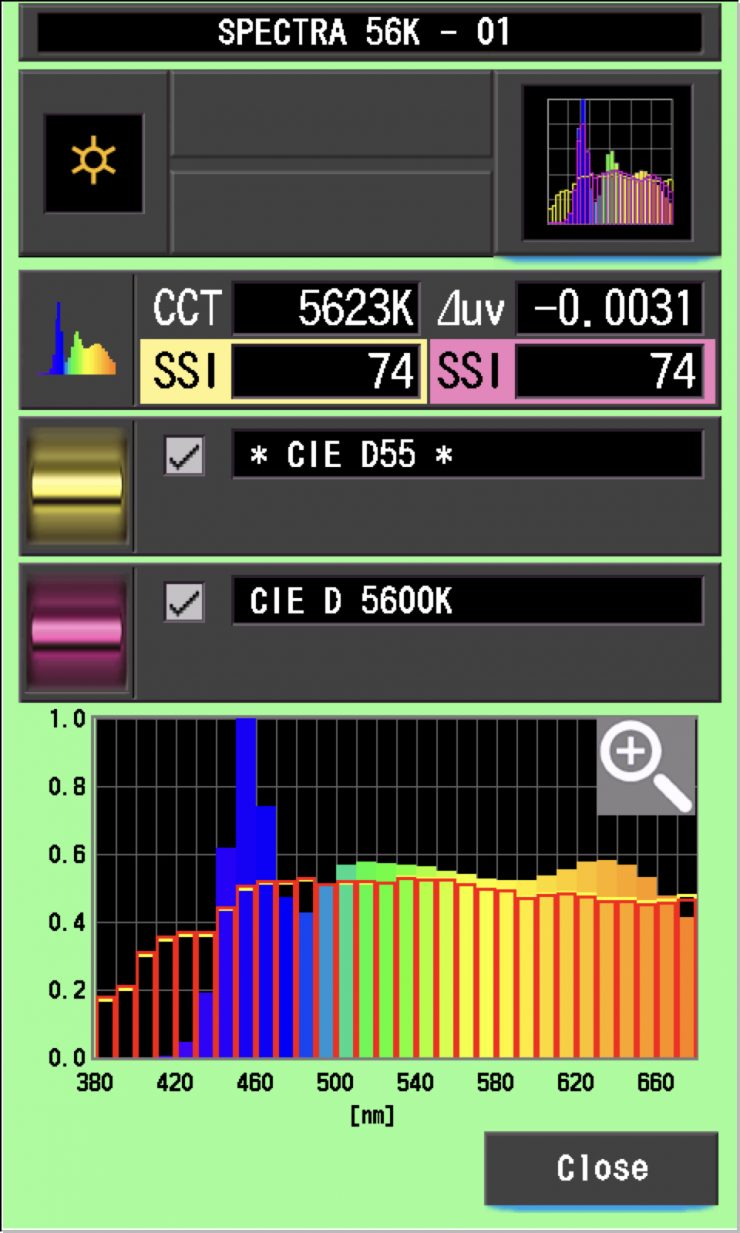
In the graph above, the gold bars indicate a perfect CIE D55 source. The red bars indicate a perfect CIE D 5600K source. This lets us compare how close to a perfect 5600K lighting source the Maxima Spectra is. A score in the low 70’s is typical for a 5600K LED source. Some of the newer light engines are able to have scores in the mid to high 80’s.
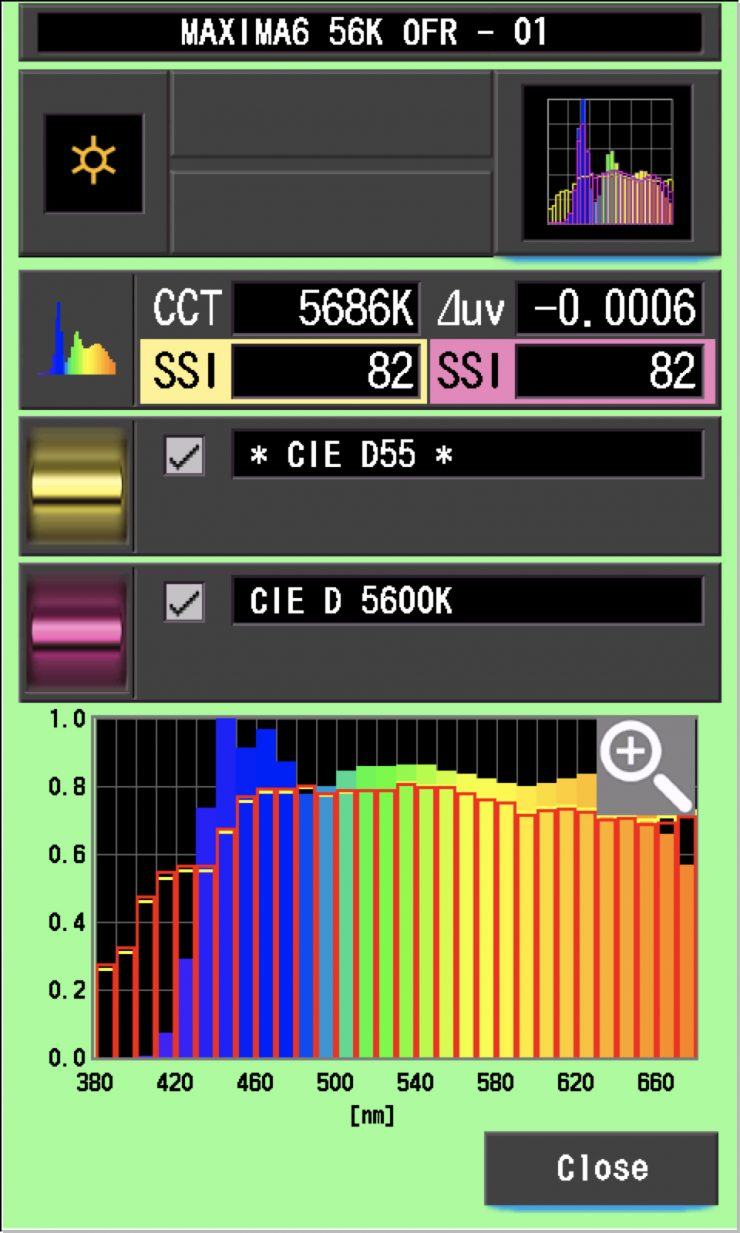
As a comparison, above you can see the SSI scores for the Maxima 6 GaN. A score in the 80s is outstanding. While 82 is a good score, the highest SSI scores I have ever recorded were with the ZOLAR 1×1 panels, which recorded SSI scores of 90.
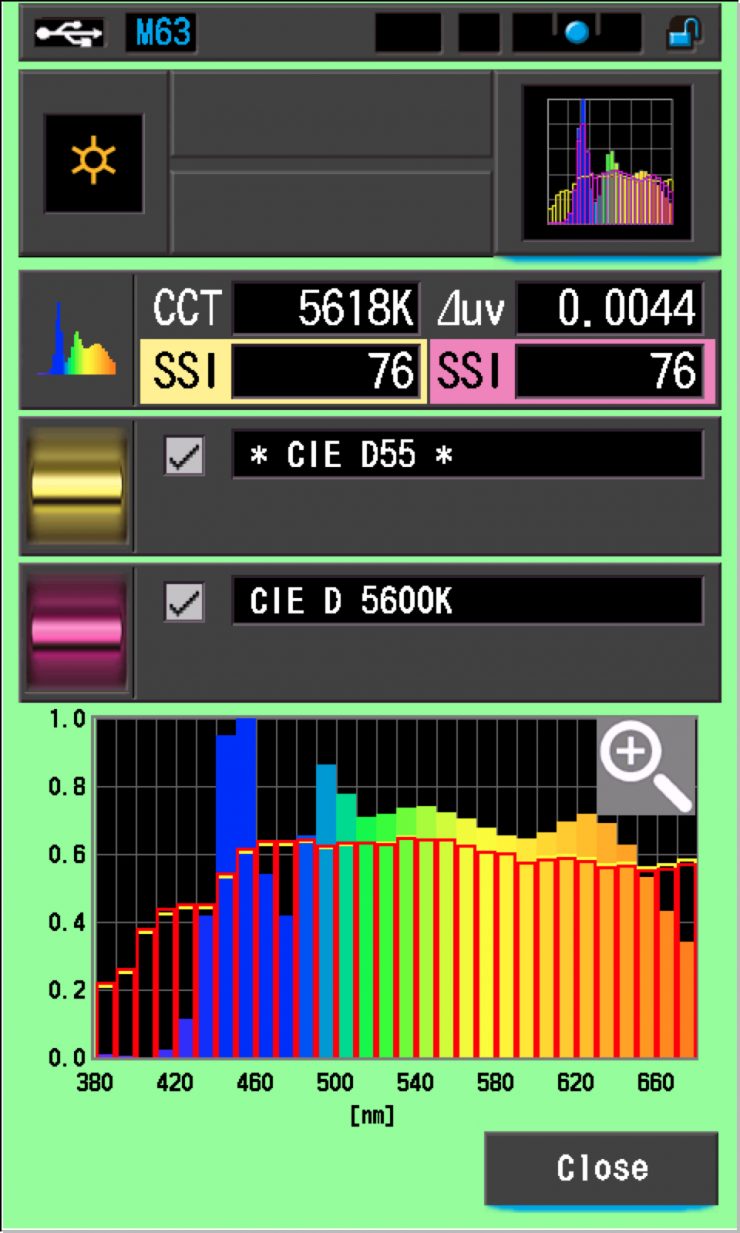
As another comparison, above is the SSI score for the very good ARRI Orbiter.
The main reason we want to record SSI scores is so we can see how well they match with other lights. As an example, I wanted to see how well the Maxima Spectra matched the Kelvin Epos 600 and the Aputure STORM 1200x. Below you can see the results.
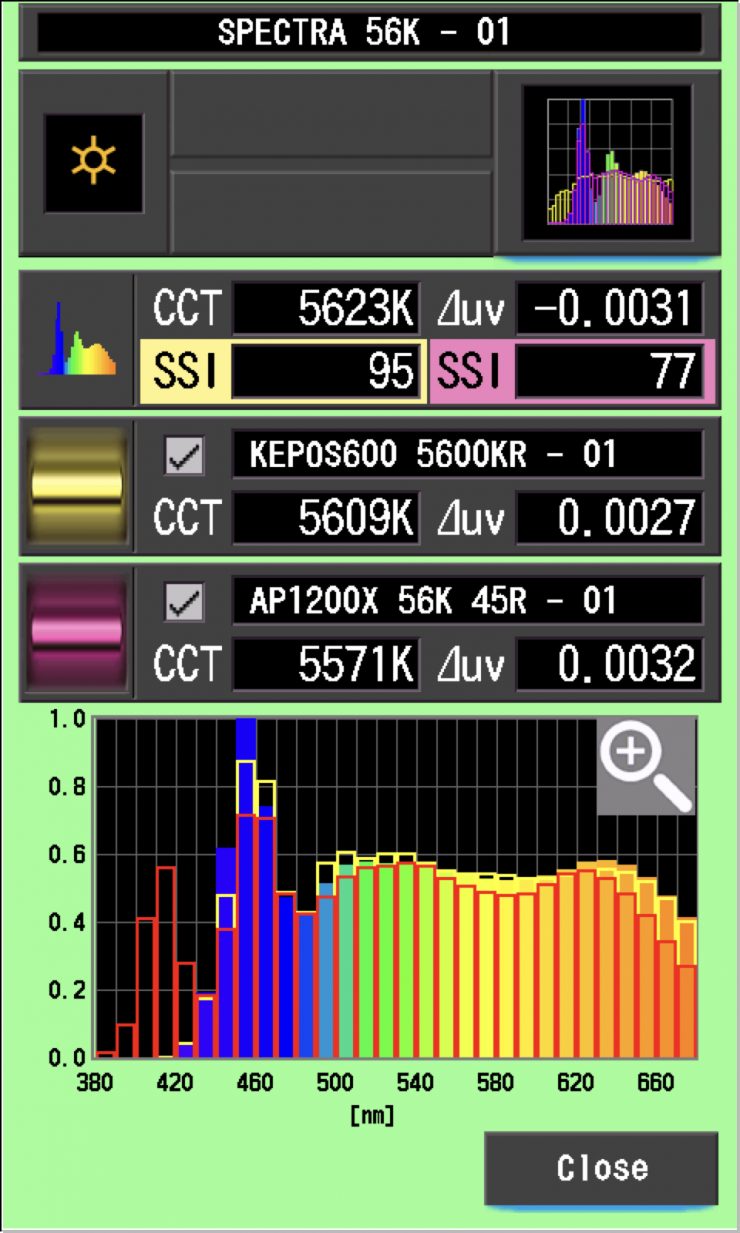
As you can see, the Maxima was a much better match to the Kelvin than it was to the Aputure. The Aputure wasn’t a great match, due to the fact that it is a very good fixture at replicating a 5600K daylight source. In saying that, very few lights from different manufacturers are ever going to be an exact match. The problem with having a light that has very good color rendering scores is that it isn’t going to match a lot of other lights.
Maxima Spectra 3200K
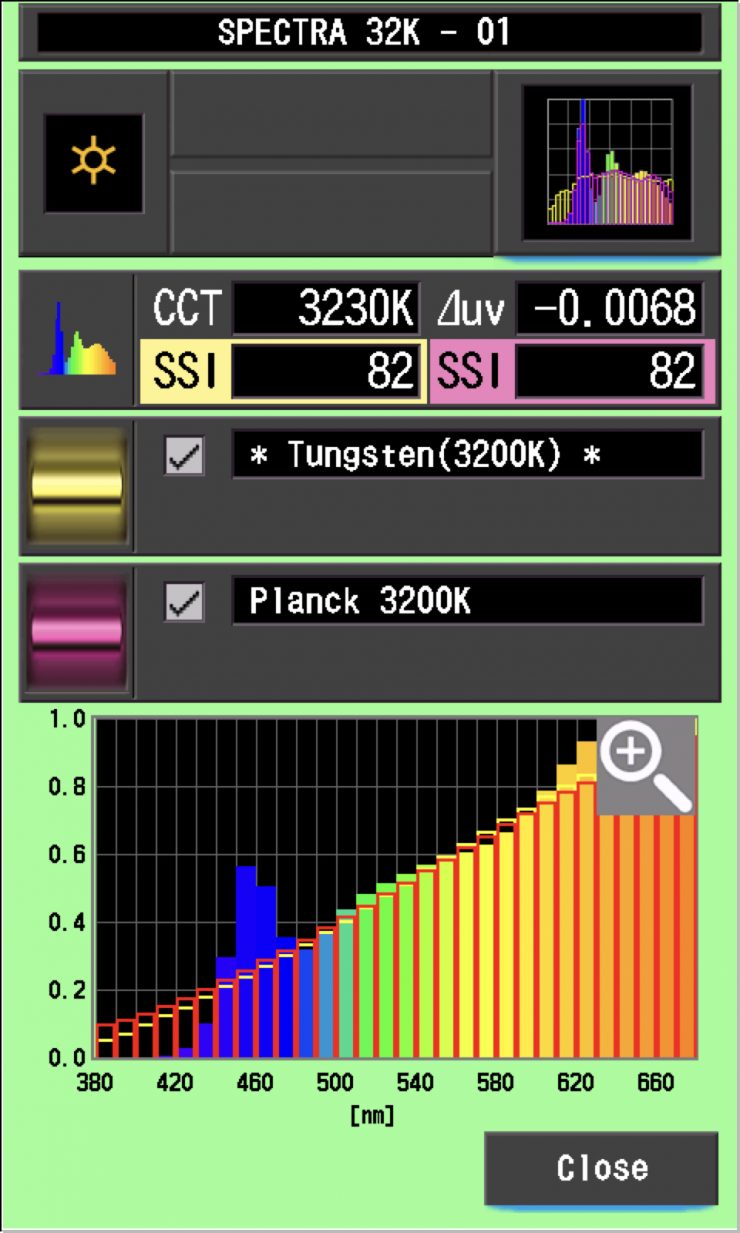
In this graph, the red bars indicate a perfect Planck 3200K source. The gold bars indicate a perfect 3200K Tungsten source. This lets us compare how close to a perfect 3200K lighting source the Maxima Spectra is. Any SSI score in the high 70’s, low ’80s is very good for a 3200K LED light. The results for the Maxima Spectra were very good when used at 3200K. As you can see, LED lights have a hard time replicating colors below about 450nm.
The main reason we want to record SSI scores is so we can see how well they match with other lights. As an example, I wanted to see how well the Maxima Spectra matched the Kelvin Epos 600 and the Aputure STORM 1200x. Below you can see the results.
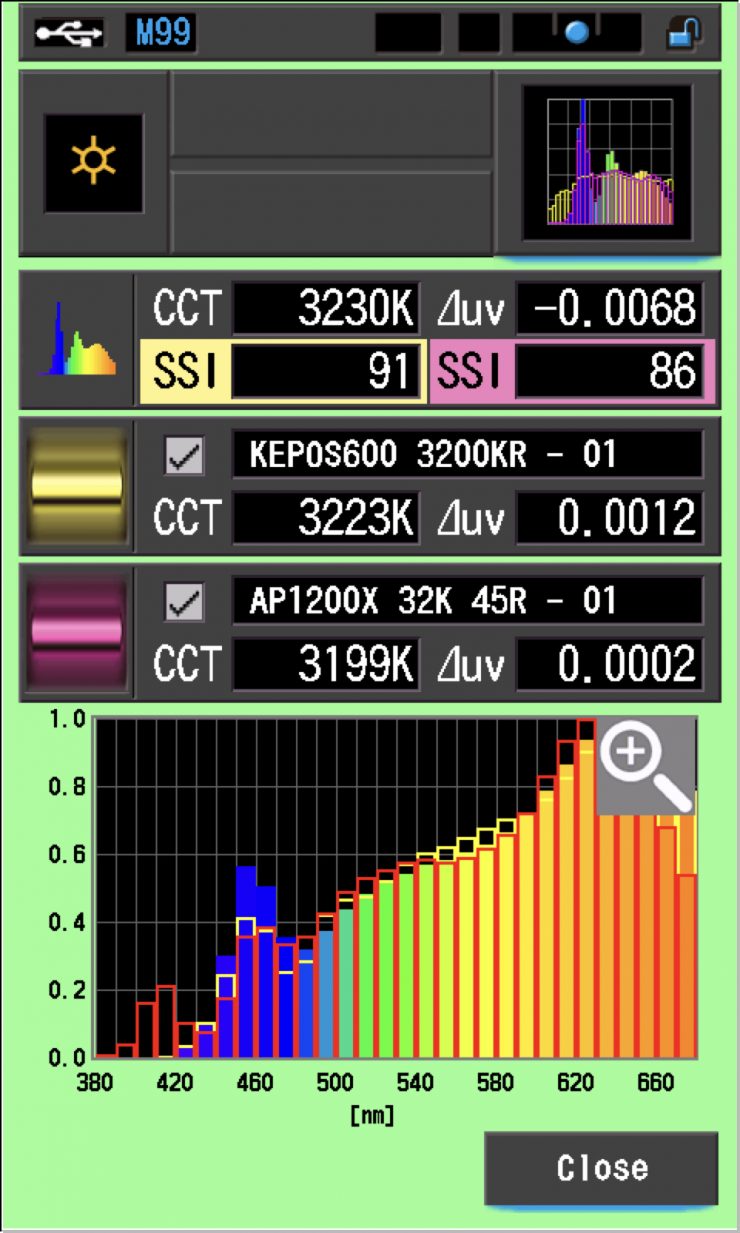
As you can see, both the Kelvin and Aputure were pretty decent matches to the Maxima Spectra, but you would have to do some tweaking to try and get them to match more closely. In saying that, very few lights from different manufacturers are ever going to be an exact match.
SSI tests are a great way of telling you what lights you own or use will work well together.
Spectral Distribution
5600K
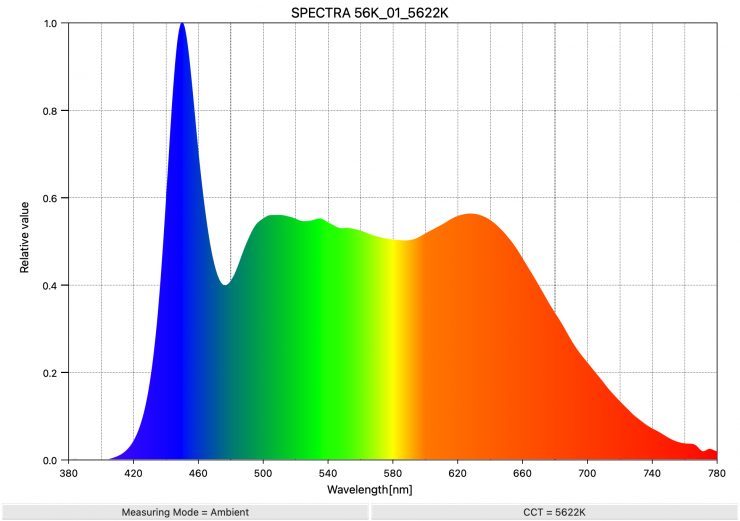
Above you can see the spectral distribution of the Maxima Spectra. The spectral distribution isn’t overly full, but there aren’t any large spikes where there shouldn’t be.
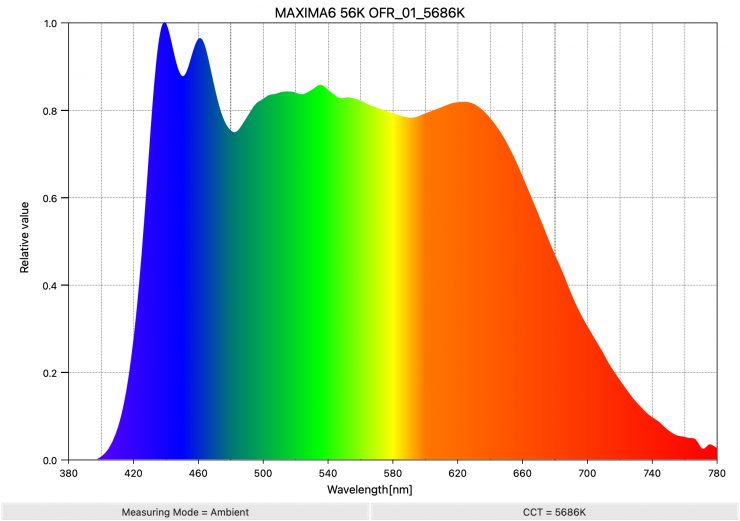
As a comparison, above you can see the spectral distribution of the Maxima 6 GaN. The spectral distribution is extremely full, and there aren’t any large spikes.
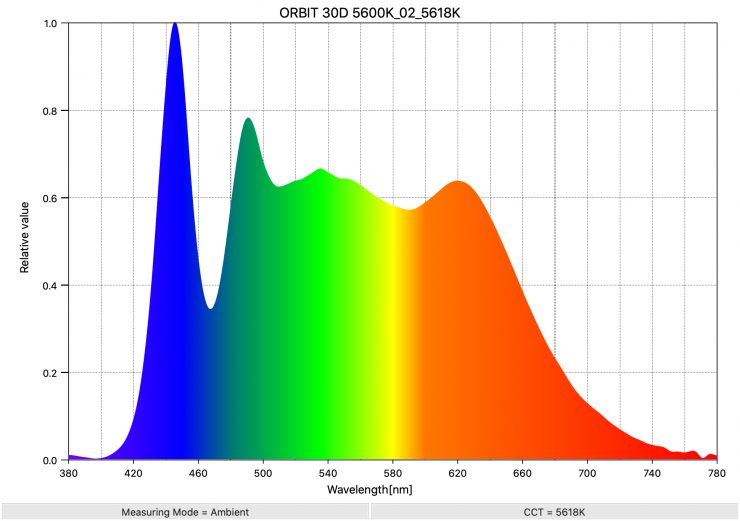
As another comparison, above you can see the spectral distribution of the ARRI Orbiter when it is set at 5600K. The spectral distribution is reasonably full, but you can see a green spike.
3200K
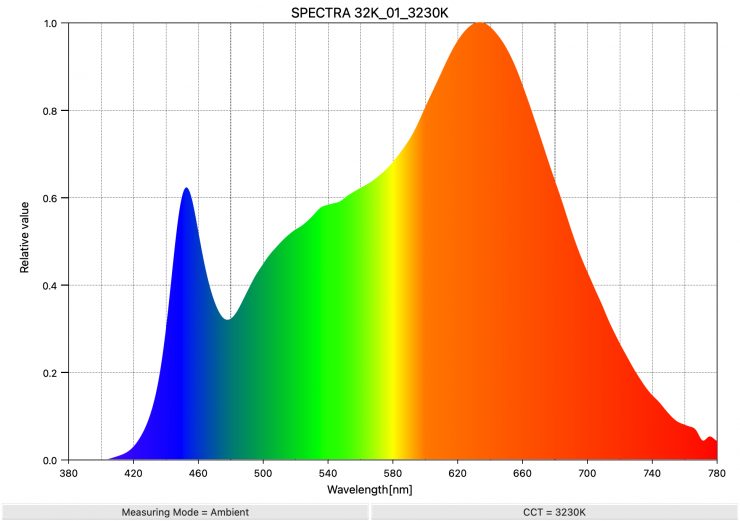
Above you can see the spectral distribution of the Maxima Spectra when used at 3200K. The spectral distribution is very good, and there aren’t any large spikes where there shouldn’t be.
Real-World Performance, Usability & Quality of Light
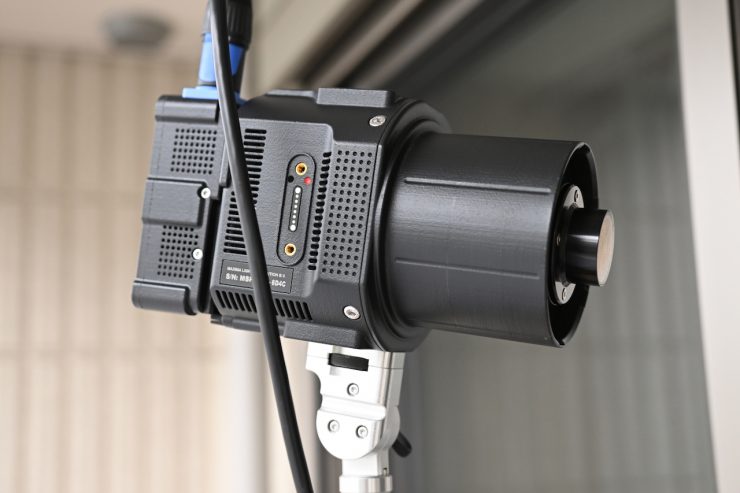
As I always say, photometric scores only tell you part of the story. So let’s find out if the scores from the Maxima Spectra translate into good real-world performance.
The quality of the light that is coming from the Maxima Spectra is really nice, but like any fixture, how you use it is more important than what it can do.
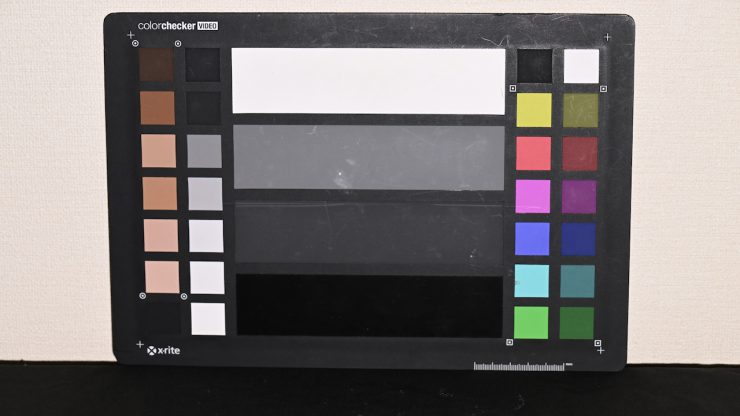
Preset 5600K Camera WB 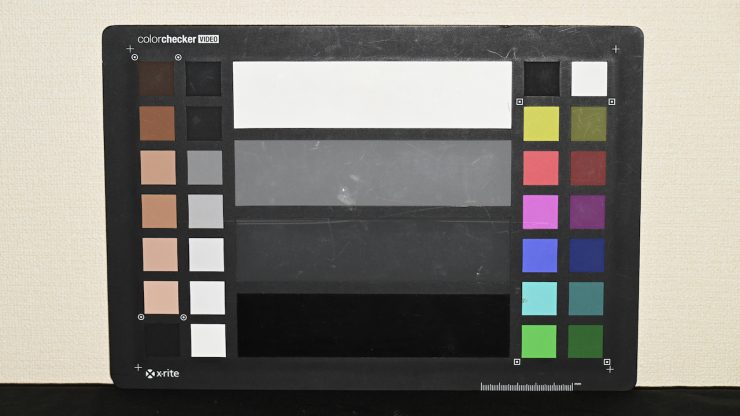
Camera WB
Firstly, let’s look at one of the most important aspects of a light, color accuracy. I set up a small test in a controlled environment where I shot a color checker chart with the camera WB at a preset value of 5600K, with the light set at 5600K. I then did a manual WB to see what the differences were. As you can see, the Maxima Spectra leans just a tiny bit magenta, but at least in my opinion, it looks better before doing a camera WB.
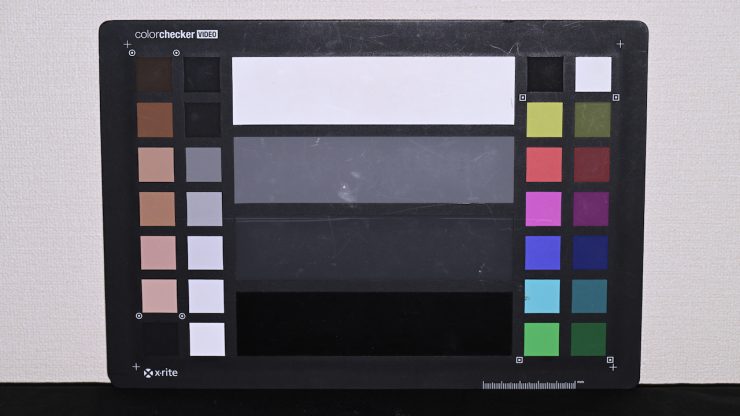
Preset 3200K Camera WB 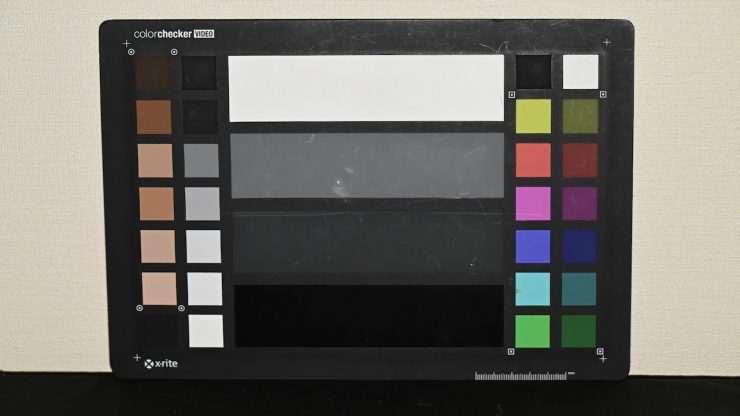
Camera WB
Now, let’s do that exact same test, but this time at 3200K. In the real world, at 3200K, the light also leans slightly magenta.
The Maxima Spectra is compact and lightweight, and this alone makes it an intriguing proposition for anyone who wants to keep their kit size to a minimum.
The ease of use that this fixture offers is impressive. Because it has been well thought out, nothing is overly complicated, and it doesn’t take long to set up the light or put it away once you are done.
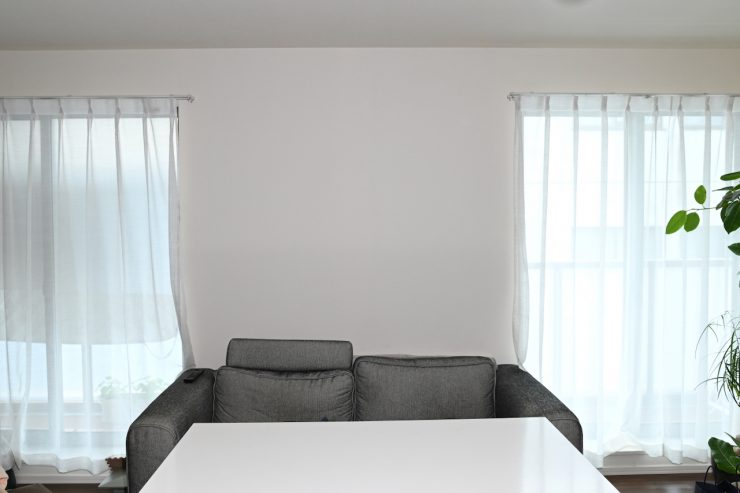
Open Face 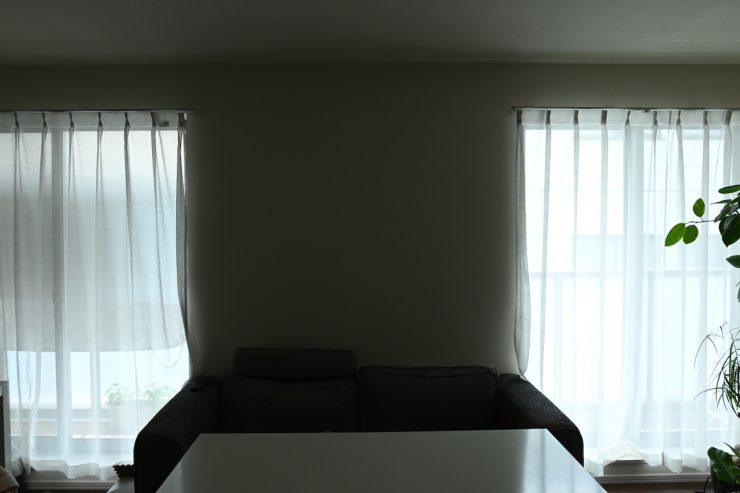
Light Off
Above, you can see what the light looks like when set at a distance of 3m / 9.9′ from a wall and used open face. I have kept the settings on the camera the same for both shots.
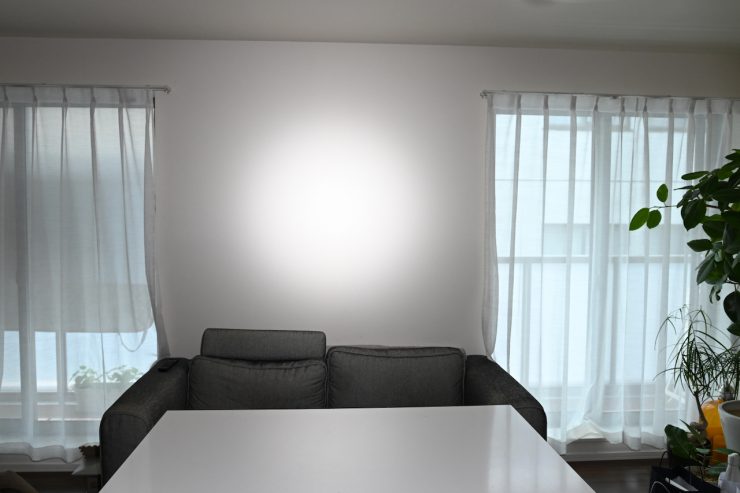
Profoto MaxiZoom Reflector Spot 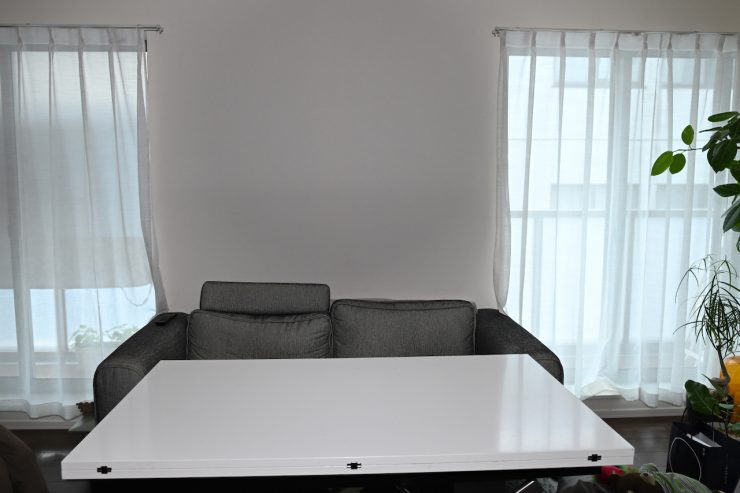
Profoto MaxiZoom Reflector Flood 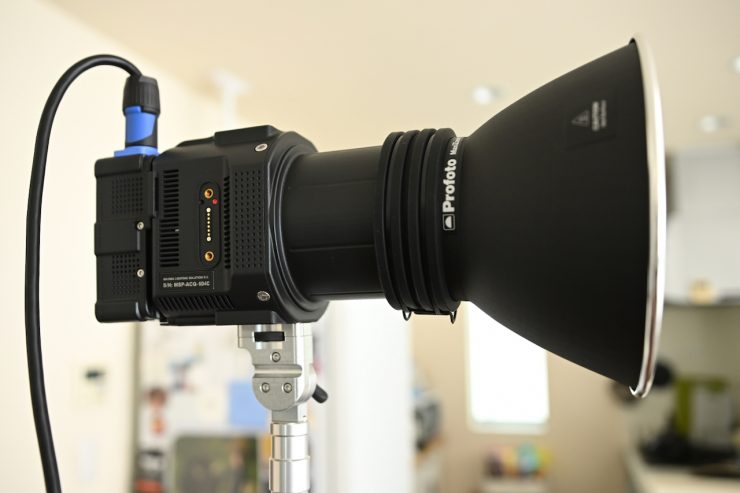
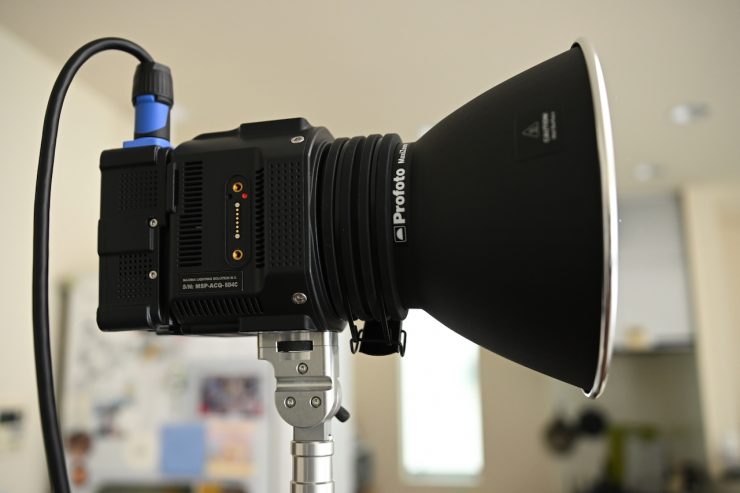
Above, you can see what the light looks like when set at a distance of 3m / 9.9′ from a wall and used with a Profoto MaxiZoom Reflector. I have kept the settings on the camera the same for both shots.
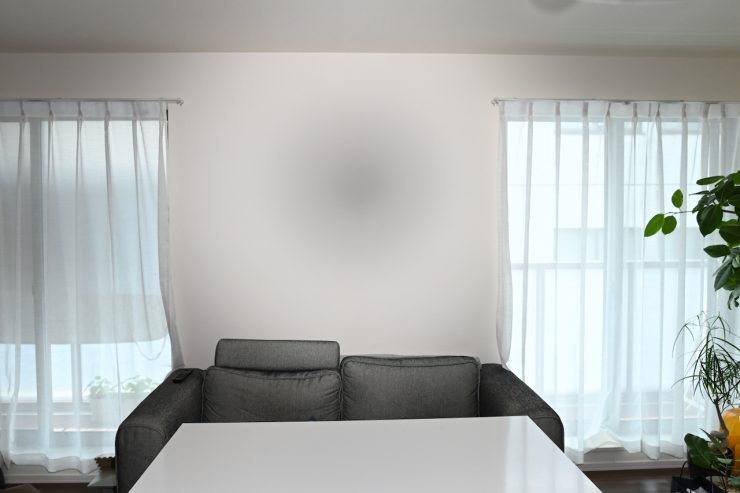
Now, I did stumble across an issue when using the light with the Profoto MaxiZoom Reflector when it was set at a certain position. I ended up getting a big black circle in the middle of the illumination. To be fair to Maxima, this is not a lighting modifier that was designed to specifically work with this fixture.
The light certainly has more than enough punch to work well for interviews, lighting up small to medium-sized rooms, etc., and creating a nice hard directional source when using reflectors. The versatility of being able to use the light as a hard or soft source is what makes spotlights such a popular option for owner/operators.
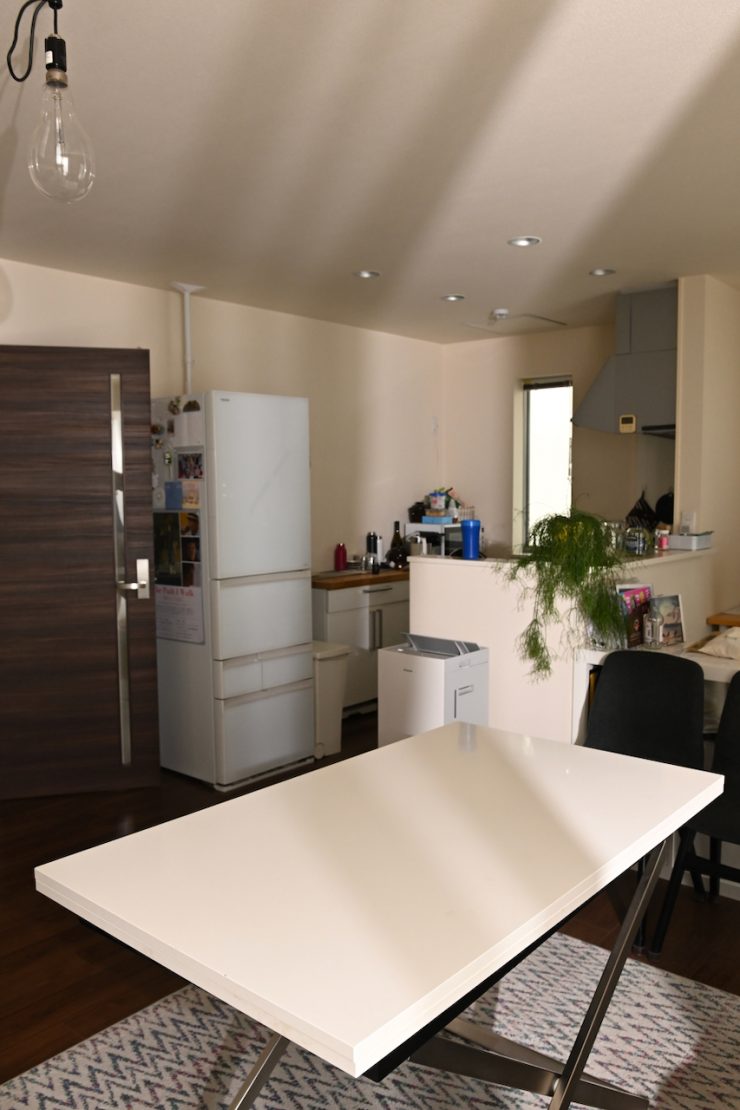
Light On 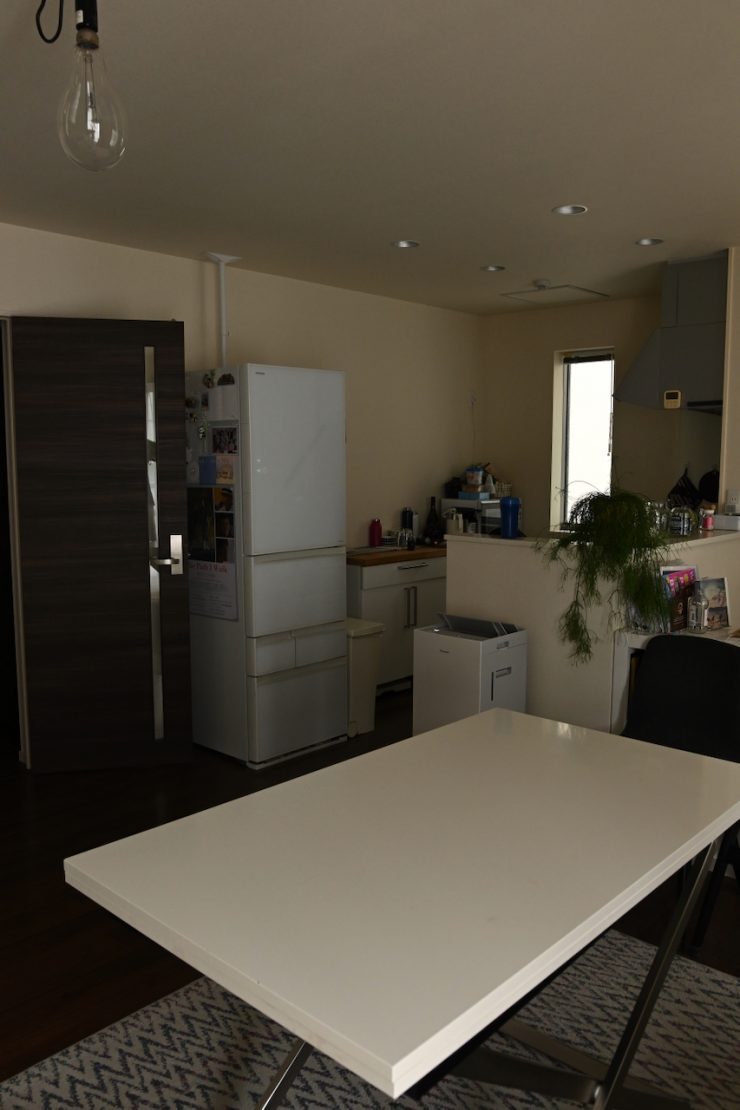
Light Off
Above, you can see comparisons where I punched the light through a sheer curtain into a room when used open face. I have kept the settings on the camera the same for both shots.
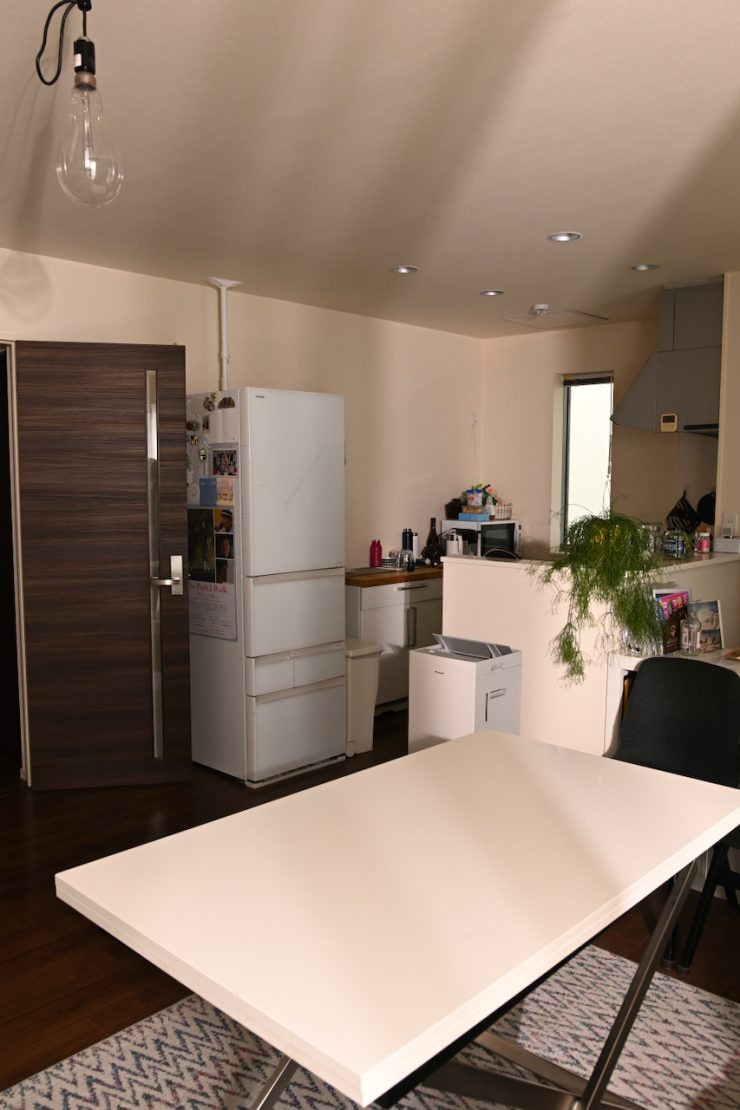
Light On 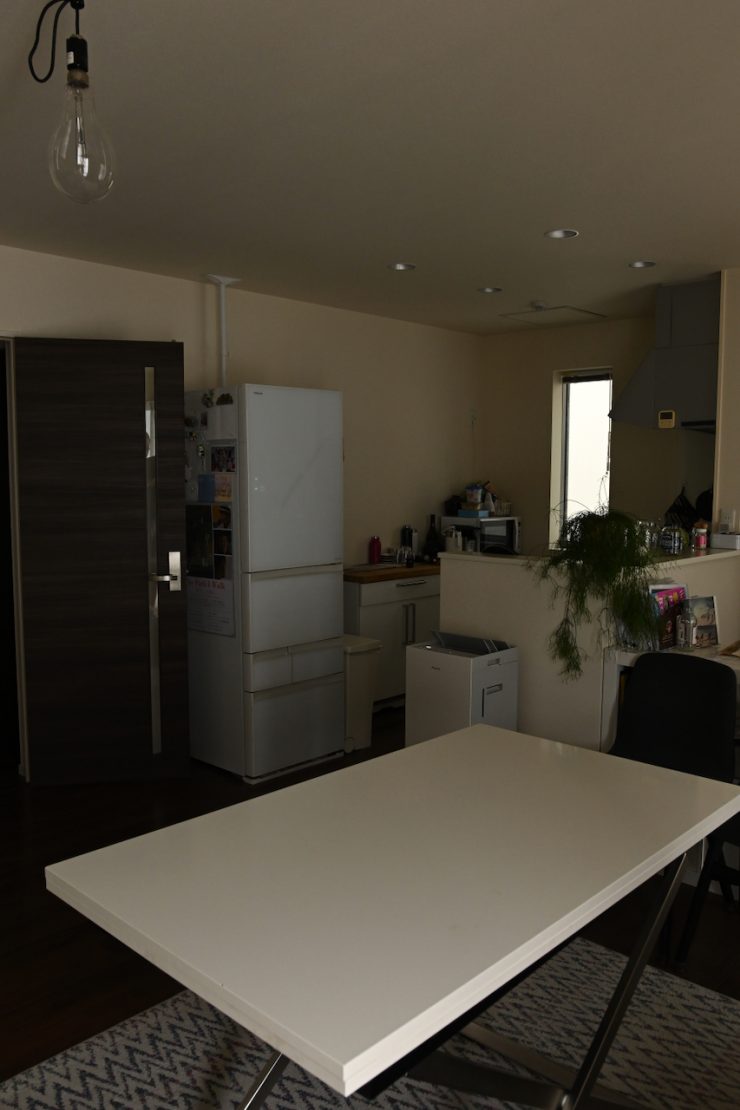
Light Off 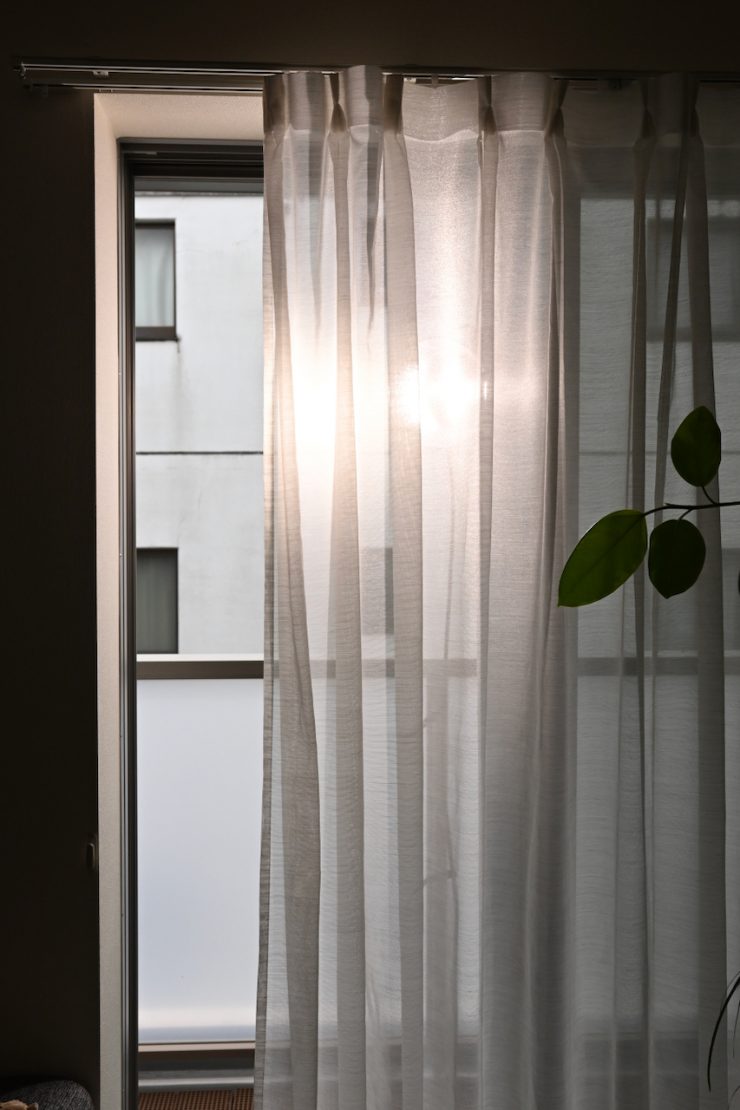
Light Position 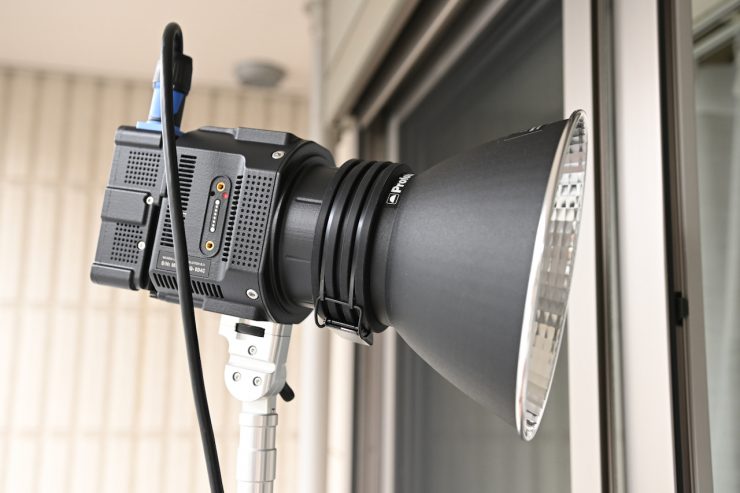
Above, you can see comparisons where I punched the light using a Profoto MaxiZoom from outside through a sheer curtain. I have kept the settings on the camera the same for both shots.
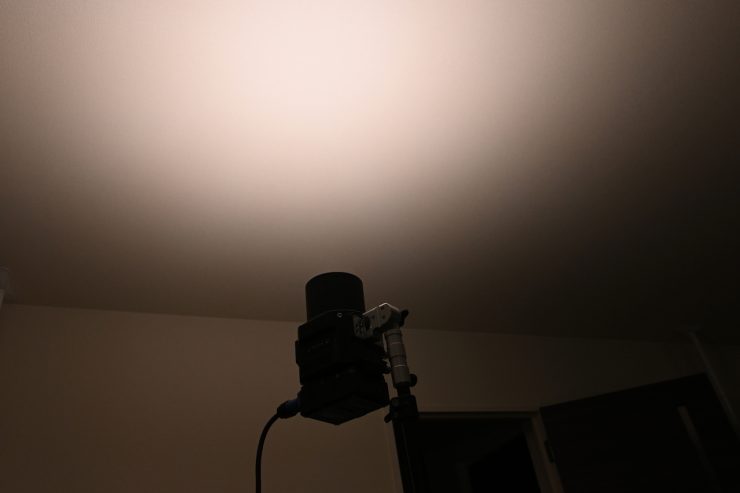
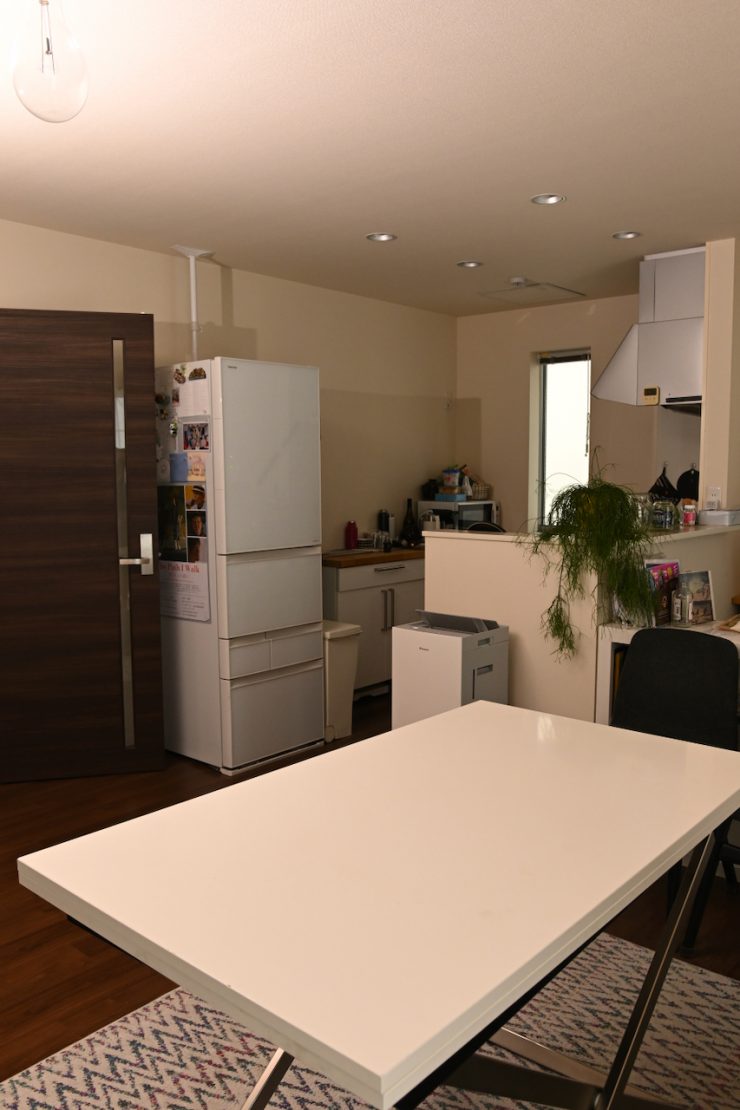
Light On 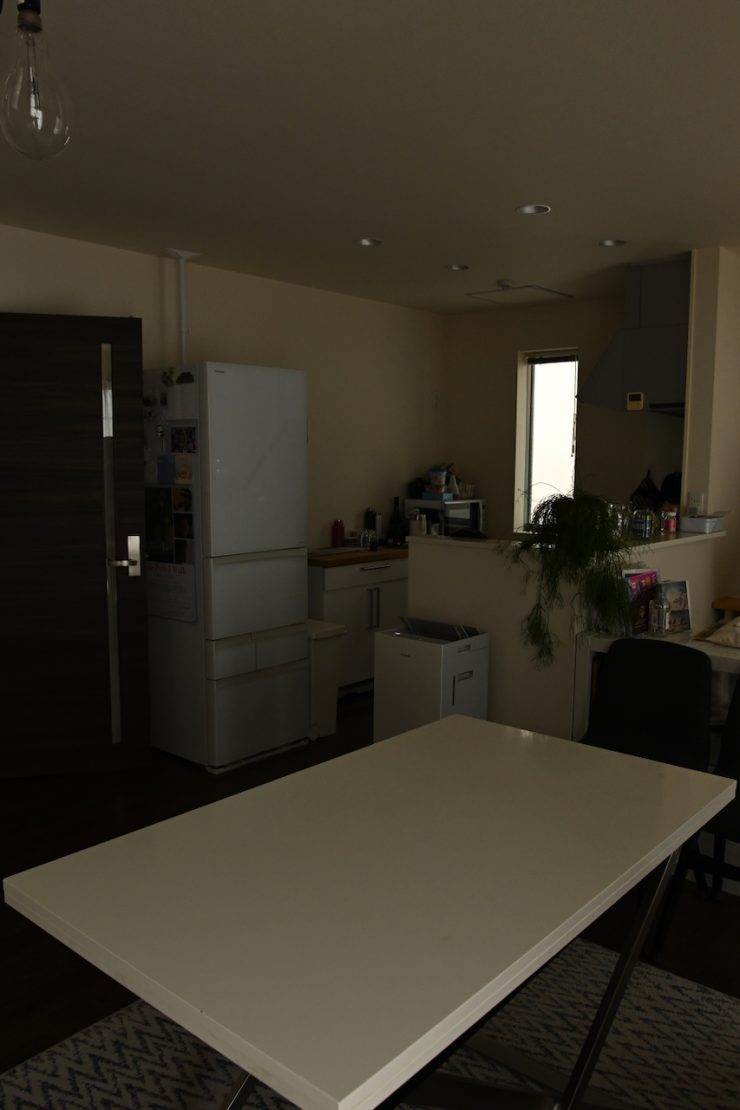
Light Off
Above, you can see comparisons where I punched the light directly into a ceiling.

Above, you can see what the light looks like when used with a Profto 4′ Octa softbox.
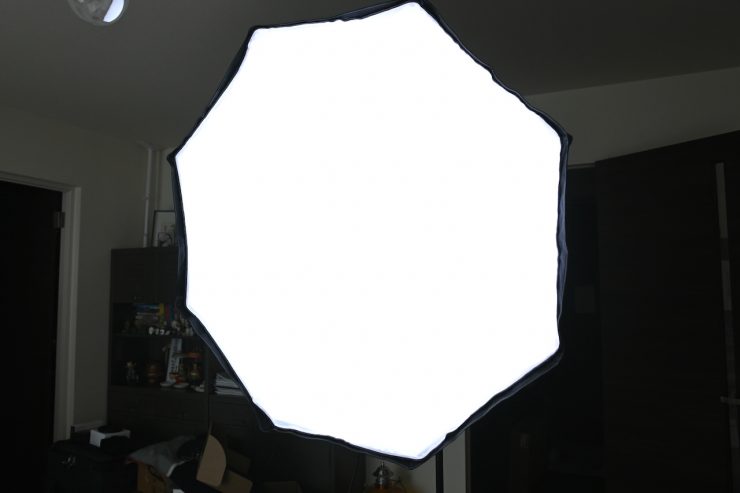
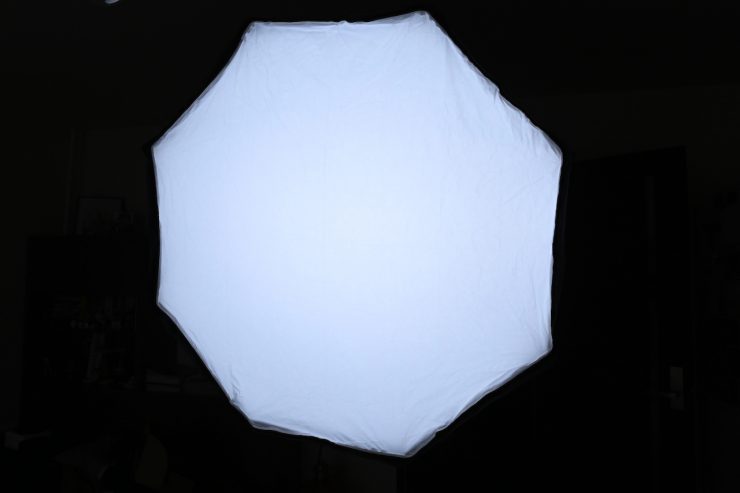
Above, you can see that when you use something as large as the Profoto 4′ Octa softbox, it isn’t going to fill it completely, but nonetheless, it will still do a decent job.
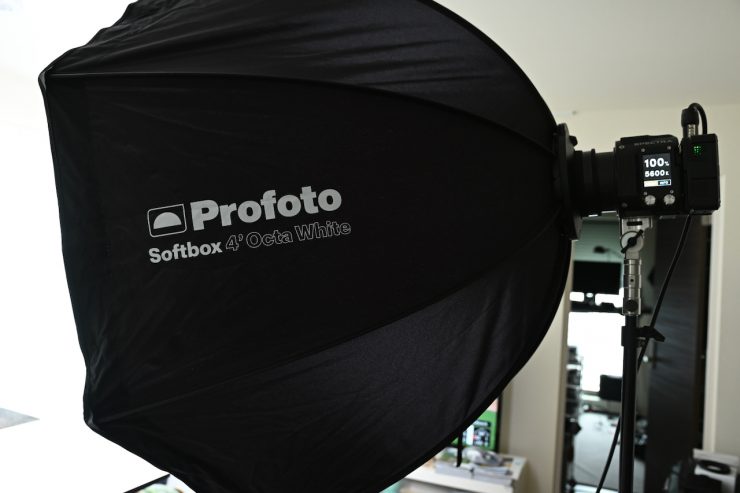
The mount has no problem supporting the weight of a large lighting modifier.
Who is the Maxima Spectra aimed at, and where does it fit in the market?
You could use the Maxima Spectra for lots of different lighting applications, but the fixture is certainly being targeted as a versatile, lightweight, high-output, and high-quality lighting fixture for professional use in the TV and film industry.
Pricing & Availability
The Maxima Spectra is now available to purchase for 799 €.
It comes with a 2-year warranty with repair and upgrade service in the EU.
Specifications
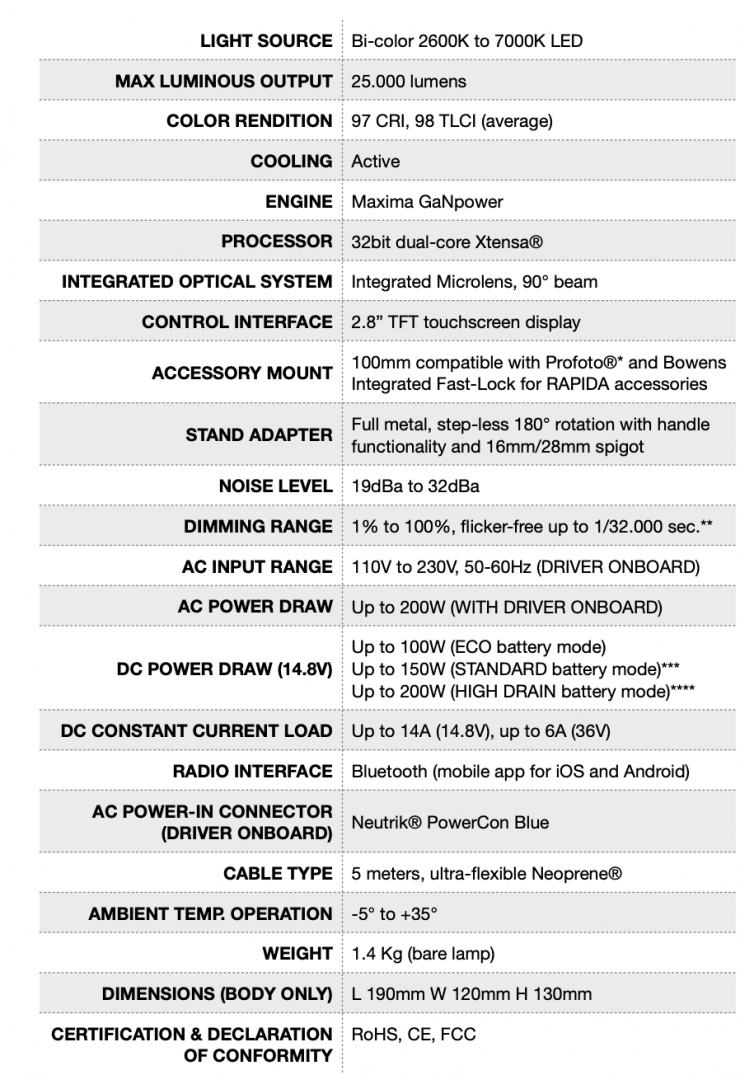
Conclusion
If you are an owner-operator who is looking for a small, well-built, bright travel-sized lighting solution that can be run via flight-safe batteries, the Maxima Spectra is certainly worth considering.
The light’s photometric performance was generally pretty good, but not as good as its siblings. It has a good amount of output, and it is very CCT accurate between 3200K-7000K (only at 6500K was there a slight anomaly).
There really is no such thing as the perfect light. There are pros and cons to every light. The best light is often the one that works well for your particular needs.
Whenever something new comes out, there are always going to be questions asked, such as, “Why do I need that?” and “Does this do anything that can’t already be done with something that I already own?” These are important questions that only you can answer.
Any potential buyer of a Maxima Spectra has to weigh up the cost and feature set against fixtures they may already own, or competing fixtures that offer different functionality. The only issue, as I mentioned earlier, is that Maxima is a small company and they only make a handful of lights, so you can’t just go with one brand to cover all of your needs like you could with some other manufacturers.
The great aspect of the Spectra, like most spotlights, is that it has the ability to be a hard light source, a soft source, or just about anything else you want it to be by coupling it with a wide array of lighting modifiers.
The mounting options are great, as is the ease of use and ability to be run off flight-safe batteries.