
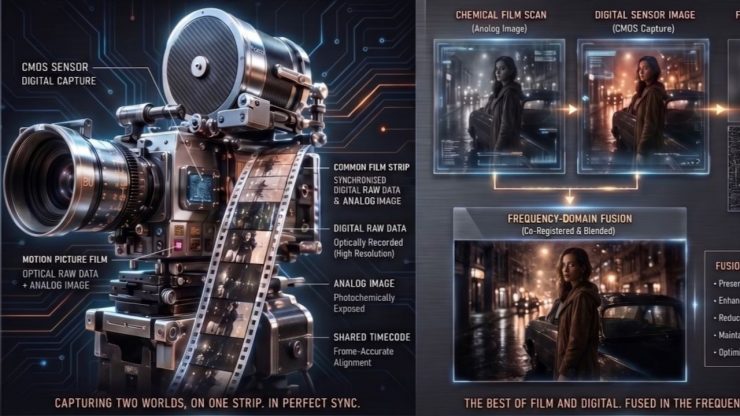
After apparently 25 years of development, Frank Riebert has unveiled RieberVision, a hybrid film/digital motion picture camera system concept. Please note this is a concept and not a camera that is even in the prototype stage. Whether or not it ever gets built remains to be seen.
Frank Riebert was a Senior Camera Technician at Otto Nemenz in Hollywood for more than 20 years.
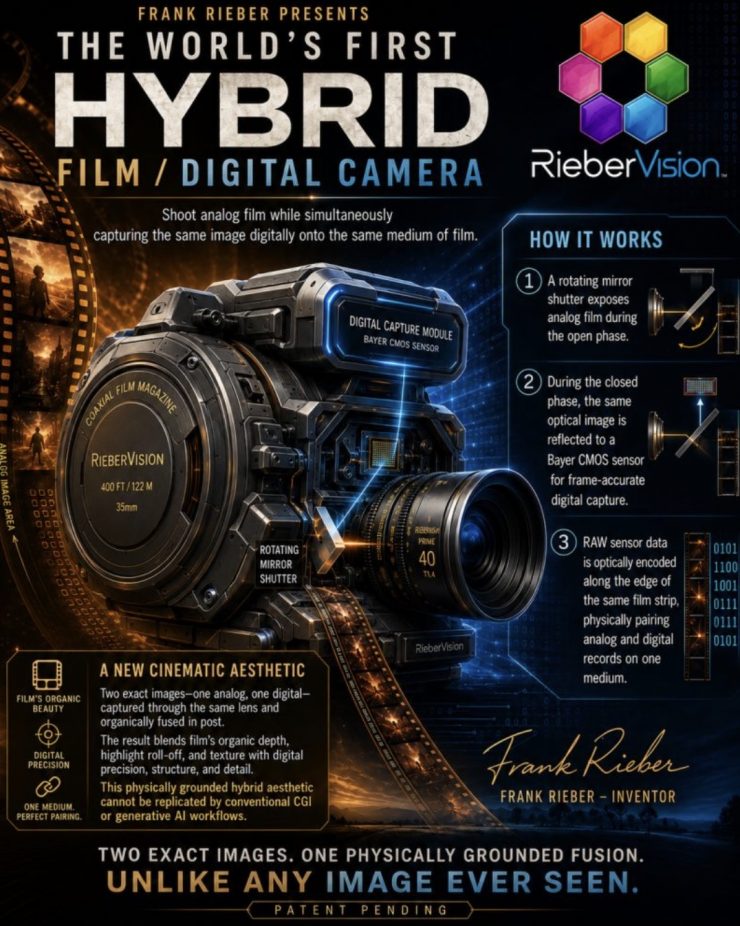
According to Frank, the concept camera is designed to shoot traditional analog motion picture film while simultaneously capturing a frame-accurate digital image of the same scene through the same lens. The system uses a rotating mirror shutter positioned in front of the film gate. During the open phase, the film emulsion is exposed. During the closed phase, the same optical image is reflected upward to a Bayer CMOS sensor for digital capture. The RAW digital sensor data can then be optically encoded along the edge of the same film strip, physically pairing the analog film image and the digital image on one medium.
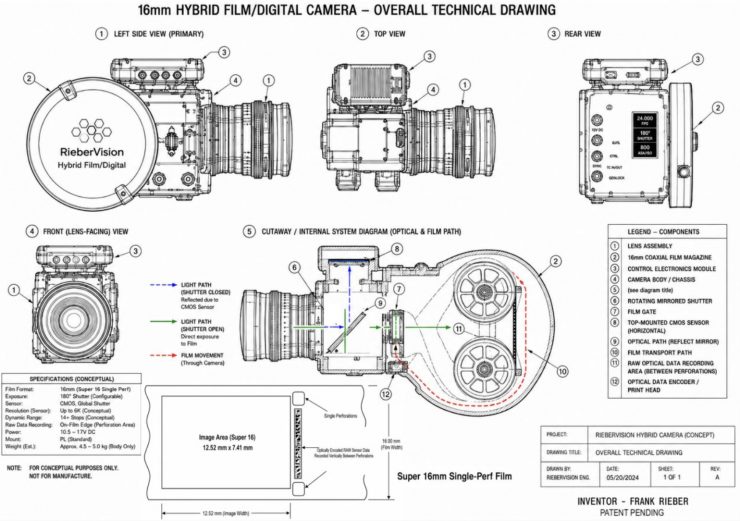
The technical drawing above is for a 16mm Hybrid Film/Digital Camera, a proposed Super 16 platform designed to capture the organic character of film while simultaneously recording a frame-accurate digital representation of the same optical image. The system uses a rotating mirrored shutter positioned within the optical path: When the shutter is open, the lens directly exposes the Super 16mm film image area. When the shutter closes, the mirrored surface redirects the incoming image upward to a horizontally mounted CMOS sensor.
The digital RAW sensor information is optically encoded onto the same single-perforation 16mm film strip. The data is recorded vertically in the area between adjacent perforations, creating a physical relationship between the analog frame and its corresponding digital data. The coaxial film magazine contains the feed and take-up rolls side by side, preserving a practical 16mm camera configuration while integrating the additional optical, electronic, and data-recording systems.
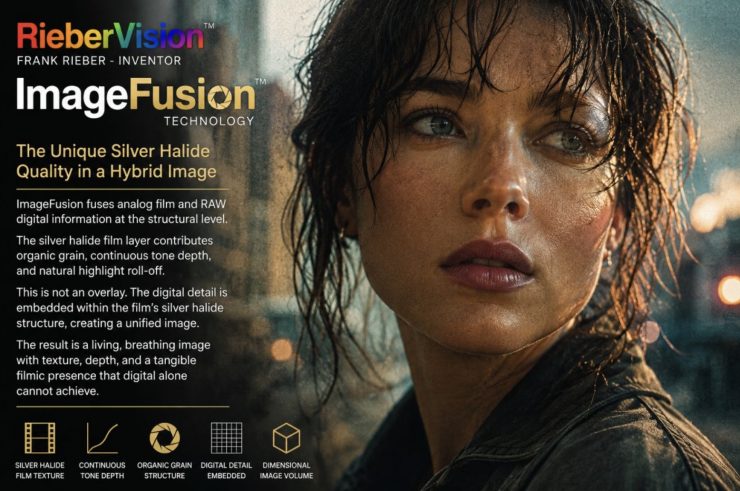
According to Frank, the real breakthrough is not only the camera, but what happens when the two images are fused together through his proprietary ImageFusion technology. ImageFusion is claimed to organically fuse the analog film scan and the corresponding digital image into what Franks refers to as a new cinematic aesthetic.
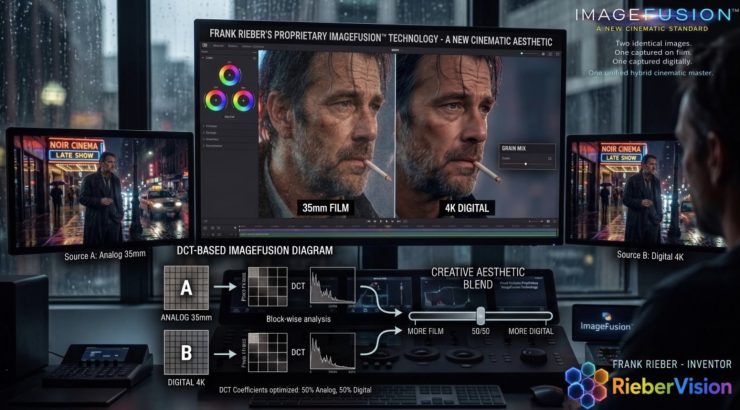
It is claimed to be more than a simple blend, a LUT, a film-emulation filter, CGI, or generative AI. It is a physically grounded fusion of two real optical records captured from the same moment in space and time. Aesthetically, the result is different because film and digital contribute different visual traits. Film brings density, highlight roll-off, organic grain structure, color depth, texture, etc. Digital brings precision, sharpness, edge integrity, structural detail, and frame-accurate image information. Through ImageFusion, those qualities are not layered on top of each other. According to Frank, edges can retain digital clarity while being absorbed into the texture of film grain, while highlights can carry the smooth compression of analog emulsion while preserving digital structure. Skin tones can have the depth and density of film while maintaining the precision of the captured image.
Frank claims that the final image is not a film or digital look; it becomes something new. He goes on to say that this aesthetic cannot be truly reproduced by conventional CGI or generative AI. Those tools can imitate the surface appearance of film, but they are not starting from two real optical captures made through the same lens and physically paired on the same strip of film.
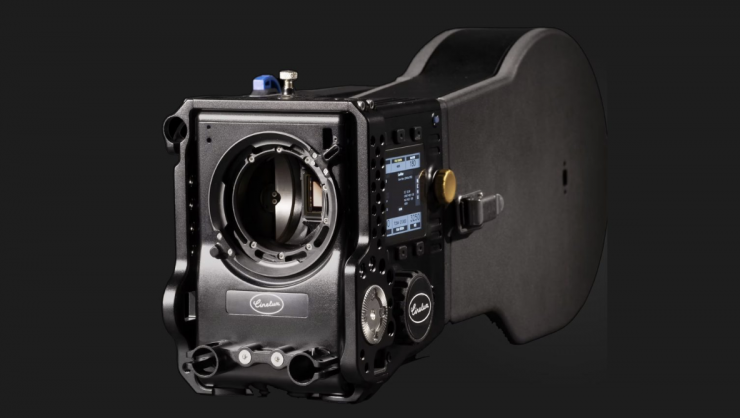
The idea for a hybrid film/digital camera isn’t a new one. Recently, at Cine Gear 2026, Cinelux was showing a prototype of its SIXTEEN Hybrid Cinema Film Camera. The Cinelux SIXTEEN is being billed as a truly hybrid Super 16 film camera that has its very own digital cinema sensor built in. It features a 3K Super 16 sensor that records the CFExpress Type B media in many usable codecs, so you have instant digital proxies as well as a true-to-life film feed while shooting.
Cinelux is developing live-reactive image processing that will behave as closely as possible to the film stock you’re using, providing an accurate live feed that reacts with the same sensitivity to color, highlights, and shadows as your film stock, so you can eliminate surprises when you get your scans back.