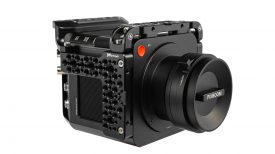


The Zhongyi Optics Z ONE FF Cine T1 Lenses are a new set that consists of a 35mm, 50mm, and 75mm T1. These are quite different from the company’s previous 50mm T1 Speedmaster, as they feature a professional cine housing with improved mechanics and better gearing.


The Z ONE FF Cine T1 Lenses were designed to offer cinematographers a fast and high-performance set at an affordable price. It makes sense for Zhongyi Optics to offer something different from the competition, as there is already a plethora of FF T1.5/1.4 PL prime lenses on the market.


The lenses share the same 114mm front O.D. and sixteen-blade iris, and they come in PL mount, with user-changeable Canon EF mounts in the kit. As far as I am aware, there is no LPL mount option available.

Over the last 2-3 years, we have seen the lens market shift axis, and gone are the days when you needed to spend a small fortune to get a quality set of primes. With so many affordable options now on the market, it has become a hard sell to convince owner/operators to buy expensive optics from traditional lens manufacturers. The performance gap between expensive cine glass and more affordable options continues to narrow.
The original 50mm T1 Speedmaster

Zhongyi Optics previously made a 50mm T1 Speedmaster Cine Lens in PL mount, but that was the only lens in the series.
Focal Lengths Available

Unlike a lot of cine prime sets, which consist of multiple lengths, the Zhongyi Optics Z ONE is only currently available in three focal lengths:
- 35mm T1
- 50mm T1
- 75mm T1
This does arguably put them at a disadvantage, especially since there is no focal length wider than 35mm. I would like to see Zhongyi Optics bring out a couple more focal lengths; however, anything wider than 35mm and longer than 75mm would be a challenge to make T1. The company has recently teased two future focal lengths, so it will be interesting to see what they will be.

At this stage, it’s probably best to think of the Z ONE lenses as a specialty set and not as a complete prime lens solution; however, that could change in the future.
Optical Design


All of the lenses feature a whopping 16 aperture blades. The optical design is as follows:
- 35mm T1– 12 groups 13 elements
- 50mm T1– 10 groups 11 elements
- 75mm T1– 13 groups 11 elements

The minimum focus distance is as follows:
| MOD | |
| 35mm T1 | 60cm / 2′ |
| 50mm T1 | 52cm / 1.8′ |
| 75mm T1 | 70cm / 2.4′ |
Images are claimed to be fully resolved at 8K+ resolution, and the lenses cover both VistaVision and Super35 formats. The Z ONE series can cover a 46mm image circle.
Size & Weight


The Zhongyi Optics Z ONE FF Cine T1 lenses are not lightweight options. which doesn’t come as any real surprise, given their fast T stop and image coverage. Below are the weights for the various focal lengths:
| WEIGHT | |
| 35mm T1 | 6.61 lb / 3kg |
| 50mm T1 | 6.61 lb / 3kg |
| 75mm T1 | 6.61 lb / 3kg |
All three focal lengths are the exact same length.


As a comparison, the Tokina Cinema Vista 50mm T1.5 weighs 2.15kg / 4.73 lb.


Above, you can see how the Zhongyi Optics Z ONE FF Cine compares in size to the NiSi AUREUS 85mm T1.4.
Below, you can see how the weight of the lenses compares to the DZOFilm Arles primes and the NiSi AUREUS series.
| WEIGHT | |
| Zhongyi Optics Z ONE 35mm T1 | 6.61 lb / 3kg |
| NiSi 50mm T1 | 5.04 lb / 2.29kg |
| NiSi AUREUS PRIME 35mm T1.5 | 2.86 lb / 1.3kg |
| DZOFilm Arles 35mm T1.4 | 3.6 lb / 1.65kg |
| Zhongyi Optics Z ONE 50mm T1 | 6.61 lb / 3kg |
| NiSi AUREUS PRIME 50mm T1.5 | 2.86 lb / 1.3kg |
| DZOFilm Arles 50mm T1.4 | 3.7 lb / 1.69kg |
| Zhongyi Optics Z ONE 75mm T1 | 6.61 lb / 3kg |
| NiSi AUREUS PRIME 85mm T1.5 | 2.86 lb / 1.3kg |
| DZOFilm Arles 75mm T1.4 | 3.7 lb / 1.66kg |
The Zhongyi Optics Z ONE lenses are around twice the weight of some of the more affordable cine lens options, but you do have to clearly remember that they are T1 and not T1.4/1.5.


The weight arguably makes the lenses a challenge to use with smaller-sized mirrorless hybrids. At least in my opinion, they are better suited for use with mid- to large-sized digital cinema cameras.
Build Quality


The previous build quality of Zhongyi Optics cine lenses was pretty ordinary, to say the least. With so many affordably priced competing options now available, the company needed to step up its game. The outside of the Z ONE lens casing is hard metal, and while it has been designed with a matte black finish to avoid light reflecting off it, it is susceptible to marks and scratches.


The focus rings are nicely weighted, and their operation is very smooth. The focus rotation is 270 degrees, which is great if you are using a follow focus, but if you are pulling focus by hand, you will find it difficult to go from the minimum focus to the maximum focus point.


The iris ring has less resistance than the focus ring, but that is what you would expect. In general, the focus and iris operation is a lot better than previous Zhongyi Optics offerings. While the mechanics aren’t as good as those of a Tokina Cinema, Zeiss, ARRI, Cooke, etc., they are on par with lenses from companies such as NiSi and DZOFilm.


There is a removable lens support adapter that takes a 3/8″ thread. Being as heavy as the lenses are, it’s probably a good idea to use a lens support.


The only issue with using a lens support is that, because of the physical size of the lenses, it is hard to fit them on rails. You need to be a little creative to get it to work.


Aesthetically, the Z ONE lenses are quite nice and understated.
Markings


The Z ONE series has clearly marked focus and iris scales on both sides of the lens.


The markings are easy to read and can be seen on both sides of the lens. On the operator’s side, the focus marks are in meters, and on the camera assistant’s side, they are in feet.


The only small issue I came across was that the meter and feet infinity markings don’t line up.
Fall off and Vignetting

The lenses have a really nice falloff; you get a nice amount of illumination across your image without any vignetting.
Going fully nuts

If you wanted to, you could pair the Zhongyi Optics Z ONE lenses with a Kipon PL-PL 0.7x Focal Reducer on something like an ARRI Alexa 35 to really push the optical limits!
The Kipon PL-PL 0.7x focal reducer is designed to reduce the focal length of a lens by a factor of 0.7x and increase the light transmission by one stop. In Laymen’s terms, it enables you to use full-frame lenses on S35-sensor PL-mount cameras to create a wider field of view and increase the T-stop.
While you could do this, I wouldn’t advise it. Because the adapter allows light to pass through to a maximum T-Stop of T1.5 set on the attached cine lens, the resulting T-Stop is up to T1.1 already.
Sharpness
Putting out a T1 full-frame cine prime is no mean feat, and making it sharp when used wide open is a very difficult challenge. I didn’t for one second think that the lenses were going to be tack sharp at T1, but nonetheless, that is why we do tests. I haven’t used any noise reduction or anything else in post to affect the image.
When set wide open at T1, the lenses are still very usable, but the sharpness certainly improves once you start stopping them down.
The 35mm T1 is a little soft when used wide open, and there is some halation and lack of contrast, as I would expect. By T1.4, there is noticeably better sharpness. What was interesting is that the lens didn’t get remarkably sharper when stopping it down. I couldn’t tell a massive difference between T2 and T5.6, for example.
The edge sharpness on the 35mm T1, when used wide open, wasn’t great. Once you stop the lens down, to say T5.6, it improves dramatically.
As you would expect, the 50mm T1 is quite a bit sharper than the 35mm T1 when used wide open. Stopping the lens down does provide improvement.
Just like with the 35mm T1, the edge sharpness on the 50mm T1, when used wide open, wasn’t great. Once you stop the lens down, to say T5.6, it improves dramatically.
The 75mm T1 is, at least in my opinion, the sharpest out of the three lenses. When used wide open, it provides decent results, and again, stopping the lens down does provide improvement.
When it comes to edge sharpness, the 75mm T1 was a lot better when used wide open than the other two focal lengths.
Above, you can see a test where I compare the sharpness of the Zhongyi Optics Z ONE 75mm T1 against the NiSi AUREUS 85mm T1.4 and Tokina Cinema Vista 85mm T1.5 @T1.5.
This test did somewhat surprise me, as the Zhongyi Optics Z ONE 75mm T1 was able to hold its own against both of these lenses. What was also of interest is that the Z ONE 75mm T1 had less chromatic aberration fringing on the outside of the bokeh than both the NiSi and the Tokina.
Lens Breathing
I tested out the lenses by doing large focus throws, and to my eye, there is a little bit of focus breathing, but it is very well contained. breathing. What you do see is some perspective shift, which is normal when refocusing a lens.
Image shift is the change in location of a fixed point after a focus rack. It should be in the same spot after you rack focus.
Perspective shift is the focal length of the lens being modified by the movement of the optics. A slight change in focal length may happen if there is a floating element that moves and is not properly corrected for in the design. Certainly, the great majority of lenses have this issue. It’s also tenths of a mm, so not overly noticeable.
Focus breathing is a change in image size, so the size of the object will get larger as it moves out of frame. That is reproduction size.
In summary, perspective shift is the effective focal length change (angle of view change) and focus shift is reproduction size of the object changing as focus moves. Think of it like Macro. A macro lens can be 1:1 life size reproduction, but as you focus, it can change the reproduction size. That is focus shift from intentional breathing design. The angle of view is not overly affected in that case because it is flat field focus. On spherical lenses, the angle of view does
Lens Flare
The Zhongyi Optics Z ONE lenses have some very interesting flare characteristics. The flares, at least in my opinion, add some character, but they do differ somewhat across the focal lengths.
The flare colors you get are blue, green, and purple. The lenses do produce some halation when used wide open at T1, but it’s not over the top. You can also get some veiling, depending on the light. Depending on the camera you are using, the results will also change.
The 50mm and 75mm T1 had slightly more veiling and softness to the flare than the 35mm T1. You can see more examples of flare in my test footage further down in the review.
What is nice is that the lenses still retain a good amount of contrast even with direct light hitting the front of them.
Chromatic Aberration
You would expect to see some chromatic aberrations with lenses that have a maximum aperture of T1.

The lenses certainly do have chromatic aberration when used wide open at T1, especially when filming bright backlit scenes. You can clearly see the purple fringing in my test footage further down in the review.
Bokeh

Nice bokeh is something you want if you are purchasing a fast lens. The bokeh produced by the Z ONE lenses is nice and round, as you would expect from a 16-blade aperture. At T1 on an FF sensor, the bokeh becomes almost non existent because of just how out of focus it gets. I didn’t personally find that the image pops, as the in-focus to out-of-focus areas don’t really have a gradual falloff. The bokeh is certainly nice and round and relatively clean. I didn’t see tons of onion rings or excessive amounts of color fringing on the edges of round circles.
Bokeh is a personal thing, just like flare, and whether you like it or not will depend on your tastes.
Color Tone


The Zhongyi Optics Z ONE, at least in my opinion, has a fairly neutral color tone that leans a little cold, like a Zeiss. What you prefer from a lens is entirely going to come down to personal choice.
The color tone of a lens is something you should look at closely if you are going to be using primes and zooms from different manufacturers. Certain prime and zoom lenses work better together than others. What will work for you will also depend on what camera you are using.
Real World Thoughts


I liked using the Zhongyi Optics Z ONE lenses. As they are a little different, they can provide some interesting results. Being able to shoot at T1 is more of a creative choice than anything else, but it is arguably one of the main reasons you would buy a set like this.
I went out and took some quick shots in natural lighting conditions using the lenses to see how they performed. I shot mostly wide open at T1 to show you what they look like. The biggest problem when shooting at T1 in bright conditions is that you need a ton of ND. I was running an ND1.5 filter and the internal ND on the Alexa 35 at ND 2.1.
The lenses provide good results, but it is hard to focus at T1, even on an S35 sensor camera! On a full-frame sensor camera, the depth of field at T1 is so shallow that it makes getting anything in focus a big challenge. If you rocked up on set and set the aperture at T1, the focus puller is going to wake up in the middle of the night in cold sweats!

The Zhongyi Optics Z ONE series are certanly niche lenses, given their fast T stop and large size and weight. The size and weight alone are likely to put a lot of potential buyers off, especially in a market where cine prime lenses have gotten smaller and lighter.

Whether you need lenses that can go to T1 is an individual choice. While having a lens that goes to T1 might sound cool, you have to ask yourself how often you would actually be shooting at T1. I think what makes these lenses interesting is that you can stop the lenses down, and they are still as fast as other offerings on the market.

In some ways, the Zhongyi Optics Z ONE series is sort of a proof of concept where the company is showing what they can do optically.
There is certainly no doubt about the optical performance of these lenses. They are very sharp even when used wide open, and they produce beautiful bokeh and a soft fall-off. The lenses surprised me, and they performed a lot better than I thought they would.
Price & Availability


Despite their fast maximum T-stop and size, the Zhongyi Optics Z ONE series is affordably priced. Below are the retail prices:
- Single Lens: $2,499 USD
- Full Set: $6,999 USD
The lenses are now available to back on Indiegogo. There are special deals for early adopters.


The NiSi 50mm T1, which will be available in August, will cost $2,799 USD. That is only available in LPL mount.

As another comparison, the NiSi AURUES Primes retail between $1,699 USD and $2,599 USD, depending on the focal length.

Other competition comes in the form of the DZOfilm Arles primes, which retail between $2,199 USD and $2,749 USD, depending on the focal length.
| PRICE | |
| DZOFilm Arles FF/VV Prime Cine 5-Lens Set (ARRI PL) | $8,999 USD |
| DZOFilm Arles 14mm T1.9 | $2,399 USD |
| DZOFilm Arles 18mm T1.4 | $2,399 USD |
| DZOFilm Arles 21mm T1.4 | $2,299 USD |
| DZOFilm Arles 25mm T1.4 | $1,999 USD |
| DZOFilm Arles 35mm T1.4 | $1,999 USD |
| DZOFilm Arles 40mm T1.4 | $1,999 USD |
| DZOFilm Arles 50mm T1.4 | $1,999 USD |
| DZOFilm Arles 75mm T1.4 | $1,999 USD |
| DZOFilm Arles 100mm T1.4 | $1,999 USD |
| DZOFilm Arles 135mm T1.8 | $2,299 USD |
| DZOFilm Arles 180mm T2.4 | $2,399 USD |
Other lenses that could be considered competition would be the Rokinon XEEN CF Pro Cine Lenses, which retail for $1,599 USD.