
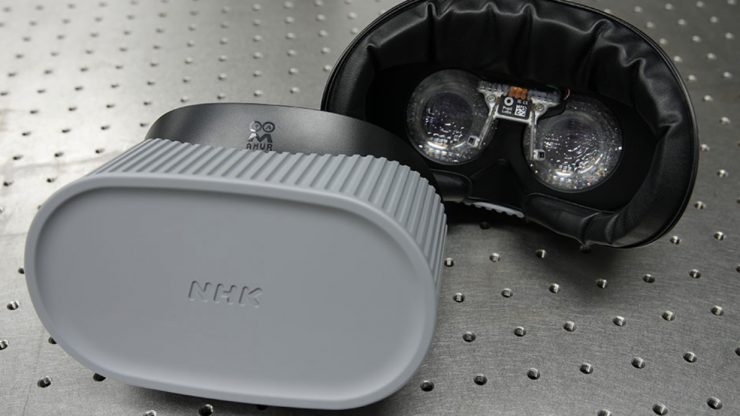
The NHK Broadcasting Technology Research Laboratory has developed a Light Field Head-mounted Display that is thinner and has higher resolution than existing VR display devices.
It was designed with the aim of delivering a comfortable VR viewing experience that minimizes eye strain. NHK has been conducting research into light-field head-mounted displays (HMDs) that reproduce the light rays travelling from objects to the eye. What they have come up with is a light-field HMD featuring a slimmed-down optical system and improved 3D image resolution.
The issue with existing VR headsets is that they produce a sense of depth by projecting images from two displays through lenses to a position in the distance to create slightly offset images (parallax) to the left and right eyes. This type of binocular system often leads to what is commonly referedd to as ‘visual fatigue’. To counteract this, NHK is utilizing Light field technology to recreate the light rays emitted from an object that reaches the eyes. This allows the eyes to focus on the correct position, which in turn enables the device to display natural three-dimensional images that are less tiring to view, even for extended periods of time.
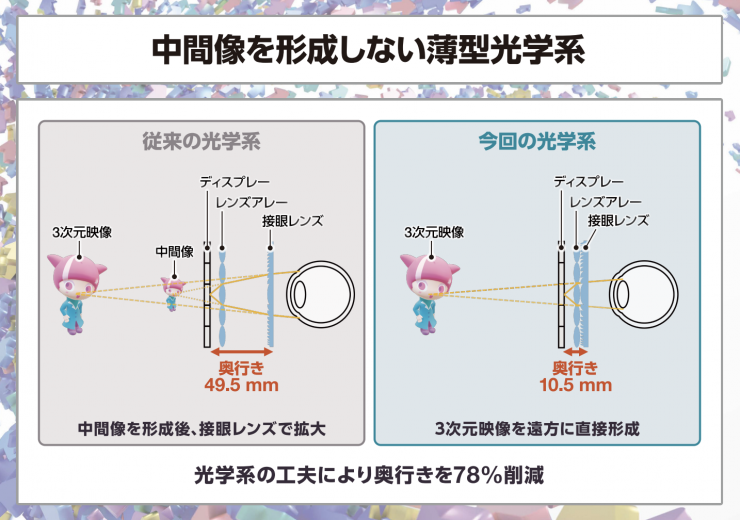
Conventional light-field HMDs display three-dimensional images at a distance by first forming an intermediate image using a display and a lens array, and then magnifying it with an eyepiece lens. The problem with this method is that it requires a gap of around 4cm between the lens array and the eyepiece lens. What this means in layman’s terms is that the HMD becomes large and bulky. NHK’s solution can deliver 3D images directly to the eye without the need for an intermediate image, and they have been able to reduce the depth of the optical system by 79% compared to conventional designs.
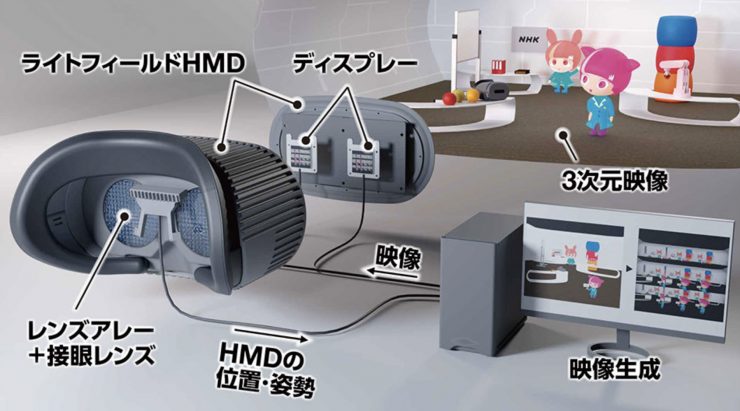
Light-field HMDs use a lens array and an eyepiece lens to reproduce the light rays that travel from a single distant point to various positions on the eyeball, thereby displaying 3D images with adjustable focus.
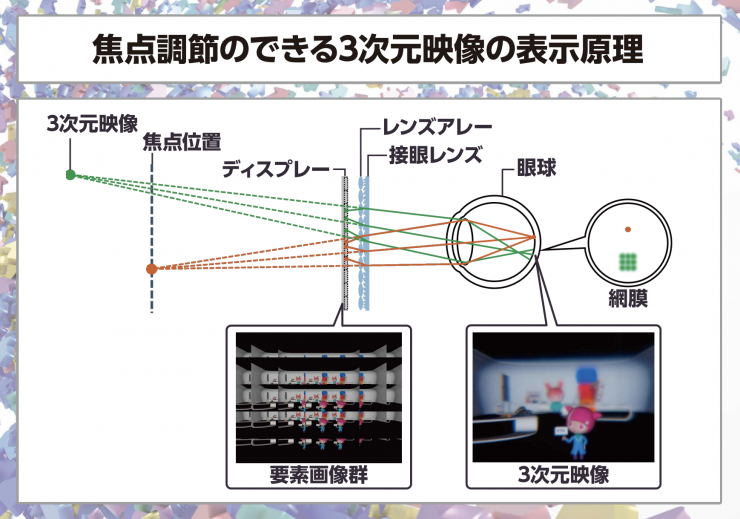
By placing two lenses in contact with each other and controlling the direction of light rays as if they were a single lens, you can display 3D images directly without an intermediate image, whilst also achieving a slimmer optical system.
By adopting a display with a narrower pixel pitch than conventional models and combining this with the high-speed generation of element images using ray tracing technology, high-definition 3D images can be displayed in real time.
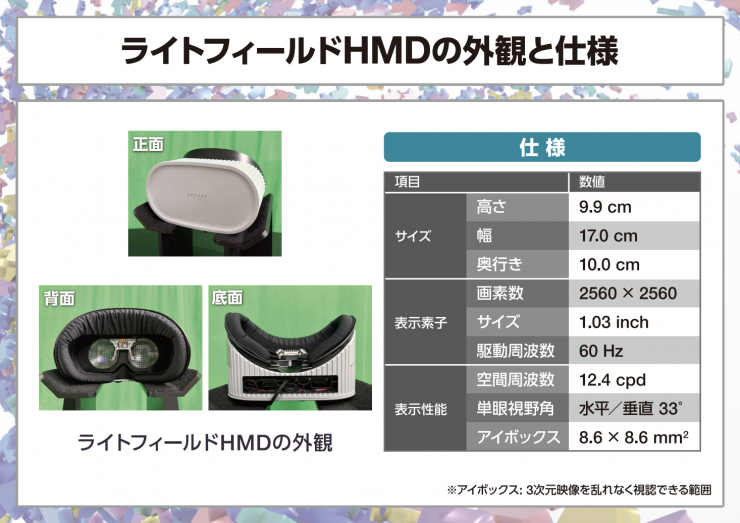
Above, you can see the specifications of NHK’s solution.
It’s a long way off!
NHK states that they will continue to improve and work on the technology and that a production version won’t be available till around 2035.
It will be shown at the Giken Open 2026 Tech Expo, which will be held from Thursday, 28th May to Sunday, 31st May 2026 in Tokyo.