
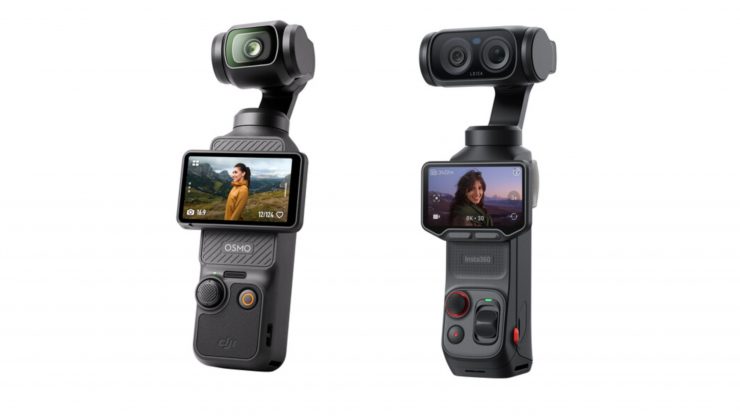
DJI has filed yet another patent ownership lawsuit against Insta360. This time, it is against Insta360’s recently announced Ultra. To rub salt into the wound, a lot of DJI’s newest products are currently not allowed to be sold in the US, while no such restrictions apply to Insta360.
Here is what DJI is stating in the IN THE UNITED STATES DISTRICT COURT
FOR THE EASTERN DISTRICT OF TEXAS MARSHALL DIVISION lawsuit: SZ DJI TECHNOLOGY CO., LTD., v. ARASHI VISION INC. d/b/a INSTA360; ARASHI TECHNOLOGIE B.V. d/b/a INSTA360; ISTONE INNOVATION LTD. d/b/a INSTA360; and INSTONE TECHNOLOGY (HK) LTD. d/b/a INSTA360, which was filed on June 10th, 2026
In 2018, DJI introduced the original Osmo Pocket—the first truly pocketable, integrated handheld gimbal camera. It has continued to innovate on this design, and in 2023 launched the Osmo Pocket 3, featuring an intuitive rotatable touchscreen for precise control. Insta360’s new Luna line of gimbal cameras, including but not limited to the Luna Ultra, supporting accessories, and the Insta360 mobile application (collectively, the “Accused Products”) blatantly copy DJI’s patented inventions wholesale. From its silhouette to its feature set, the Accused Products mirror what DJI has spent the better part of a decade engineering and patenting for its innovative handheld gimbal camera systems.
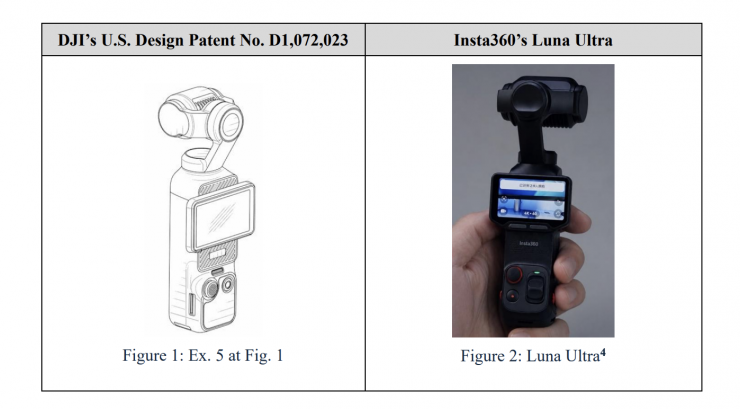
DJI brings this action to stop Insta360’s infringement and to recover damages adequate to compensate DJI for the harm Insta360 has caused and continues to cause. As detailed in the Counts that follow, the Accused Products embody, either literally or under the doctrine of equivalents, one or more claims of each of the Asserted Patents. DJI seeks a judgment of infringement, a permanent injunction, an award of damages no less than a reasonable royalty, profit disgorgement, enhanced damages under 35 U.S.C. § 284 for willful infringement, attorneys’ fees under 35 U.S.C. § 285, and such other and further relief as the Court deems just and proper.
Defendants’ Knowledge of DJI’s Patents
In the lawsuit, it is also stated that:
On information and belief, Defendants have closely monitored DJI’s products and patent portfolio for years. Insta360’s own chief executive officer has publicly acknowledged that Insta360 maintains and regularly updates detailed analyses comparing DJI’s commercial products against the Insta360 and DJI patent portfolios, and that Insta360 specifically evaluates whether DJI’s products fall within the scope of Insta360’s own patent claims.
Insta360 is no stranger to patent lawsuits. Back in February, the U.S. International Trade Commission rejected GoPro’s patent infringement claims, affirming Insta360’s independent innovation.
Insta360 secured a complete victory in Investigation No. 337-TA-1400 as the U.S. International Trade Commission (ITC) issued a final determination in favor of the company. The ruling meant that Insta360 can continue to import and sell its existing product lineup in the United States.
The Commission cleared Insta360 with respect to five utility patents relating to stabilization, horizon leveling, distortion correction, and aspect ratio conversion, confirming that the patents were invalid, not infringed, or both. The Commission also reversed the Administrative Law Judge (ALJ)’s prior finding of infringement as to the ’052 patent relating to distortion and identified an additional non-infringement ground for the ’840 patent relating to stabilization.
This all comes just a few months after DJI filed a patent ownership lawsuit in China against Insta360’s parent company, Arashi Vision. The lawsuit claims that six key patents registered by Insta360 infringe on existing DJI patents. DJI is arguing that the disputed technologies, which include flight control systems, structural design, and image processing, were developed by former DJI employees within one year of their leaving DJI.
This patent dispute is undoubtedly linked to Insta360’s Antigravity A1 Drone.
According to Insta360, their products and technology are the result of years of independent innovation, and they stand firmly by their work. They do not accept the groundless allegations from their competitor and will defend themselves through the appropriate legal process. Since this is an active legal matter, they can’t get into details.
Insta360 also states that they have seen a trend of early players in the action camera industry trying to use legal tactics to stifle fair competition and innovation, but those efforts are ultimately bound to fail. Just last month, they secured a complete victory in the U.S. ITC patent case, which they say was a strong endorsement of their independent innovation.
Here’s Insta360’s press release for reference.
Insta360 goes on to say that rather than focusing on litigation, they remain committed to investing in R&D and will continue to grow their market share and earn their position through sustained innovation.
Insta360’s company founder, JK Liu, issued this statement:
Basically, this is about a few former DJI employees who joined Insta360 and applied for patents during their time with us. DJI claims ownership of these patents. I would like to clarify the following:
DJI claims that any patents generated by employees within one year of leaving DJI should belong to DJI. We carefully reviewed the patents applied for by these employees during that period. The evidence shows that all ideas and innovations were independently created at Insta360. Regarding the area of most interest—flight control—the only potentially relevant patent is one that lets users achieve an FPV-style “building dive” with one button press. This was my idea, and I was deeply involved in refining and approving it. Under current flight restrictions, this patent isn’t very useful, so the feature wasn’t implemented. If DJI wanted this patent, they could’ve just asked for it.
Regarding the “hiding inventors to avoid accusations” claim: many of our domestic patents initially hide the inventors, who are disclosed during the PCT filing phase. This is to respect inventors while delaying the exposure of our employee roster to headhunters, which is why this system exists in the first place. Many of our patent applications also hide inventors who are not former DJI employees. If our motive were as DJI claims, we wouldn’t have used these names at all.
Most of the drone-related patent applications involved in this matter were filed 4+ years ago. Since then, our product roadmap has changed significantly, and many patents have never been used.
We understand why GoPro and DJI sued us—established players hate losing market share. At the same time, many functions and accessories from DJI’s 360 camera and action cameras have been called out in the media as “copied” or “strikingly similar” to Insta360’s. Last year, our team found that DJI’s products could fall within the scope of 28 Insta360 patents—11 of our hardware/structure patents, 8 software-method patents, 6 control-method patents, and 3 accessory patents. But we didn’t sue them. Here’s why:
As a smaller company with limited resources, we prioritize innovation over litigation, expanding our markets through differentiation and providing consumers with more choices. Over the past year, while the major players engaged in price wars, we continued innovating. The market grew over 80%, new players took market share, but overall sales increased. Insta360’s Q4 of 2025 saw our fastest growth and highest revenue in years. Of course, if someone wants to bring a legal battle to our front door, we’ll do what it takes to fight for what’s right. We spent over $10 million to win the GoPro case, and we’re approaching this situation with the same mindset.
So, when would we actually go nuclear with our patents? Only if we’re blocked from launching new products or innovating in a category. For example, if we’re not allowed to make drones anymore.
As for DJI suing Insta360, let’s wait for the court’s evidence collection and investigation procedures to play out. This kind of thing is common in tech. In the meantime, we’re focused on launching 7 or 8 new products and series this year, including gimbal cameras, lavalier microphones, and another drone. Stay tuned.
The bottom line is we respect intellectual property, but we also respect facts, legal procedures, and rulings. We are not afraid of patent lawsuits. We refuse to fight over the same pie; we prefer to expand the market through continuous innovation and earn our place. Litigation is only used as a last resort.