
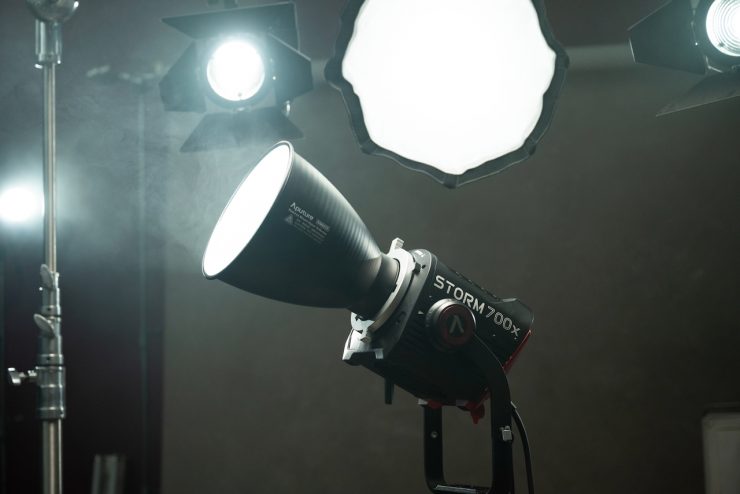
Aputure has added to its STORM family with the announcement of the STORM 700x point source fixture and CF10 Fresnel. The STORM 700x features the same BLAIR light engine that is found in the STORM 400x and 1200x.
Key features
- 700W tunable-white compact point source fixture
- Advanced white point control with green/magenta color correction (±G 100% full ASC MITC range)
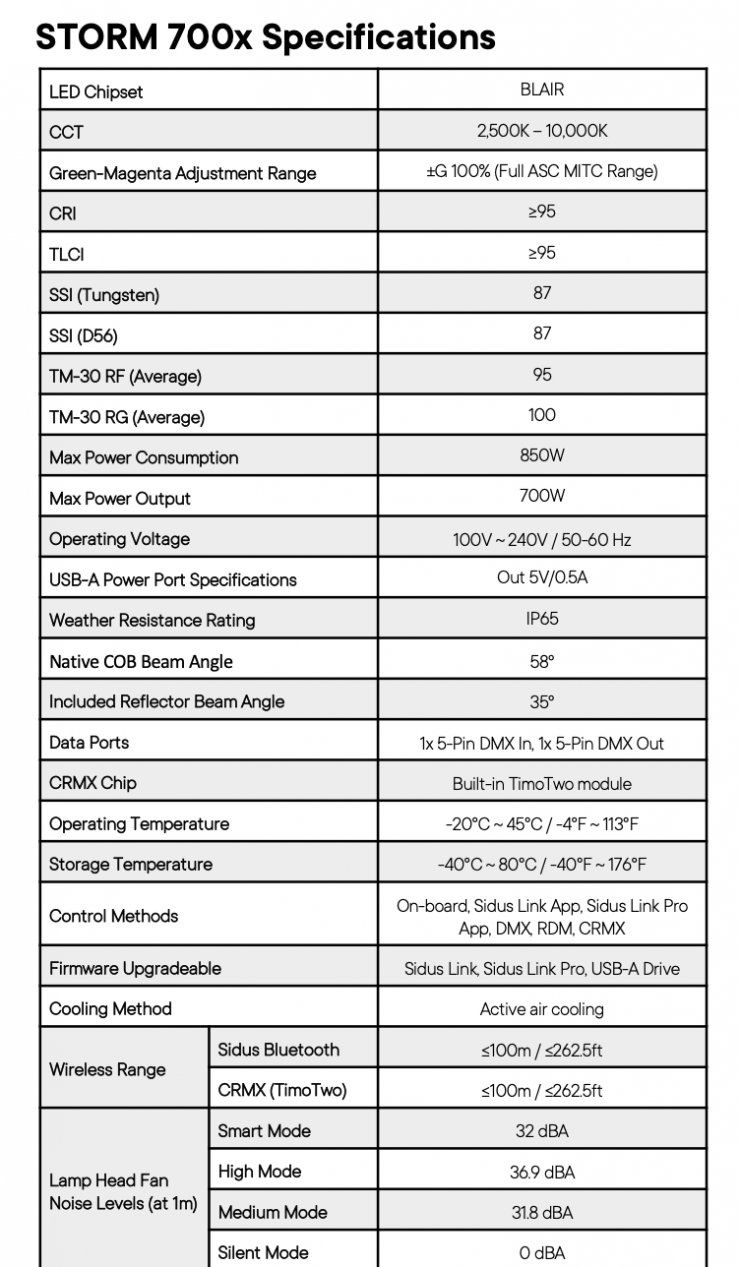
- CCT range of 2,500K-10,000K
- Groundbreaking proprietary LED chipset: Blue, Lime, Amber, Indigo, Red (BLAIR)
- Advanced diode color mixing allows fixture to more effectively utilize each diode’s light output
- 16,730 lux @3m (5600K) when using included 35º reflector
- Ultra-high color accuracy: CRI≥95, TLCI≥95,, SSI [P3200]: 87, SSI [CIE D5600]: 87, TM-30 Rf (average) 95, TM-30 Rg (average) 100
- 70%+ coverage of Rec. 2020 color gamut
- Robust ProLock Locking Bowens Mount design allows for more secure and optically aligned modifier accessory connection
- IP65 weather resistance
- Smooth 0.1-100% stepless dimming
- Multiple control methods: Sidus Link and Sidus Link Pro App, LumenRadio CRMX, 16-bit 5-Pin DMX512 in & out
- Supports firmware batch-updates via Sidus Link, Sidus Link Pro, and USB-A
- Dual output modes: Max and Constant
- High-Speed Photography, Lead-Follow, and Studio Modes
- 4 fan modes: Smart, High, Medium, Silent
- 12 DMX control profiles with multiple DMX dimming modes and customizable DMX signal loss behaviors
- 4 dimming curves: Linear, Exponential, Logarithmic, S-Shaped
- 9 light effects: Paparazzi, Fireworks, Flickering Bulb, Cannon, Lightning, TV, Pulse, Flash, Explosion, Flame
- 10 savable presets
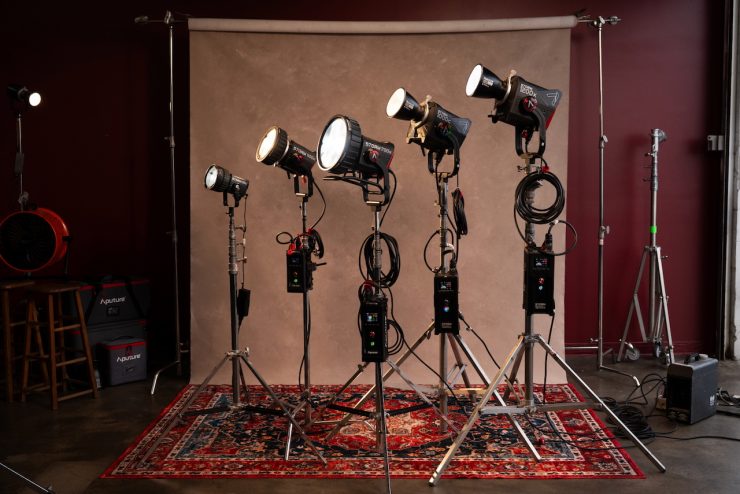
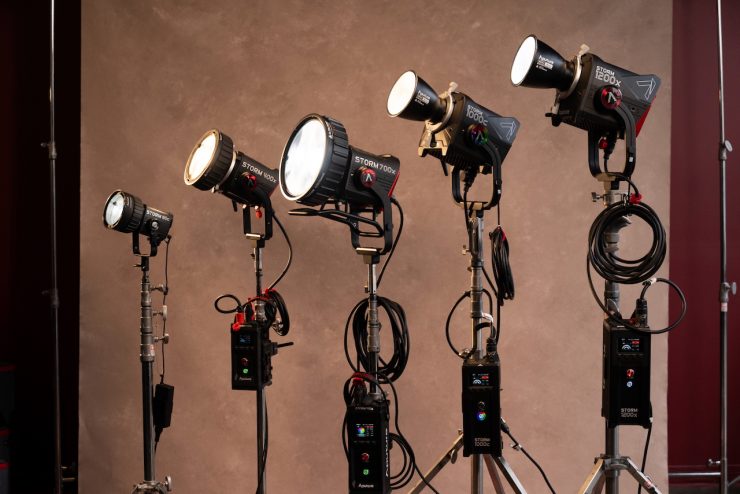
Aputure now offers a comprehensive range of lights in the STORM series that can be used for a wide array of lighting applications.
Output
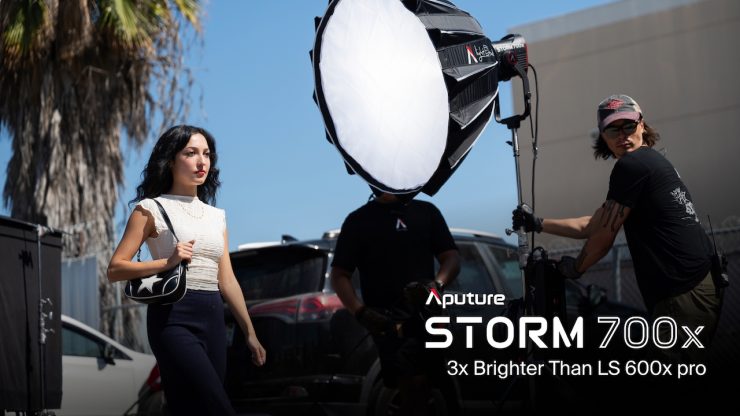
According to Aputure, when used with its included reflector, at a distance of 9.9′ / 3m, the the STORM 700x has a claimed output of 18,670 Lux. To put that figure into perspective, that is three times brighter than the LS 600x Pro.
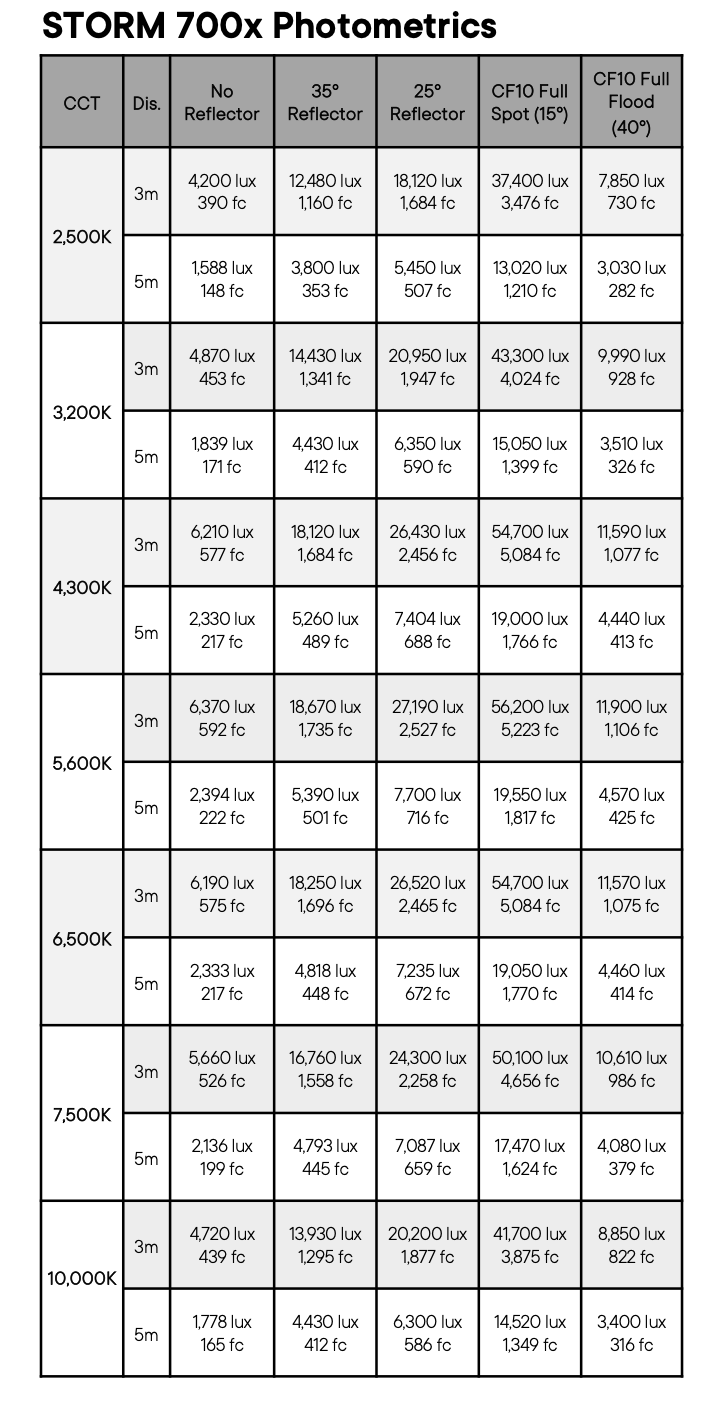
Above you can see the claimed output of the STORM 700x at various CCT settings and with various lighting modifiers.
How does this compare to some of the competitors? Below you can see:
5600K @1m / 3.3′
| | Output at 5600K | CCT (K) |
| Aputure STORM 700x | 168,380 lx* (35° reflector) | NA |
| NANLUX Evoke 600C | 73,500 lx (45° reflector) | 5671K |
| Kelvin Epos 600 | 83,000 lx (62° reflector) | 5666K |
| Prolycht Orion 675 FS | 55,700 lx (55° reflector) | 5515K |
| Aputure LS 600c Pro | 49,000 lx (62° reflector) | 5617K |
| Nanlite Forza 720B | 73,000 lx (55° reflector) | 5397K |
| Aputure LS 600x Pro | 64,800 lx (55° reflector) | 5397K |
*Figure based on claimed output and converted using the inverse square law. Please note this figure hasn’t been independently verified.
Power Draw
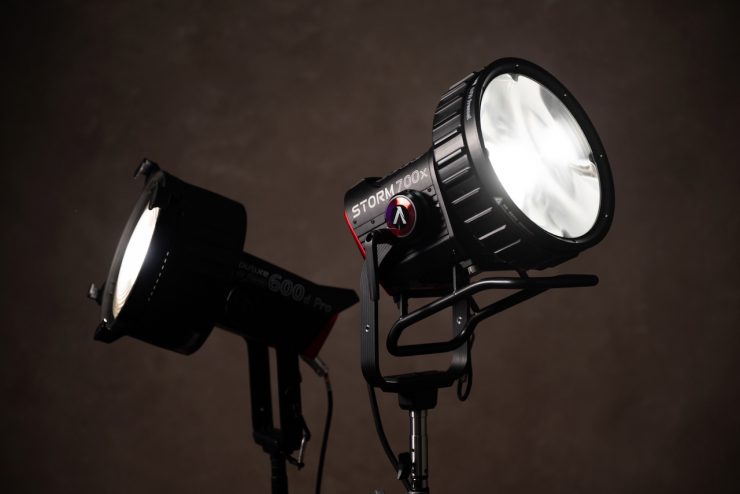
The light draws a maximum of 850W, and it has a maximum power output of 700W.
So, how does the power draw compare to other competing fixtures? Below you can see.
| Aputure STORM 700x | 850W |
| NANLUX Evoke 600C | 600W |
| Kelvin Epos 600 | 600W (nominal) 720W (rated) |
| Prolycht Orion 675 FS | 675W |
| Aputure LS 600c Pro II | 720W |
| Aputure STORM 400X | 500W |
| ARRI Orbiter | 500W |
| Aputure LS 600x Pro | 720W |
| Aputure LS 600d Pro | 720W |
| Nanlite Forza 720B | 800W |
| Nanlite FC500C | 500W |
| Falcon Eyes S600CPro | 600W |
| Godox LITEMONS LA600R | 600W |
| COLBOR CL600R | 600W |
| HIVE LIGHTING Super Hornet 575-C | 600W |
There is no 48V DC input, so you can’t power it remotely from block batteries. When I asked Aputure about this, they told me that after talking to clients and Aputure users, hardly anyone was using the 48V input on previous fixtures like the LS 600x Pro. With so many large battery options from companies like EcoFlow and BLUETTI dropping in price so fast, most people have migrated to those solutions as they are considerably more cost-effective than 48V block battery solutions. Eliminating the 48V input also allowed Aputure to keep down the size and weight of the control box.
Unlike some competing fixtures, you also can’t power it from regular 14.8V batteries, as there are no battery plates. This does arguably put it at a slight disadvantage if you need to power a fixture remotely in the field.
BLAIR Light Engine
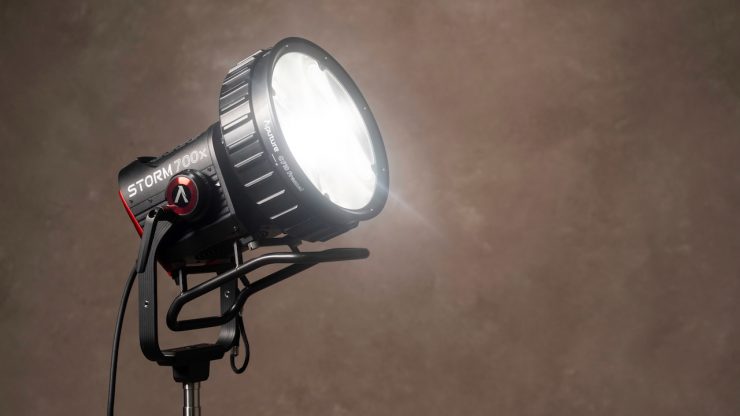
BLAIR stands for Blue/Lime/Amber/Indigo/Red. Aputure claims that the light engine is capable of producing the highest quality white light, an ultra-wide CCT range, full +/- Green control, and extreme color-accurate dimming.
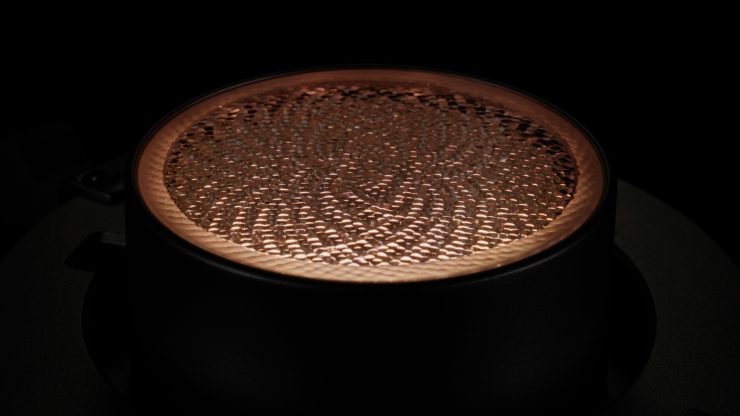
The BLAIR Light Engine utilizes blue, lime, amber, indigo, and red, LED emitters. This is quite different from RGBWW or RGBACL. Lights that utilize RGBACL don’t use any white LEDs, instead, they mix all of those different color LEDs to produce white light, and that’s essentially what BLAIR is doing too. Instead of having a green emitter, they are utilizing indigo.
Aputure decided to call it BLAIR because they wanted to avoid the alphabet soup confusion of other RGB variants. Regardless of whether you like the name or not, it is easier to remember.
The STORM 700x features a CCT range of 2,500K-10,000K with full ASC MITC range +/- Green adjustment. The BLAIR light engine’s design also means the STORM 700x can render saturated hues across more than 70% of the Rec.2020 color space, controllable in x,y and Limited HSIC+ modes.
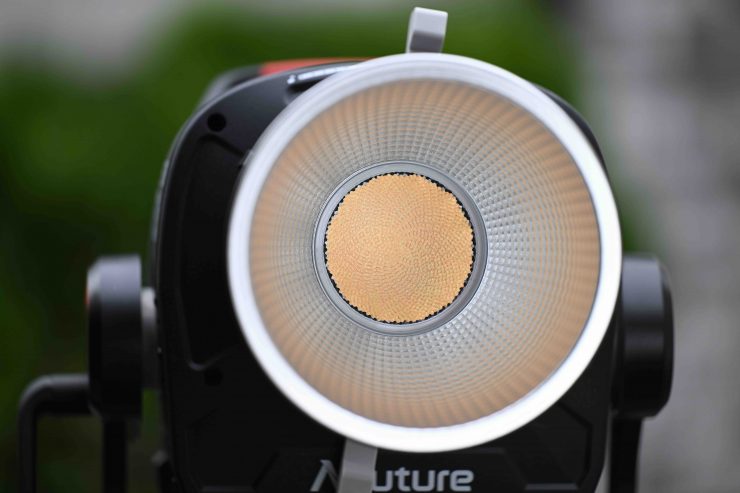
Aputure states that the 700x is a full spectrum white light with excellent CRI and SSI. It is claimed to deliver a better quality white light to fill out the color spectrum while offering greater adjustability. The calibrated Indigo is said to enhance fluorescing materials, resulting in a higher quality white light that better matches natural daylight and black body sources such as tungsten quartz.
Adding Indigo is very interesting because the light it emits is right at the edge of our visible spectrum, and that is why engineers probably haven’t thought about doing it before, that was until now. But why Indigo? Well, not all objects or surfaces reflect light; some of them absorb it. What Aputure engineers found is that by adding an Indigo emitter, certain materials and objects retained their natural brightness and color. In practice, this actually makes quite a noticeable difference. In some of the examples I have seen, you can certainly see its benefits. The benefits will be more noticeable when using the light at daylight CCT setting as opposed to tungsten.
The human eye is only really capable of detecting wavelengths from 380 to 700 nanometers, and most LED lights don’t contain any information below around 420 nanometers. The BLAIR light engine adds information right out to 405 nanometers.
Hive Lighting has been using 7 LED-chip blending. Instead of the traditional 3 colors, Hive uses red, amber, lime, cyan, green, blue, and sapphire. Companies like ARRI and Kelvin are using RGBACL, while a lot of other lighting companies are using RGBW and RGBWW.
The advantage RGBACL has over RGBWW and RGBCW is that it is capable of giving you a larger CCT range, and it can produce more saturated colors with more output. RGBWW lights tend to struggle to create saturated colors like yellow, and they don’t always have as much output when generating saturated colors. They can also have a large drop-off in output at different CCT settings.
There is a lot of debate and argument over what is better. Certain companies will tell you that RGBACL is better, while others will tell you that RGBWW is better. I don’t have any horses in this race, so I am not influenced by what lighting companies say.
Aputure also has another version of BLAIR called BLAIR CG, which is used in the STORM C fixtures. Along with the blue, lime, amber, indigo, and red emitters, it also has additional cyan and green emitters.
How did they arrive at BLAIR?
Instead of just making incremental improvements, Aputure got to the point where they asked themselves what are we trying to do, and what are the problems we are trying to solve. They wanted to come up with a better mouse trap and not just build another existing one. This led them to look at different ways of coming up with an alternative solution to what was already available. Aputure received a lot of feedback from Art Directors, make-up artists, etc. that things just never seemed to look quite right when trying to replicate daylight sources.
With LED lights, replicating tungsten has always been a lot easier than replicating daylight. A lot of LED lights, when used at daylight CCT settings, never quite look right. The color of skin tones, fabrics, etc., can look slightly off. This led Aputure to re-look at the spectrum to see what was missing.
What Aputure found is that there was a discord between measuring colors with a meter and seeing what actually happened when it came to light being reflected and absorbed by colors. Certain surfaces reflect light, and others absorb it, and then there is another group that reflects back light that is different from what is hitting it. This can lead to differences in color and brightness. This discovery led to what Aputure believes was the key ingredient that was missing in the color engine, Indigo.
Probably the best way to describe it is that if you were to shine an incandescent UV light at an object, you can see how bright that reflected light is compared to the light being emitted from the source.
If an LED light doesn’t have a certain frequency that is contained in UV light, it won’t look the same. This is why so many LED lights struggle to replicate daylight sources, because up to now, those frequencies weren’t being generated by the light engine. Why engineers didn’t see this in the past is because they believed that these frequencies weren’t visible to the human eye, but what they were overlooking was that the reflected light from these frequencies was visible.
How do you step up from the popular Storm 600 series?
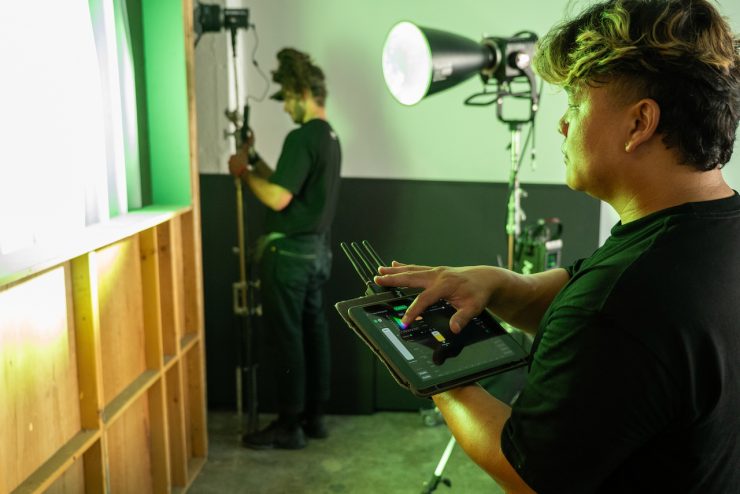
According to Mitch Gross, Aputure Marketing Director, the greatest challenge for the STORM 700x was to come up with something that was better than their own Light Storm 600 series fixtures. A lot of shooters love the balance of size, power draw, and output that the 600 series offered. These lights were powerful enough to be used as a key in daylight, yet still portable enough for one person to carry around in their personal kit and use on a baby pin light stand.
Aputure didn’t want to stray too far from the path, so the trick was to outperform their Light Storms in spectrum quality, versatility, and sheer output while retaining most of the same features and portability.
Size & Weight
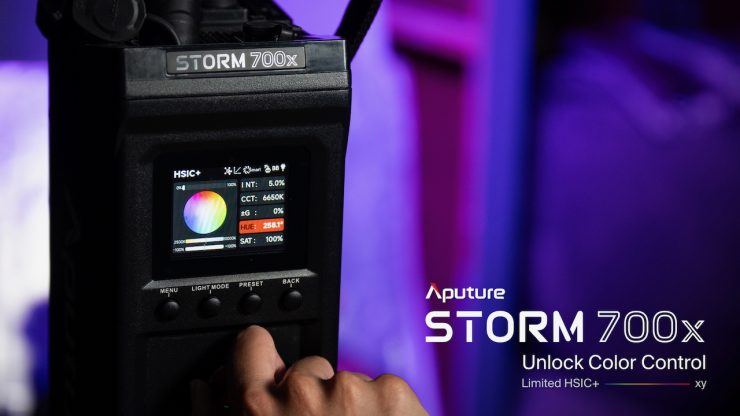
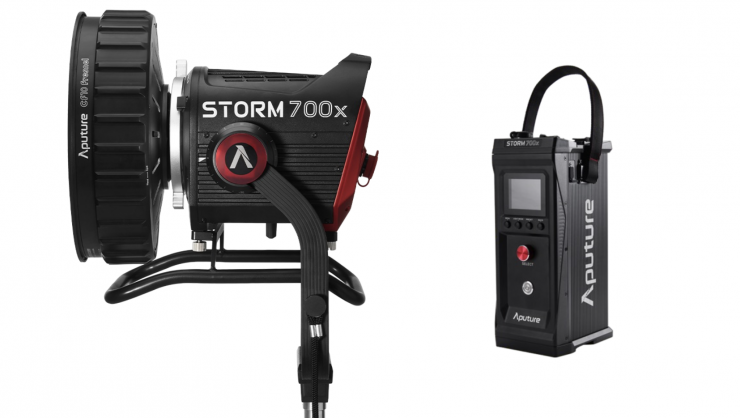
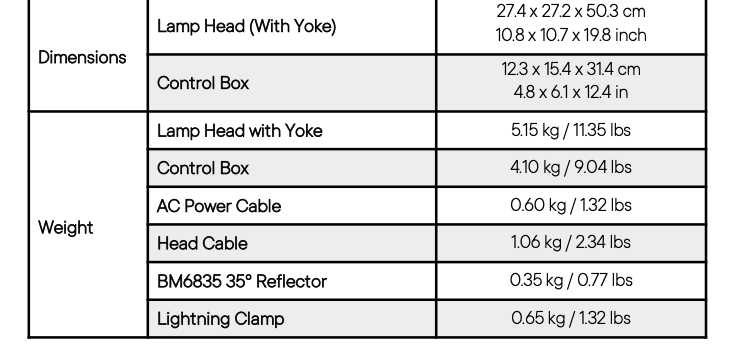
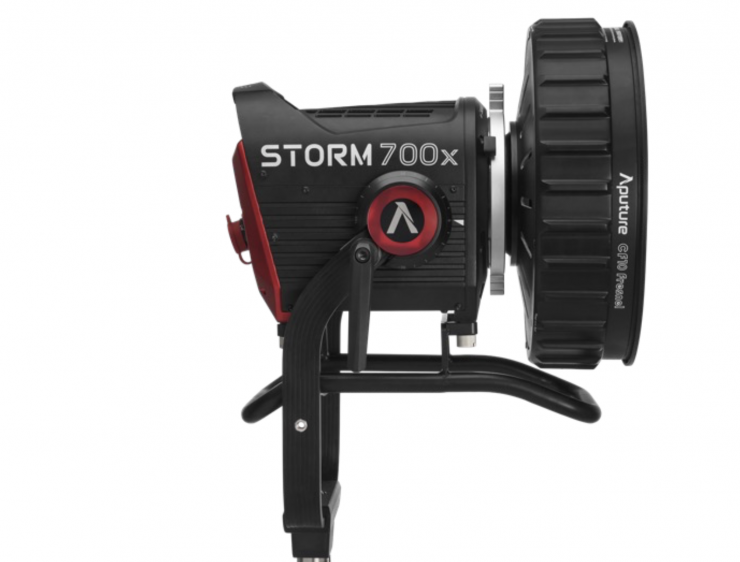
The STORM 700x consists of a separate lamp head and an integrated control unit/power supply. The lamp head and yoke weigh 5.15 kg / 11.35 lbs, and the power supply/controller weighs 4.10 kg / 9.04 lbs.
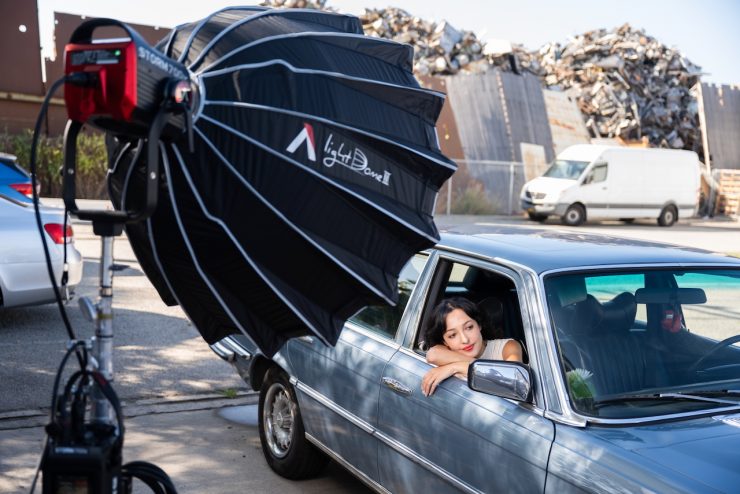
The whole set-up weighs 12 kg / 26.46 lbs (including the lamp head & yoke, power supply/controller, reflector, AC cable, header cable, and clamp). The light head has physical dimensions of 27.4 x 27.2 x 50.3 cm / 10.8 x 10.7 x 19.8″.
As a competition comparison, the NANLUX Evoke 600C has an all-in-one design that integrates lamp head, control unit, and power supply into a single 7.26 kg / 16.01 lb unit, measuring 358 x 246 x 205 mm / 14.1 x 9.7 x 8.1″.
So, how does this weight compare to some other similar fixtures?
| | TOTAL WEIGHT |
| Aputure STORM 700x | 9.25 kg / 20.39 lbs |
| NANLUX Evoke 600C | 7.26 kg / 16.01 lb |
| Kelvin Epos 600 | 12.18 kg / 26.85 lb |
| Prolycht Orion 675 FS | 12 kg / 26.46 lb |
| Aputure LS 600c Pro II | 11.3 kg / 24.9 lb |
| Aputure STORM 400X | 6.95 kg / 15.31 lb |
| ARRI Orbiter | 11.7 kg* / 25.8 lbs |
| Aputure LS 600x Pro | 10.05 kg / 22.15 lb |
| Nanlite Forza 720B | 9.5 kg / 20.94 lb |
| Nanlite FC500C | 6.14 kg / 13.53 lb |
| Godox LITEMONS LA600R | 5.1 kg / 11.2 lb |
| COLBOR CL600R | 8.2 kg / 17.8 lb |
| Falcon Eyes S600CPro | 9.95 kg / 21.71 lb |
| HIVE LIGHTING Super Hornet 575-C | 6.12 kg / 13.5 lb |
* Doesn’t include the weight of the yoke frame
If you are travelling a lot, every kg or pound you can save helps, especially if you are flying.
Beam Angle
The native COB beam angle of the STORM 700x is 58º. With its included reflector, it is 35º.
As a comparison, the native beam angle of the NANLUX Evokle 600C when used open face is 65°. When you use it with its included reflector, the beam angle is 25°.
ProLock Bowens-S Mount
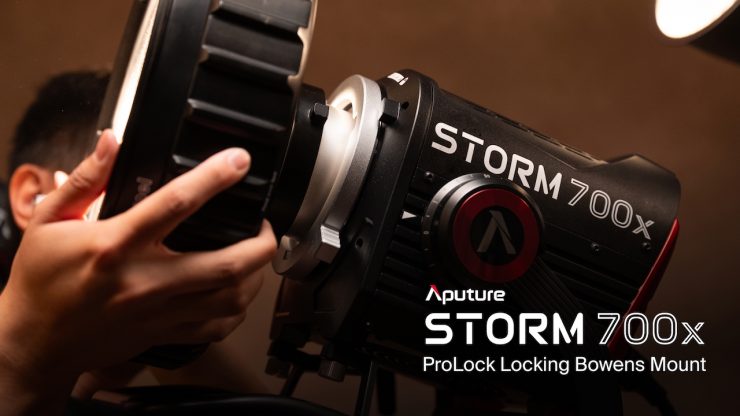
Just like the STORM 1200x, the STORM 700x features a positive locking clamp on the Bowens mount. This is a smart idea because a lot of standard Bowens mounts on competing fixtures leave a lot to be desired. The Bowens S-mount was never designed to take large and heavy Fresnels or the types of lighting modifiers that are now available.
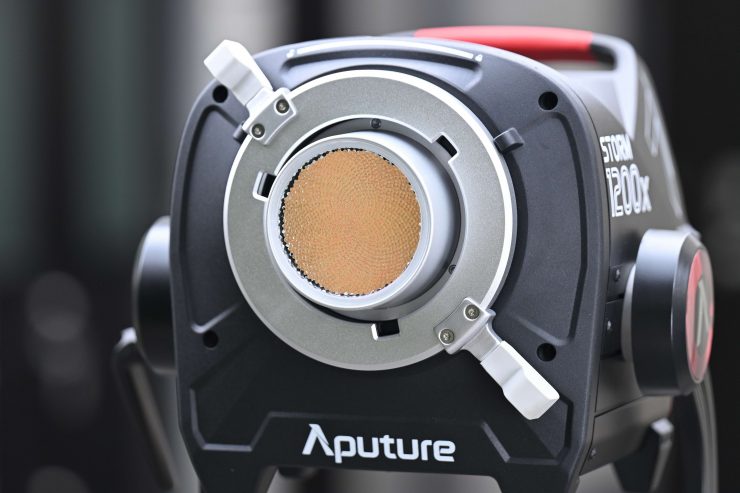
Aputure STORM 1200x 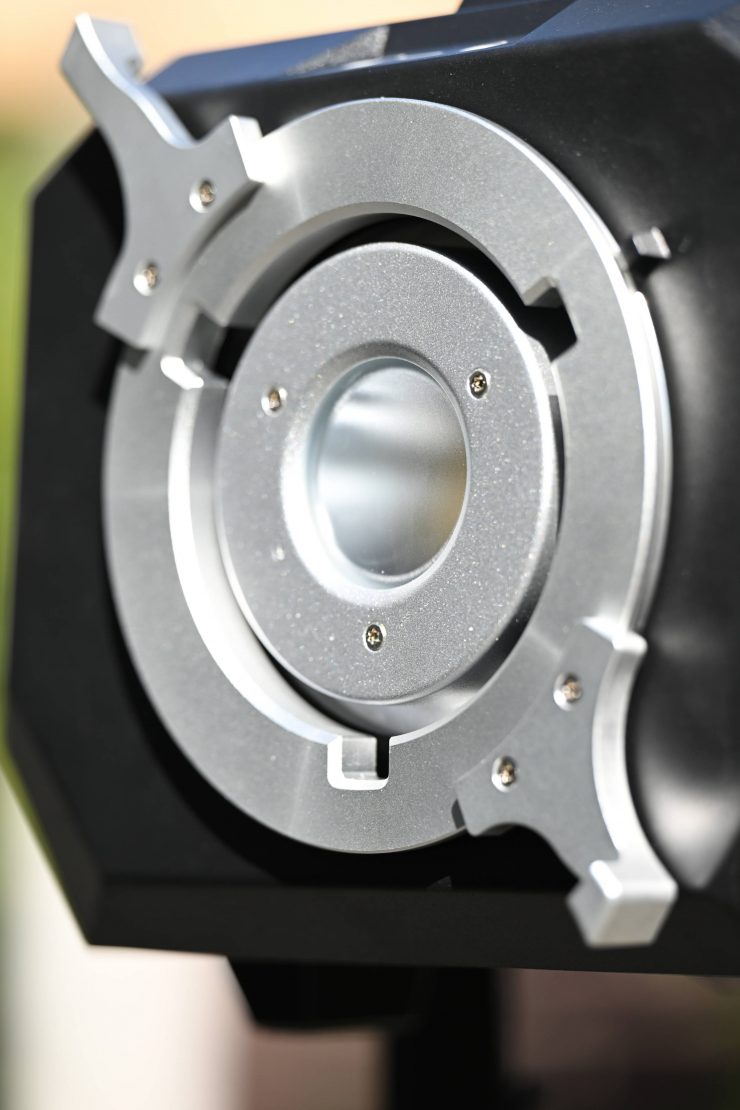
Prolycht Orion 675 FS
The ProLock Bowens-S Mount is a direct result of the Prolycht acquisition. The Prolycht Orion 675 FS featured a Prolock Locking Bowens Mount and that technology has now found its way into Aputure products.
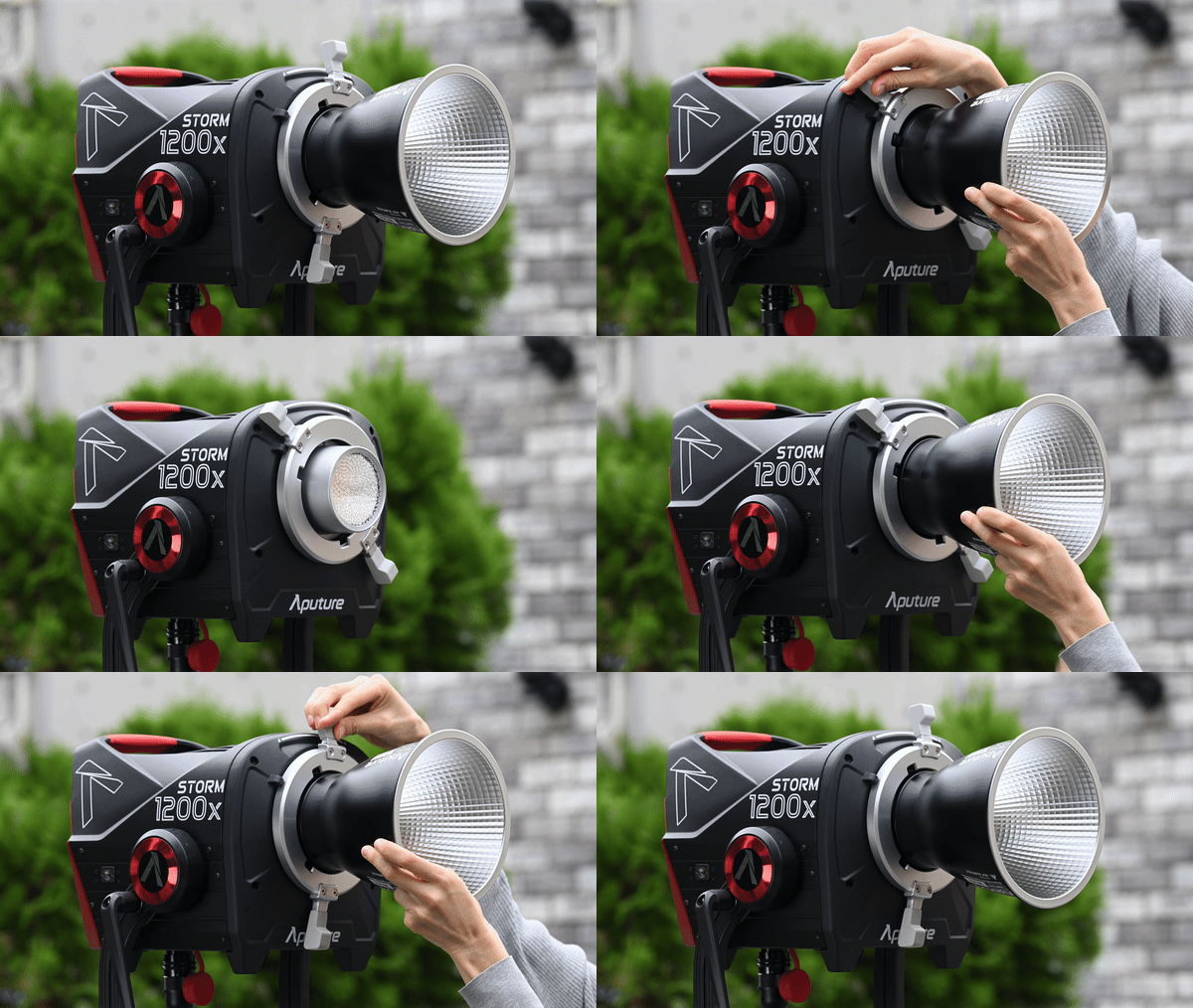
Essentially, the ProLock is like a PL mount for your light. It works in exactly the same way as a PL camera mount. It is made out of metal and it is very strong. This allows you to put heavy lighting modifiers or a Fresnel on the STORM 700x without fear of anything breaking. Every time I put the F10 Fresnel on the Aputure LS 600c Pro, I worried that I was going to break the mount.
Once you lock in an accessory, it doesn’t move or wobble around like it would if you were using a standard Bowens mount. Having the ProLock also makes it far easier to attach and remove lighting modifiers.
The ProLock is a great feature, and it allows you to stick with a Bowens-S mount instead of going to a proprietary mount.
IP65 Weather Protection
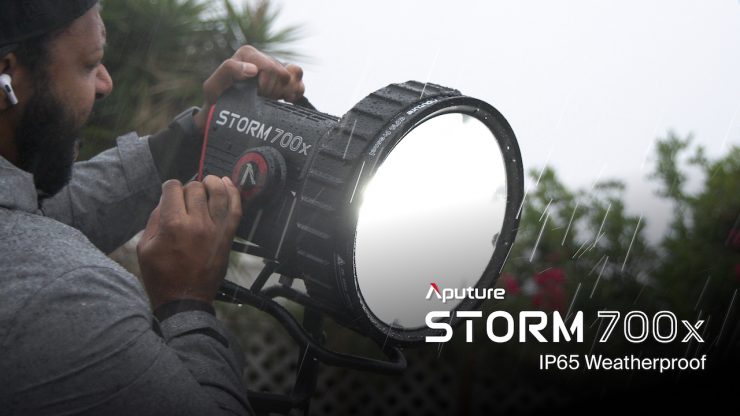
The fixture features IP65 dust and weather protection, which means the STORM 700x can work in extreme environments. Seals on every connector and around components allow not only the lamp head but also the control box and cabling to be used outside in the rain.
CF10 Fresnel & Barn Doors Kit

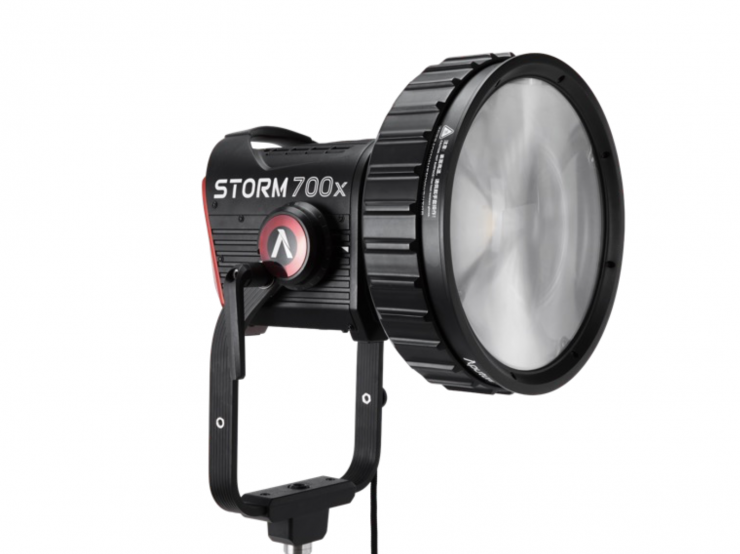
The CF10 Fresnel and Barn Doors Kit is a compact Bowens mount Fresnel kit that includes the Fresnel’s barn doors. The CF10 Fresnel is a 10-inch diameter lens optimized for use with the STORM 700x. The CF10 optimizes and amplifies the light output of the STORM 700x with a 15º to 40º spot-flood range, providing smooth falloff from center to edge, all with a compact form factor. Coming as a kit with the CF10 Barn Doors, the CF10 Fresnel and Barn Doors Kit is a compact solution for users to achieve greater versatility and control of their STORM 700x’s output. The kit’s carrying case comfortably fits the Fresnel and its Barn Doors within.
Even though the CF10 Fresnel and Barn Doors Kit was optimized to work with the STORM 700x, it will also work with the LS 600c Pro II, LS 600c Pro, and STORM 400x.
The CF10 Fresnel weighs 2.10 kg / 4.63 lb, and the CF10 Barn Doors weigh 1.40 kg / 3.09 lb.
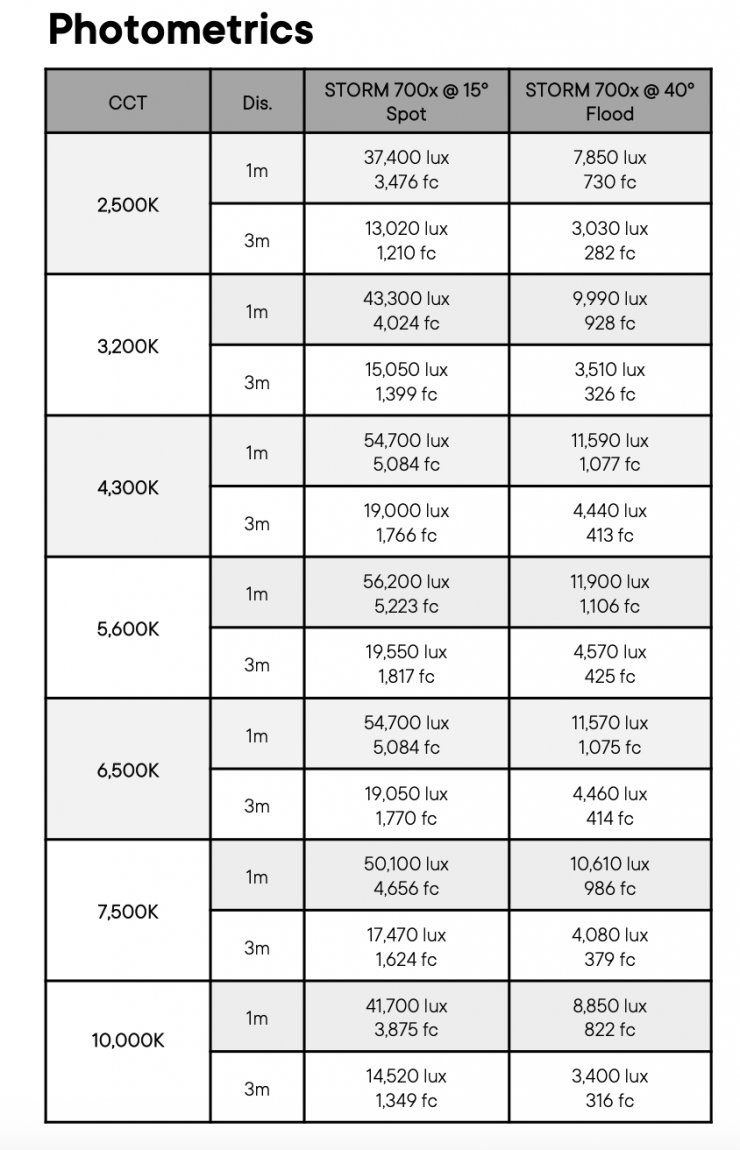
Above you can see the claimed output at various CCT settings when using the Fresnel with the STORM 700x.
Other STORM 700x Accessories
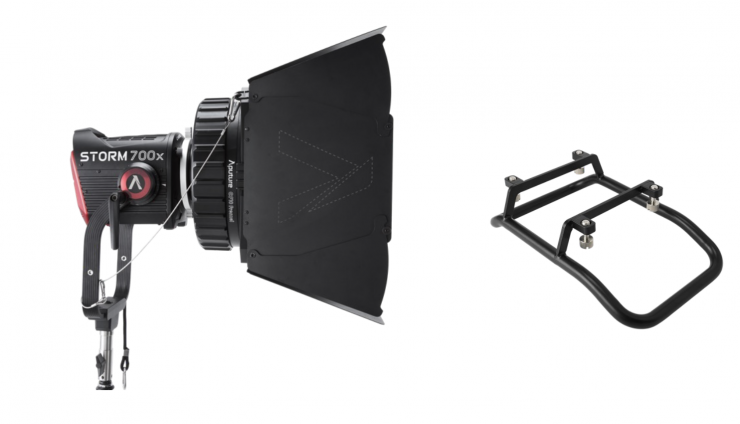
Aputure has also introduced accessories specifically designed for the STORM 700x.
- The STORM 700x Skid Base is a stainless steel skid attachment that allows users to place the STORM 700x flat on the ground without tipping over, even with a CF10 Fresnel attached.
- The BM6825 25º Reflector is a hyper reflector with a tighter hard light output than the STORM 700x’s included 35° reflector.
- The STORM 700x 8-Pin Lamp Head Cable (15M) is a 15-meter head cable that enables users to mount the fixture on light stands or trusses while keeping the control box accessible on the ground. It is three times longer than the cable included with the STORM 700x.
- The STORM 700x Cine Kit packages the light with the CF10 Fresnel and Barn Doors Kit as well as the STORM 700x Skid Base, making a convenient and complete production package.
Pricing & Availability
The STORM 700x is available now for preorder. Below are the prices:
- Aputure STORM 700x $1,690 USD
- Aputure STORM 700x Cine Kit $2,140 USD
- Aputure CF10 Fresnel & Barn Doors Kit $499 USD
- Aputure STORM 700x Skid Base $69 USD
- Aputure BM6825 25° Reflector $60 USD
- Aputure STORM 700x 8-Pin Lamp Head Cable (15M) $259 USD
Below you can see how the price compares to the competition:
| | Price |
| Aputure STORM 700x | $1,690 USD |
| NANLUX Evoke 600C | $2,064.00 USD |
| Kelvin Epos 600 | $2,999 USD |
| Aputure LS 600c Pro II | $1,490 USD |
| Aputure LS 600d Daylight LED Monolight | $872 USD* |
| Aputure STORM 400X | $1,059 USD |
| Nanlite Forza 720B | $1,519 USD* |
| Aputure LS 600x Pro Light Storm | $1,393 USD |
| Nanlite FC500C | $719.20 USD |
| Godox LITEMONS LA600R | $919 USD |
| HIVE LIGHTING Super Hornet 575-C | $3,157.37 USD* |
| COLBOR CL600R | $1,999 USD |
*Currently on sale at B&H as of the 21/10/2025
Specifications