
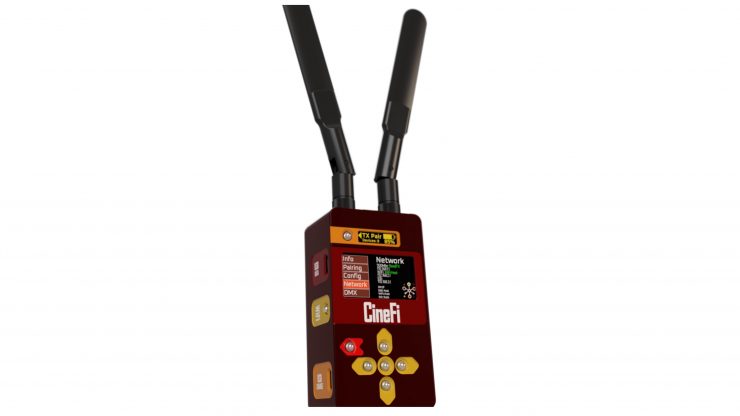
The CineFi Wireless Fox Box is a multi-protocol wireless lighting control unit built specifically for modern film, television, and video production sets. It functions as the hub of CineFi’s wireless network ecosystem, and it was designed to bridge traditional lighting rigs with modern IP-based control software.
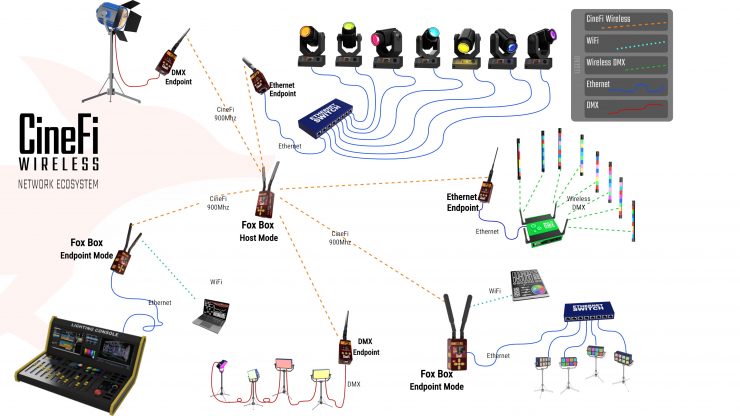
Unlike traditional systems, the Fox Box provides full, bidirectional network communication to bridge Ethernet and DMX within a single, flexible platform that can operate as either a base or client.
It features integrated WiFi for control from nearby iPads and laptops, along with USB expansion for added capabilities. includes a rechargeable battery, durable mounting, and flexible power options. Fox Box also has Art-Net and sACN that can be delivered directly to fixtures and nodes, with the ability to support a broad range of network data across the system.
Key features
- Dual-Protocol Convergence (DMX + Ethernet): Merges standard DMX hardware with Ethernet-based lighting protocols (such as Art-Net and sACN) into a single transceiver.
- Long-Range 900MHz RF Transmission: Operates on the 900MHz wireless frequency band rather than the crowded 2.4GHz Wi-Fi spectrum, allowing it to easily punch through physical set obstacles, walls, and dense radio frequency interference.
- Base or Client Modes: Functions as either a master wireless transmitter (Base Mode) sending control data from a console, or as a wireless receiver (Client Mode) mounted directly onto lighting fixtures.
- Integrated Wi-Fi Control: Features built-in Wi-Fi access so lighting technicians can connect iPads, tablets, or laptops directly to the Fox Box to manipulate lights via apps like Blackout, Luminair, or GrandMA without requiring external routers.
- USB Modular Expansion: Equipped with USB expandability to plug in additional dongles, extra DMX outputs, or modules like GPS.
- Internal Battery Power: Runs off an internal battery lasting up to 12 hours on a single charge, allowing fast setup and breakdown without needing constant AC wall power.
CineFi Wireless was started by Adam Knapp (previously the Director of R&D at Ratpac Controls, where he developed the AKS and Cintenna wireless systems, along with a number of portable power and data-distribution products) because he saw an issue with outdated DMX lighting control. DMX512, which nearly all lighting control is based on, was developed in the late 1980s, when 512 control parameters were an enormous amount of capacity. Even into the 2010s, that model worked reasonably well for wireless lighting, as it allowed you to send a universe of DMX from a transmitter to a receiver, and you could control a substantial part of a set.
Fast forward to today, and modern fixtures are very different. A single pixel fixture can consume hundreds or thousands of parameters, while fixtures and consoles increasingly operate as network devices with Ethernet connectivity, management interfaces, full web UI, discovery, diagnostics, and bidirectional data.
The wired side of the industry has adapted through protocols such as sACN and Art-Net, which can carry many universes efficiently across standard IP networks; however, the wireless side largely has not.
Most professional wireless systems are still fundamentally designed around moving lighting control data from a transmitter to an endpoint, rather than extending the network itself. Many current and upcoming multi-universe systems achieve additional capacity by selectively transmitting changes, compressing or aggregating control data, reconstructing values at the receiver, or presenting proprietary links as if they were network connections. Those are legitimate engineering approaches, but they remain fundamentally different from transporting the underlying IP network itself, and create severe bottlenecks or limitations as a result.
At the other end of the spectrum, crews can build conventional wireless Ethernet networks using enterprise switches, infrastructure-grade point-to-point systems and access points, cabling, and IT infrastructure, but that equipment was never really designed around the realities of a production set and is generally seen as a workaround.
CineFi has taken a different approach, and rather than optimizing a wireless DMX link to behave more like a network, they built a long-range 900 MHz IP network specifically for production environments.
The Fox Box, which is planned to be released toward the end of this year, is the first product built around that network.
At its heart, the system provides a full IP transport layer over 900 MHz. What that means is that Fox Box can carry Art-Net, sACN, and essentially any other IP-based protocol rather than creating a proprietary representation of DMX and reconstructing it at the other end.
It also means the system behaves like a network, because it is one! CineFi supports standards-based multicast and IGMP operation across multiple wireless nodes, rather than treating every receiver as an isolated point-to-point link. Traffic is bidirectional, so clients can originate data themselves, and CineFi can bridge into existing wired networks rather than requiring the lighting system to live inside its own closed wireless ecosystem.
Fox Boxes can operate as host or client, as well as in relay mode to extend coverage. CineFi is also developing a mesh mode for larger and more complex environments. One major benefit that’s already being utilized on active sets is that the console can now go anywhere, as it no longer needs to be wired directly to the “transmitter”. This means it can connect to a client node instead, and let the host unit remain in a central location.
Because the system is designed as network infrastructure, CineFi also put a substantial amount of work into redundancy. The system can provide automatic wireless fallback for wired network paths, support redundant transmitters, and store multiple network credentials. Systems can be paired with a button, through exchanged keys, or by cloning configuration from another transmitter to create a ready-to-use backup.
A Fox Box can connect directly to an iPad or computer over USB as a network interface, providing a direct path into the CineFi network without Wi-Fi or an external Ethernet adapter. The host USB interface can also support accessories including GPS hardware, SDR-based spectrum-analysis tools, third-party network interfaces, and selected control surfaces.
One of the other areas that the company has concentrated heavily on is diagnostics. The Fox Box exposes wireless performance, traffic rates across individual interfaces and network bridges, CPU and memory utilization, connected nodes, and other system information directly on the unit. Many of those measurements are logged and graphed rather than simply providing a signal-strength indicator.
The web interface expands on that considerably by providing a graphical view of the CineFi network and its topology, along with network status, traffic, and lighting protocol information. CineFi’s objective is for an operator to be able to see not only the CineFi radios themselves, but the network attached to them, including sACN sources, their destinations, and, where the attached network infrastructure exposes the necessary information, devices connected behind individual nodes.
CineFi plans to follow the Fox Box with three smaller Foxtail products built around the same wireless network:
USB Foxtail — a compact endpoint that connects directly to USB-capable computers and tablets, effectively giving them a direct connection to the 900 MHz network.
Ethernet Foxtail — a small wireless-to-Ethernet bridge for fixtures, switches, or other network equipment that doesn’t require the full Fox Box interface.
DMX Foxtail — an endpoint for conventional DMX equipment, allowing existing fixtures and devices to participate in the same CineFi Wireless network without requiring native Ethernet support.
These products are being developed in conjunction with the company’s OEM platform FoxChip. FoxChip takes the core RF hardware, networking stack, and management architecture and packages it for integration directly into fixtures and other manufacturers’ products. Instead of an OEM designing another proprietary wireless-DMX receiver into a fixture, the fixture can become a native node on an IP network, without the sacrifice in functionality from ditching cables seen in current systems.
You can contact CineFi directly to find out more: