

Panasonic has released a video with one of its engineers, where he talks about the LUMIX S 100mm F2.8 MACRO. The LUMIX S 100mm F2.8 MACRO, the first life-size macro lens for the LUMIX full-frame S series, has been born.
The lens is claimed to be the world’s smallest and lightest full-frame 100mm F2.8 AF macro lens, measuring approximately 82.0mm in length and weighing approximately 298g.
Panasonic set out to make a macro lens within the prime range that matched the F1.8 series’ compact size. The reason the F1.8 series is popular is that all of the lenses are the same size and length. Panasonic feared that if they ended up making a macro lens that was a lot larger than the F1.8 prime series, they would end up deviating from the core concept.
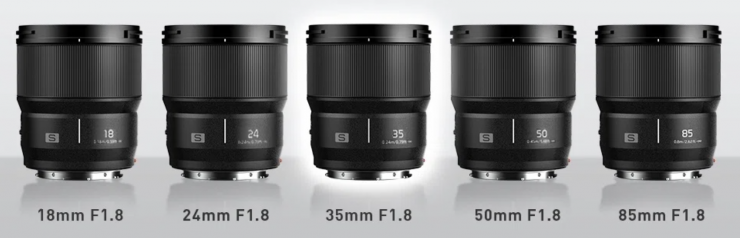
The target for the F1.8 series was ‘a 40% reduction in overall length compared to competitors’. For the 100mm macro, the design team needed to come up with a solution, so they ended up having to extend the overall length of the lens by 5mm. Five millimetres may sound like a small margin, but in design terms, this 5mm creates considerable breathing space for the design.
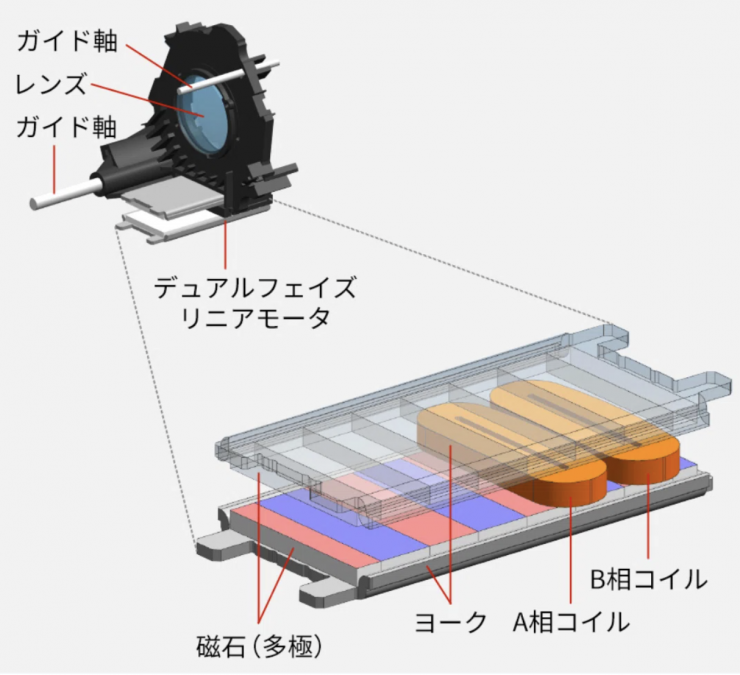
Conventional lenses employ voice coil motors (VCM), but the 100mm F2.8 MACRO adopts a new dual-phase linear motor. Both the conventional VCM and the dual-phase linear motor utilise the principle known as Fleming’s left-hand rule, whereby force is generated when current flows through a conductor within a magnetic field. With the conventional VCM, the placement of the magnets meant thrust could only be generated by a portion of the coil. Attempting to move a large lens required multiple VCMs due to insufficient thrust, contributing to larger lens sizes and increased weight.
Consequently, the dual-phase linear motor employs multipolar magnets, enabling thrust generation across nearly the entire coil. By adopting a unique configuration where magnets are positioned oppositely on both sides of the two-phase coils, and establishing control technology that switches between the two-phase coils based on position while energising them, Panasonic was able to achieve seamless operation across the entire range.