

Sony UK has posted up a video called A Filmmaker’s Guide to S-LOG3. Alexandru Don shares his top tips on how to best utilize S-Log3 when working with Sony mirrorless hybrids, and the Cinema Line series that includes the FX3, FX30, and FX6.
This is very much being targeted at entry-level users who may not be familiar with S-Log3.
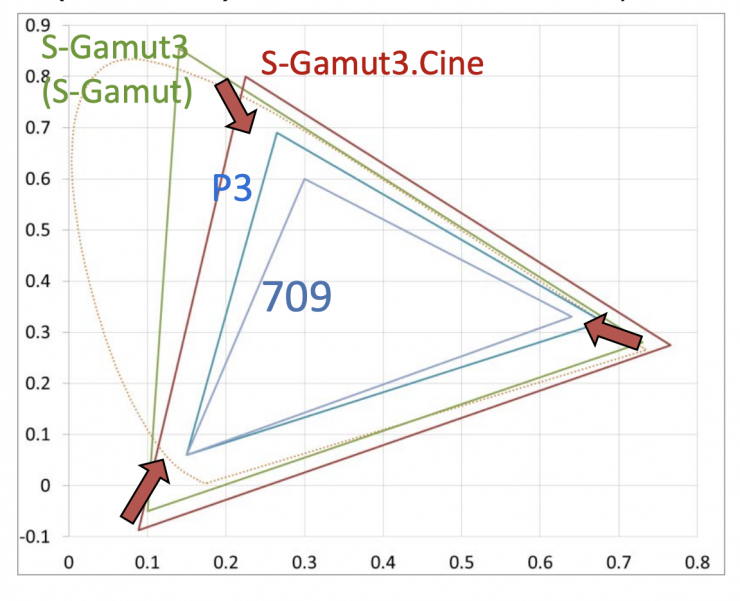
S-Log3 was introduced with the F65, F55, and F5, so it has been around for quite a long time. S-Log3 is based on Cineon Digital Negative revised in 2007.
S-Gamut3.Cine/S-Log3 was designed for a more pure log workflow. Color space is similar to negative film scan which is used for TV production, film out and digital cinema. Color reproduction is designed slightly wider than DCI-P3 to provide ample room of grading. Tone curve is more like pure log encoding characteristics preserving more tonal gradations in the blacks, and has good compatibility with Cineon workflow.
S-Gamut3/S-Log3 is very close to camera native color, and is very good for archiving as a digital camera negative, as 8/10/12bit code value. Color space of S-Gamut3 is kept in the same area as the original S-Gamut, though color reproduction inside S-Gamut3 is more accurate than S-Gamut.
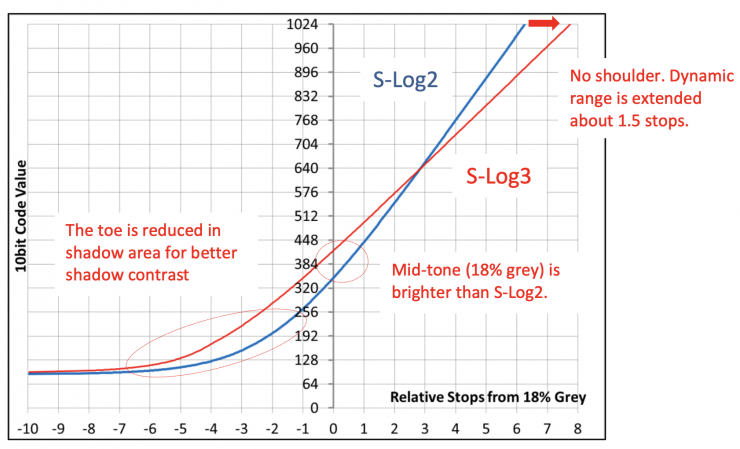
S-Log3 tone curve has no shoulder and has reduced the toe (non-linear curve in shadow area). It is more like a pure log encoding than S-Log2 to provide better log based grading (See chart below). Mid-tone value; 18% grey is brighter than S-Log2. S-Log3 has 1.5 stops wider dynamic rage than S-Log2, covering the full EI range. It is not necessary to change the conversion formula for each EI setting.