
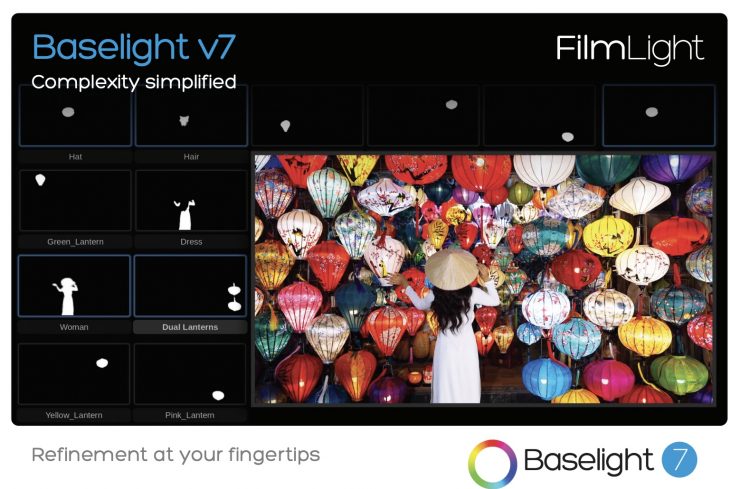
FilmLight’s Baselight v7 features key improvements and changes in Truelight Colour Spaces, with a focus on enhancements to its color management system.
The Redesigned Output Display Pipeline necessitated a re-thinking of the color space architecture. It introduces the concept of a device color space so users can manage simultaneous display requirements, ensuring accurate color representation across different output devices like HDR displays via SDI, secondary image viewers, and Mac OS UI displays. It also has settings for brightness compensation for different display types (Apple vs. non-Apple monitors).
Key features
- ACES 2.0: Integrated support for ACES 2.0 and updated support for AMF.
- Texture Smoothing: Used to smooth imperfections in skin, whilst maintaining detail.
- Consolidate and Transcode: The Consolidate feature has been expanded to include a Transcode option. Media can be transcoded to any supported image format and the scene can automatically be updated to use the new media.
- Dolby Vision review: Import Dolby Vision metadata via XML, and per frame metadata from IMF, QuickTime and Dolby Mezzanine files for review in Baselight.
- Open Timeline I/O import/export: Support for reading and writing Open Timeline I/O (.otio) files. » Improved AAF and XML export: Export new AAF, FCP and FCPX XML files, rather than simply modified versions of previously imported files.
- Sequence Versioning API: New functions have been added to manage sequence versioning programmatically.
- Support for HDR UI displays: View HDR content on Apple XDR or compatible HDR displays. View multiple cursors with different colour spaces accurately on the same display. This feature is also available in FilmLight REMOTE.
- Track roles: Tracks can now be assigned roles to define how the track should be used or viewed. As an example, designating a track as ‘Offline’ will allow it to be used as a reference for Transform Matching and comparisons with the offline reference.
- Improved face matching: A new face identification model has been implemented. This improves accuracy when copying grades between shots, ensuring that the correct faces are selected when pasting.
- Flexi for developers: New interface primitives are now available to developers using Flexi. This includes: point and rectangle lists, keyframe animation, Blackboard panel controls and the ability to link points and rectangles to trackers.
Baselight v7 now fully supports ACES 2.0, offering a new formula-based DRT family for compatibility with OCIO and other color management systems. Key differences from ACES 1 include less contrasty and saturated rendering, improved tone scale tracking, and better handling of out-of-gamut colors.
A new color space, web video 1.96 gamma Rex 709 2025, has also been introduced to ensure color-accurate rendition of SDR content on social media platforms, especially on Apple devices.