


Adobe has agreed to pay $75 million to the Department of Justice and an additional $75 million worth of free service to its customers. The FTC (Federal Trade Commission) originally took action against Adobe and two of its executives, Maninder Sawhney and David Wadhwani, for what they described as deceiving consumers by hiding the early termination fee for its most popular subscription plan and making it difficult for consumers to cancel their subscriptions. The case was then referred to the DOJ.
The DOJ issued the following statement:
The Justice Department announced today that it has filed a proposed stipulated order that, if entered by the court, will resolve a case against software company Adobe Inc. and two of its employees, Maninder Sawhney and David Wadhwani. The proposed order requires Adobe to pay $75 million in civil penalties and offer customers $75 million in free services to resolve allegations that the company’s subscription practices violated the Restore Online Shoppers’ Confidence Act (ROSCA).
ROSCA generally requires companies offering online subscriptions to clearly disclose important subscription information and to provide subscribers with simple ways to cancel. In a complaint filed in the U.S. District Court for the Northern District of California, the government alleged that Adobe violated ROSCA by using fine print and inconspicuous hyperlinks to hide important information about Adobe’s subscription plans, including information about a hefty Early Termination Fee that customers may be charged when they cancel their subscriptions. The government also alleged that Adobe thwarted subscribers’ attempts to cancel, subjecting them to convoluted and inefficient cancellation processes filled with unnecessary steps, delays, unsolicited offers, and warnings.
“American consumers deserve the right to make informed choices when deciding where to spend their hard-earned money,. The Justice Department will strongly oppose any attempt to harm Americans with deceptive and unfair business practices.”
Assistant Attorney General Brett A. Shumate, head of the Justice Department’s Civil Division.
In addition to civil penalties and free services, the stipulated order provides strong protections for American consumers going forward. Adobe will be required to clearly disclose any Early Termination Fee and how the fee is calculated before enrolling customers in subscriptions. For any free trial lasting longer than seven days, Adobe must also remind customers before converting them into a paid subscription with an Early Termination Fee. Furthermore, Adobe will be required to provide its subscribers with easy ways to cancel their subscriptions.
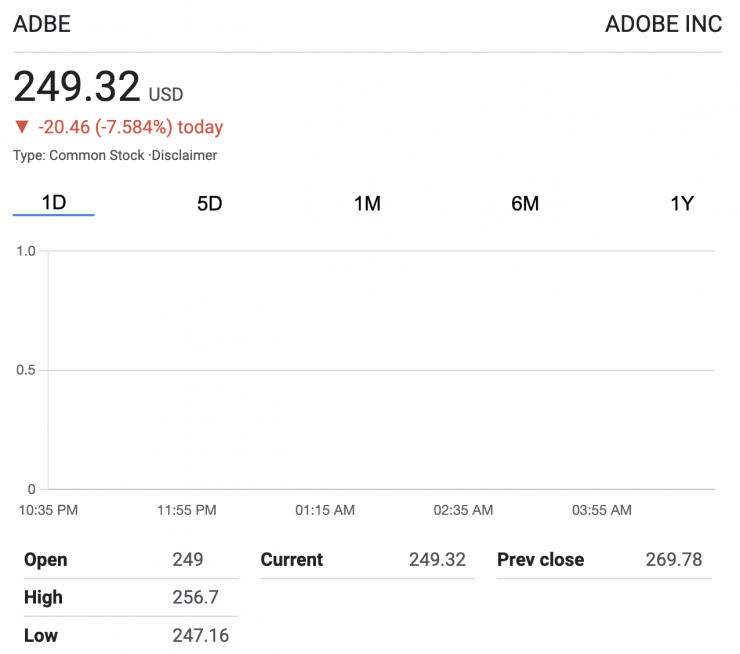
In response to this news, Adobe’s stock price went down by roughly 7.5%.
Below, you can read Adobe’s Statement Regarding the Department of Justice Settlement.
Adobe’s mission is empowering everyone to create. To support that mission, we are committed to delivering the best products alongside flexible offerings that meet the diverse needs of our customers. Our subscription model was designed to accelerate innovation while making our technology more accessible — enabling us to deliver continuous updates, cloud-based features and new services at a more affordable price.
Today, Adobe offers a wide range of options across its products so customers can choose the plan that works best for them. We have always prioritized giving our customers the flexibility to choose the plan that best fits their needs, timeline and budgets. This includes offering multiple types of plans where customers can choose between lower upfront costs and maximum flexibility.
We are transparent with the terms and conditions of our subscription agreements, have a simple cancellation process and clearly disclose the details of our plans, which we carefully crafted to maximize value and benefits to our customers. In recent years, we have made our sign-up and cancellation processes even more streamlined and transparent.
We have now finalized a settlement agreement with the Department of Justice that will bring to an end the litigation filed in June 2024 related to our disclosure and subscription cancellation practices. While we disagree with the government’s claims and deny any wrongdoing, we are pleased to resolve this matter. We have agreed to provide $75 million worth of services for free to customers that qualify. We will proactively reach out to the affected customers once the appropriate filings with the Court are made and accepted. Additionally, we have agreed to a $75 million payment to the Department of Justice.
We look forward to continuing to build innovative tools and platforms that unleash creativity, productivity and personalized customer experiences.
Below, you can also see the full statement issued by the FTC.
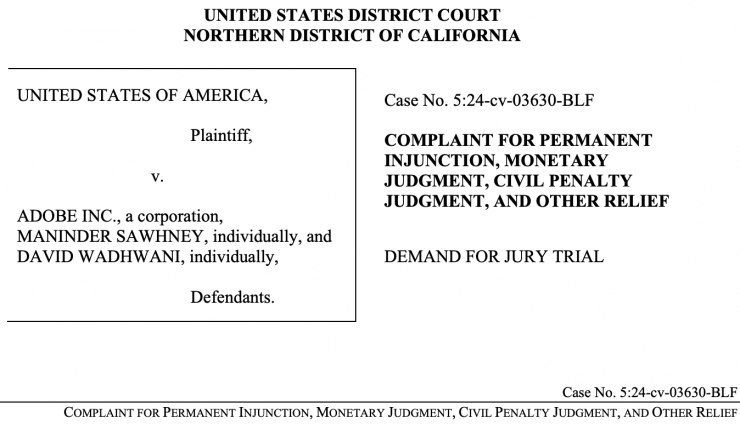
A federal court complaint filed by the Department of Justice upon notification and referral from the FTC charges that Adobe pushed consumers toward the annual paid monthly subscription without adequately disclosing that cancelling the plan in the first year could cost hundreds of dollars. Wadhwani is the president of Adobe’s digital media business, and Sawhney is an Adobe vice president. Just yesterday, Adobe CEO Shantanu Narayen stepped down as CEO after 18 years at the company. The company’s Board of Directors has already initiated a formal search for the next CEO.
“Adobe trapped customers into year-long subscriptions through hidden early termination fees and numerous cancellation hurdles. Americans are tired of companies hiding the ball during subscription signup and then putting up roadblocks when they try to cancel. The FTC will continue working to protect Americans from these illegal business practices.”
Samuel Levine, Director of the FTC’s Bureau of Consumer Protection
After 2012, Adobe shifted to a subscription model, requiring consumers to pay for access to the company’s software on a recurring basis. These subscriptions account for the majority of the company’s revenue.
According to the complaint, when consumers purchase a subscription through the company’s website, Adobe pushes consumers to its “annual paid monthly” subscription plan, pre-selecting it as a default. Adobe prominently shows the plan’s “monthly” cost during enrollment, but it buries the early termination fee (ETF) and its amount, which is 50 percent of the remaining monthly payments when a consumer cancels in their first year. Adobe’s ETF disclosures are buried on the company’s website in small print or require consumers to hover over small icons to find the disclosures.
Consumers complain to the FTC and the Better Business Bureau about the ETF, according to the complaint. These consumers report they were not aware of the existence of the ETF or that the “annual paid monthly” plan required their subscription to continue for a year. The complaint notes that Adobe has been aware of consumers’ confusion about the ETF.
Despite being aware of consumers’ problems with the ETF, the company continues its practice of steering consumers to the annual paid monthly plan while obscuring the ETF, according to the complaint.
In addition to failing to disclose the ETF to consumers when they subscribe, the complaint also alleges that Adobe uses the ETF to ambush consumers to deter them from cancelling their subscriptions. The complaint also alleges that Adobe’s cancellation processes are designed to make cancellation difficult for consumers. When consumers have attempted to cancel their subscription on the company’s website, they have been forced to navigate numerous pages in order to cancel.
When consumers reach out to Adobe’s customer service to cancel, they encounter resistance and delay from Adobe representatives. Consumers also experience other obstacles, such as dropped calls and chats, and multiple transfers. Some consumers who thought they had successfully cancelled their subscription reported that the company continued to charge them until discovering the charges on their credit card statements.
The complaint charges that Adobe’s practices violate the Restore Online Shoppers’ Confidence Act.
The Commission vote to refer the civil penalty complaint to the DOJ for filing was 3-0. The Department of Justice filed the complaint in the U.S. District Court for the Northern District of California.