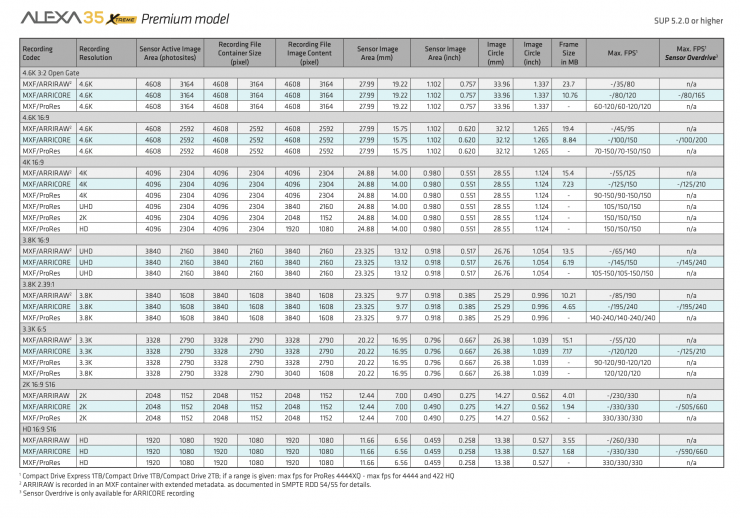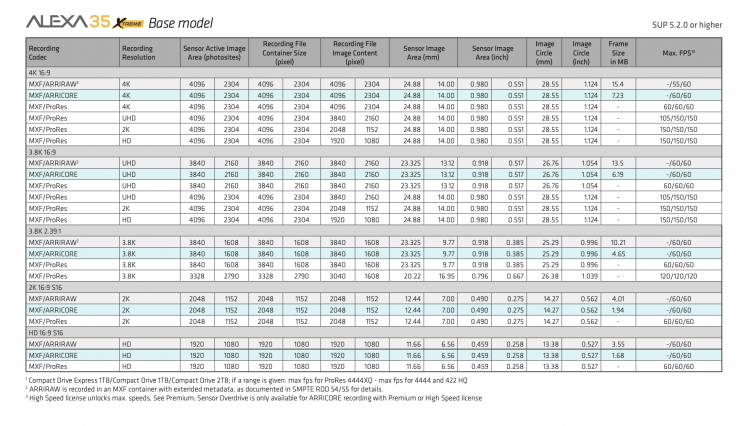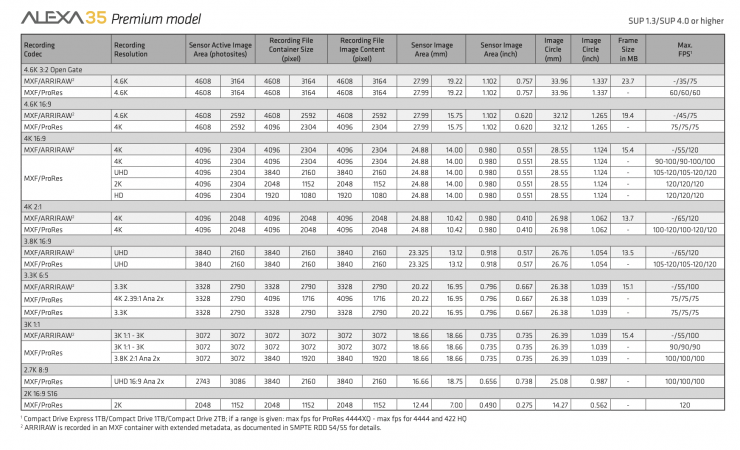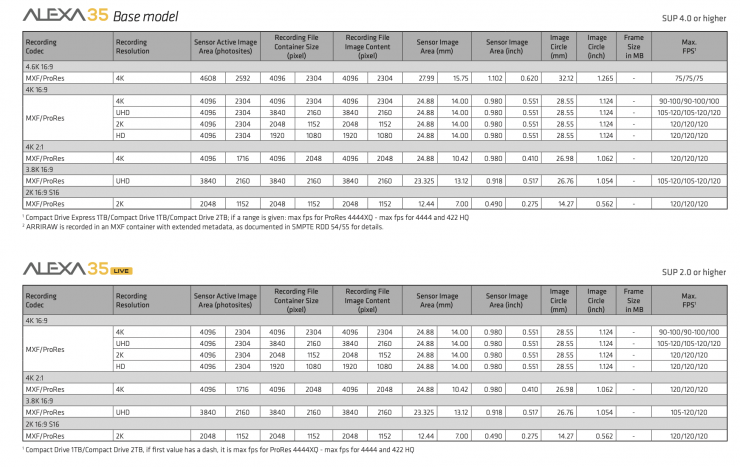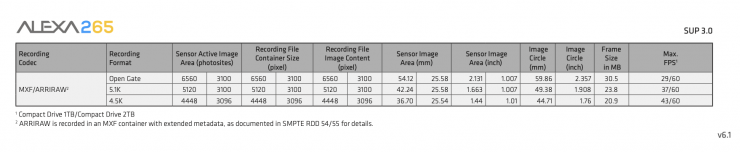

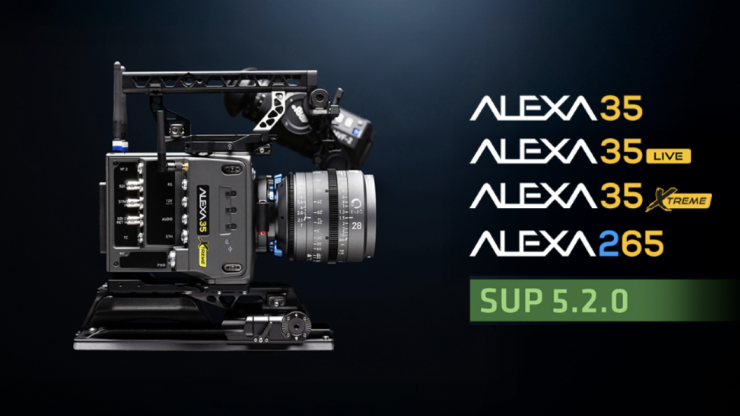
ARRI has released Software Update Package SUP 5.2.0 for the ALEXA 35 Xtreme, ALEXA 35, ALEXA 35 Live, and ALEXA 265. The ALEXA 35 Xtreme gets a new subject tracking capability that ensures the monitor image stays zoomed in on a person moving in the shot for better focus checking. There is also the reintroduction of in-camera down-sampling and in-camera anamorphic de-squeeze for the recorded ProRes image.
The subject tracking capability is a very interesting feature, but it is limited to the ALEXA 35 Xtreme, as it requires higher processing power.
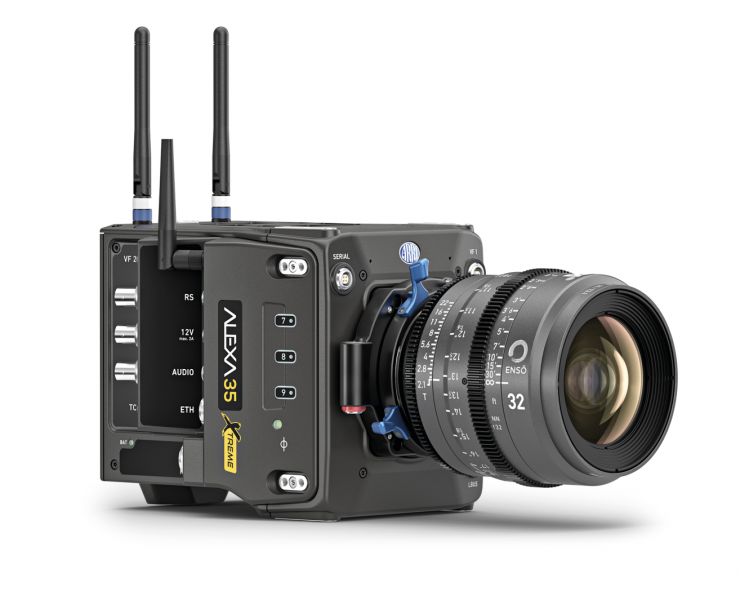
The ALEXA 35 Xtreme and ALEXA 265 benefit from new metadata that signals color space and transfer characteristics (i.e. SDR or HDR) on the SDI outputs. All cameras support the Live Production Monitor LPM-1 now and offer an increase to the sensor fps presets list from 16 entries to 32.
New Features for ALEXA 35 Xtreme
- Focus Assist: Tracking Zoom
- Sensor mode 4K 16:9 down-sampled in-camera to UHD, 2K or HD
- Sensor mode 3.3K 6:5 re-sampled in-camera to 3.8K 2.39:1 2x Ana 2x
- Improved in-camera ARRI Debayer Algorithm
- Color Space Signaling via SDI
- Support for Live Production Monitor LPM-1
- Hi‑5 control of Enhanced Sensitivity
- Expanded sensor fps presets list
New Features for ALEXA 35 and ALEXA 35 Live
- Sensor mode 3.3K 6:5 re-sampled in-camera to 3.8K 2.39:1 2x Ana 2x
- Support for Live Production Monitor LPM-1
- Hi‑5 control of Enhanced Sensitivity
- Expanded sensor fps presets list
New Features for ALEXA 265
- Live Production System LPS-1 Support
- Wi-Fi 5 GHz Client Mode
- Improved defect pixel correction
- Color Space Signaling via SDI
- Support for Live Production Monitor LPM-1
- Expanded sensor fps presets list
Focus Assist: Tracking Zoom (ALEXA 35 Xtreme only)
Utilizing the increased processing power of the ALEXA 35 Xtreme, we are working on several new features designed to assist the crew in their daily work, which ARRI wants to begin showing and continue developing in close
collaboration with its customers. The idea behind these features is to support on-set skills, not replace them, and the first of them that they want to share is Tracking Zoom.
Tracking Zoom extends the standard Zoom function by adding intelligent subject tracking. Instead of zooming into a fixed area of the image, with Tracking Zoom, the zoomed-in area automatically follows a selected person’s face, keeping them centered for easier focus evaluation. Tracking Zoom works during standby, recording, and playback. Tracking Zoom currently does not work when Sensor Overdrive is activated.
You can activate Tracking Zoom through the user buttons VF Tracking Zoom, SDI 1 Tracking Zoom, or SDI 2 Tracking Zoom.
• Short Push: Activates face detection on a selected output. Up to five faces can be detected, each marked with a bounding box. By default, boxes use corner markers. The selected face for tracking is highlighted with a solid outline.
• Subsequent Short Pushes: Cycle through detected faces to select the desired person for tracking.
• Long Push: Activates or deactivates Tracking Zoom. The operation is identical to the activation of the standard Zoom, except that Tracking Zoom automatically follows the selected face. While Tracking Zoom is active, a reference map appears in the lower-left corner. It shows all detected faces and the position of the zoomed frame within the full image.
Please note that these user buttons can also be activated from the Hi-5 when connected to the camera via white radio or an LBUS cable with Hi-5 SUP 3.2.0 or later. Using Tracking Zoom user buttons while connecting from
the Hi-5 to the camera via the RIA-1 will be possible soon.
Possible use cases for Tracking Zoom in its current form include checking focus during an interview shoot or checking focus on individual performers during playback. This feature, and others related to it, will be developed
further by ARRI going forward.
Sensor Mode 4K 16:9 Down-sampled In-camera to UHD, 2K or HD New in ALEXA 35 Xtreme
This is a feature that is available in ALEXA 35 and ALEXA 35 Live but was absent in ALEXA 35 Xtreme. By popular demand, ARRI is bringing it back.
Many customers use the 4K 16:9 sensor mode, as that provides a sensor area close to the traditional spherical Super 35 film format, resulting in the cinematic shallow depth of field, while at the same time being compatible
with most Super 35 lenses. Some productions, however, generate such enormous amounts of data that they benefit from an in-camera down-sampling to recording resolutions of UHD (3840 x 2160), 2K (2048 x 1152), or
HD (1920 x 1080). This feature works only for Apple ProRes.
Sensor Mode 3.3K 6:5 Re-sampled In-camera to 3.8K 2.39:1 2x Ana 2x (New in ALEXA 35 Xtreme, ALEXA 35 and ALEXA 35 Live)
Many customers use the 3.3K 6:5 sensor mode to shoot with 2x anamorphic lenses. When shooting Apple ProRes, it is now possible to record this either as is (Recording Resolution 3.3K [3328 x 2790]), or to have the camera do an anamorphic de-squeeze to a UHD 2.39:1 image (Recording Resolution 3.8K 2.39:1 Ana 2x [3840 x 1608]), thereby saving this step in post.
Please note that the ALEXA 35 and ALEXA 35 Live used to offer ProRes recording and in-camera de-squeeze to a recording resolution of 4K 2.39:1, whereas the ALEXA 35 Xtreme did not offer recording of any in-camera de-
squeeze. Now all three cameras offer a de-squeeze to UHD 2.39:1, which was the preferred choice of many customers.
Improved In-camera ARRI Debayer Algorithm (ALEXA 35 Xtreme only)
The in-camera ARRI Debayer Algorithm (ADA) converts the raw sensor data into a color image for ARRICORE and ProRes recording and for monitoring (viewfinder, SDI out and screen grabs). The increased processing power of the ALEXA 35 Xtreme allows this algorithm to now have the same performance as the post algorithm ADA-7SW used in the ARRI Image Software Developer Kit (SDK), which is used by all third-party tools and by
the ARRI Reference Tool.
The new in-camera ARRI Debayer Algorithm includes various improvements, including smoother and cleaner high-contrast edges, especially when seen against a green or bluescreen background, and the eradication of a rare banding-like artefact.
Color Space Signaling via SDI (New for ALEXA 35 Xtreme and ALEXA 265)
This update enables signaling of the Color Space and Transfer Characteristics (e.g., BT.709, BT.2020, PQ, HLG) over SDI, according to SMPTE ST 352 (VPID) and SMPTE 291M standards.
Support for Live Production Monitor LPM-1 (New for ALEXA 35 Xtreme, ALEXA 35, ALEXA 35 Live, and ALEXA 265)
SUP 5.2.0 adds general support for the Live Production Monitor LPM-1 and is required to operate the LPM-1.
Hi-5 Control of Enhanced Sensitivity (New for ALEXA 35 Xtreme, ALEXA 35, and ALEXA 35 Live)
Enhanced Sensitivity can now be adjusted remotely via the Hi-5 hand unit. Please note: The display of some status values like Enhanced Sensitivity, Sensor Mode, Recording Resolution, and Sensor Overdrive requires Hi-5
SUP 3.2.0 or later.
Expanded Sensor FPS Presets List (New for ALEXA 35 Xtreme, ALEXA 35, ALEXA 35 Live, and ALEXA 265)
The list of user-definable frame rate presets has been expanded to accommodate 32 entries, doubling the previous limit of 16.
Live Production System LPS-1 Support (New for ALEXA 265)
This is a feature new for the ALEXA 265 that is already present in ALEXA 35 Xtreme (with the Multicam license), ALEXA 35 (with the Multicam license) and ALEXA 35 Live. SUP 5.2.0 introduces compatibility between the ALEXA 265 and the Live Production System LPS-1, allowing operation in live Multicam environments. No license is required as the Multicam features become available when LPS-1 is attached to the camera.
Wi-Fi 5 GHz Client Mode (New for ALEXA 265)
This is a feature new for the ALEXA 265 that is already present in ALEXA 35 Xtreme but not possible for ALEXA 35 and ALEXA 35 Live. SUP 5.2.0 adds support of wireless connections to 5 GHz Wi-Fi networks (IEEE 802.11a/n/ac) in client mode, offering higher bandwidth, lower latency, and greater reliability in congested RF environments.
Please note that the 5 GHz client mode requires the longer antennas with the white and blue bands, which will also improve transmission for 2.4 GHz.
Peripheral Updates
The following peripheral software and firmware versions are included with SUP 5.2.0.
Versions that have changed compared to the previous release are shown in bold:
- LPL Mount (LBUS) 1.62
- PL Mount (LBUS) 1.100
- PL Mount (Hirose) 1.100
- EF Mount (LBUS) 1.14
- Multi Viewfinder MVF-2 3.62
- Camera Access Protocol 1.16.0
- MXF Library 4.4.9
Software Compatibility
To ensure full compatibility with SUP 5.2.0, the following software versions shall be used:
- ARRI Reference Tool 1.8.1
- Camera Control Monitor CCM-1 5.5.2
- Audio Extension Module AEM-1 V1.1G
- Live Production System LPS-1 1.2.0
- LPS-1 Fiber Base Station 1.1.1
- CODEX Device Manager 7.6.2
- DaVinci Resolve Studio 20.2
List of Recording Formats & Resolutions